Congress MP Manickam Tagore cries foul over the delay in Vijay’s final film Jana Nayagan getting a censor certificate.
In a post on his X handle, he wrote, “When RSS propaganda films get zero traction, zero credibility & zero public interest, the Modi–Shah regime responds with control, not confidence.
Now the film industry is in the crosshairs. Article 19(1)(a) guarantees freedom of speech & expression. But under I&B Minister @AshwiniVaishnaw this right is being systematically weakened through fear, not law. ED, CBI, IT — turned into frontal organs to silence dissent. Now even the Censor Board is being weaponised to control cinema and ideas. Institutions meant to protect democracy are reduced to tools of intimidation, while BJP-RSS propaganda is passed off as “culture”. Cinema doesn’t need political clearance. It needs constitutional protection. Democracy cannot survive when art is forced to kneel before power.”
When RSS propaganda films get zero traction, zero credibility & zero public interest, the Modi–Shah regime responds with control, not confidence.
Now the film industry is in the crosshairs.Article 19(1)(a) guarantees freedom of speech & expression.
But under I&B Minister…— Manickam Tagore .B🇮🇳மாணிக்கம் தாகூர்.ப (@manickamtagore) January 8, 2026
On 13 January 2026, Congress scion Rahul Gandhi also came out in support of Jana Nayagan stating, “The I&B Ministry’s attempt to block ‘Jana Nayagan’ is an attack on Tamil culture. Mr Modi, you will never succeed in suppressing the voice of the Tamil people.”
The I&B Ministry’s attempt to block ‘Jana Nayagan’ is an attack on Tamil culture.
Mr Modi, you will never succeed in suppressing the voice of the Tamil people.
— Rahul Gandhi (@RahulGandhi) January 13, 2026
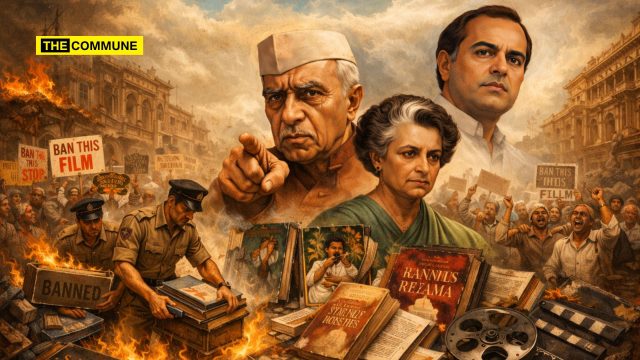
Now there may be inherent problems with the film that could have caused its delay, it is not very clear at the moment. But has the Congress party forgotten the number of films and books banned by the Congress under Jawaharlal Nehru and Indira Gandhi?
He may have forgotten, in this article, we will take a look at the full list.
List of Films & Books Banned By Jawaharlal Nehru
- Nine hours to Rama by Stanley Wolpert (1962)
- Chandra Mohini by Ansar Nasiri
- Rama Retold by Aubrey Menen
- The Heart of India by Alexander Campbell
- The Lotus and The Robot by Arthur Koestler
- Captive Kashmir by Aziz Baig (1958)
- Ayesha by Kurt Frischler (1963)
- Unarmed Victory by Bertrand Russell (1962)
- Marca-e-Somnath by Ghulam Siddhanvi
- The Dark Urge by Robert W Taylor (1955)
- Selling the book Lady Chatterley’s Lover by D.H. Lawrence (1960)
- What Has Religion Done for Mankind (1954)
- Tony Hagen’s book Nepal (full title: Nepal: The Kingdom in the Himalayas) (1963)
- Nathuram Godse’s courtroom testimony, often referred to as “Godse’s Testimony”, was prohibited from public distribution and publication immediately after his trial in 1948–1949. The government ordered police to seize reporters’ notes and banned state-level printing, with the restriction lifted around 20–30 years later via court rulings.
- Katherine Mayo’s 1936 book “The Face of India”
- Nehru: A Political Biography by Michael Edwards (1975) Nationwide ban because the government considered grievous factual errors in this book
- V.S. Naipaul’s An Area of Darkness (1964)
Books/Magazines Banned By Indira Gandhi
- India Independent by Charles Bettelheim (1976)
- Michael Edwardes’s book “Nehru: A Political Biography” (1971) was formally banned by the Government of India during the Congress rule in the Emergency era.
- M.O. Mathai’s Reminiscences of the Nehru Age, published in 1978, was banned by the Indian government shortly after release due to its controversial content on Jawaharlal Nehru’s personal life and political era.
- Thuglak, the magazine, edited by Cho Ramaswamy, halted publication for the first two weeks after the Emergency declaration. It resumed with a black front cover and faced pre-censorship on all content.
Films Banned By Nehru, Indira
This was how the censor board functioned under Jawaharlal Nehru.
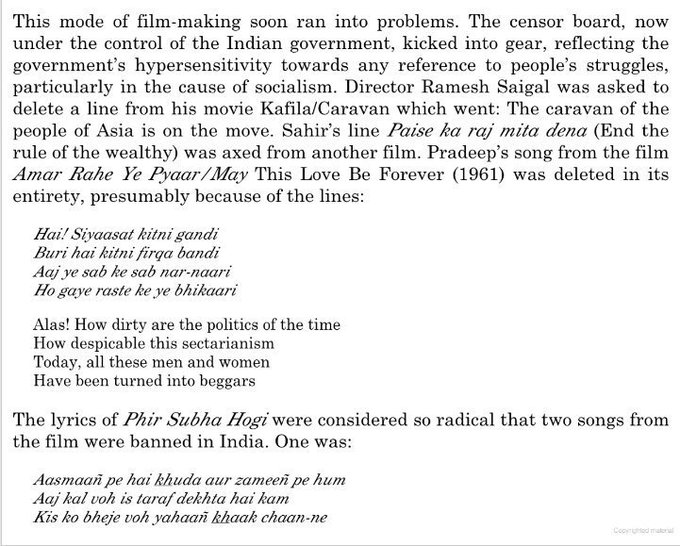
- Mrinal Sen’s film Neel Akasher Neechey was banned in 1959, and the ban lasted for roughly two to three months
- Nine Hours to Rama by Mark Robson adapted from Stanley Wolpert’s novel (1963)
- Balraj Sahni’s play Jadoo ki Kursi was banned in India during Jawaharlal Nehru’s era.
- Aandhi was released in February 1975 and was banned a few months later during the Emergency, in July 1975.
- Kissa Kursi Ka was effectively banned in 1975 during the Emergency, before it could be released, and all its prints were destroyed; a new version came out only in 1978.
- Protima Dasgupta’s 1948 Bengali film Jharna was banned by Bombay Presidency Chief Minister Morarji Desai.
- During the Emergency (1975–77) under Indira Gandhi’s Congress government, Kishore Kumar’s songs were banned from All India Radio and Doordarshan after he refused to perform for a government propaganda programme.
Other Congress-era Bans
- Javier Moro’s The Red Sari was not formally banned but effectively blocked in India for years through legal threats from Congress lawyers; only released here in 2015.
- The play “Christhuvinte Aaram Thirumurivu / Kristuvinte Aram Thirumurivu” (The Sixth Sacred Wound of Christ) by playwright P.M. Antony was officially banned by the Kerala state government in 1986, which at that time was headed by Congress CM K. Karunakaran.
- Rajiv Gandhi ordered a ban on the import of The Satanic Verses, making India one of the first countries to take that step.
- The True Furqan, written under pseudonyms Al Saffee and Al Mahdee (published 1999–2005), was banned nationwide in India in 2005.
- Ram Swarup’s Understanding Islam Through Hadis, first published in the US in 1982 and reprinted in India by Sita Ram Goel in 1983, was officially banned due to its critical analysis of Sahih Muslim Hadiths.
- A 1988 film which was an adaptation of Nikos Kazantzakis’s 1955 book The Last Temptation of Christ by Martin Scorsese was banned in India following protests from Christian groups, with Prime Minister Rajiv Gandhi assuring it would not be screened.
- The Da Vinci Code (2006), directed by Ron Howard and based on Dan Brown’s novel, was banned in several Indian states due to protests from Christian and Muslim groups over its portrayal of Jesus.
- Salman Rushdie’s The Moor’s Last Sigh, published in 1995, encountered an unofficial nationwide ban on imports due to objections over a character named Jawaharlal, a pet dog owned by a figure resembling Bal Thackeray of Shiv Sena, seen as defamatory. The government halted shipments after about 4,000 copies entered, citing potential communal discord.
Subscribe to our channels on Telegram, WhatsApp, and Instagram and get the best stories of the day delivered to you personally.