


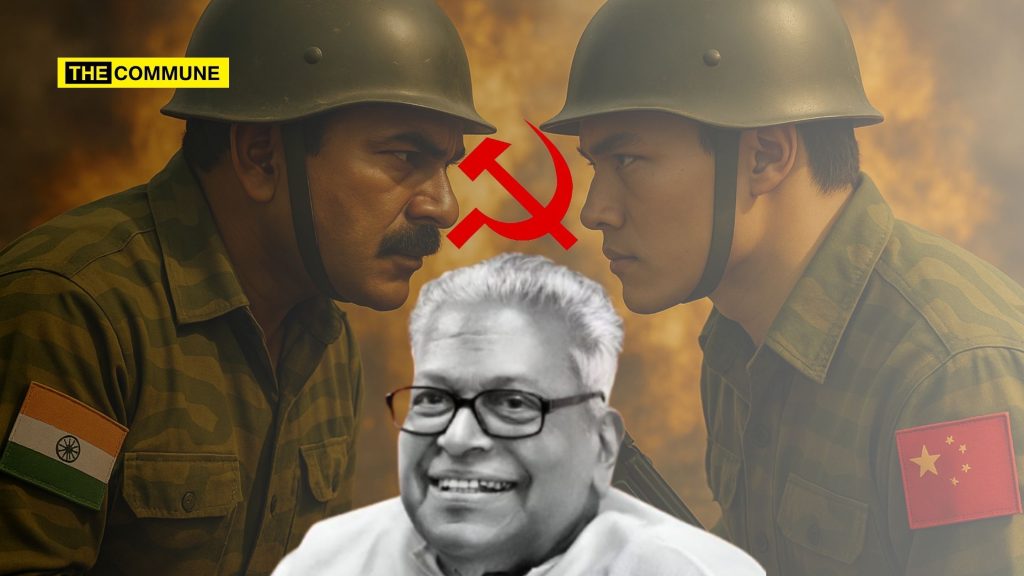
The Communist Party is facing intense criticism and accusations of hypocrisy after offering condolences and a symbolic red salute to the late Comrade V.S. Achuthanandan, the iconic Communist leader and former Chief Minister of Kerala, who passed away on 21 July 2025 at the age of 101.
Achuthanandan was a founding figure of the Communist Party of India (Marxist) and the last surviving member among the 32 leaders who famously broke away from the CPI during the historic 1964 national council meeting. The split occurred because the CPI leadership supported China during the 1962 Indo-China war, an alignment that deeply divided the party.
At the time, many CPI leaders went so far as to oppose organizing blood donation camps for Indian soldiers. In stark contrast, Achuthanandan stood against this pro-China stance not once, but twice. His defiance came at a personal cost he was physically assaulted, demoted, and eventually removed from the party’s Central Committee.
Yet, now, the same CPI that once sidelined him for his patriotism has taken to social media to declare, “CPI mourns the loss of Comrade VS Achuthanandan,” sparking widespread backlash for what critics see as a shameless and revisionist gesture.
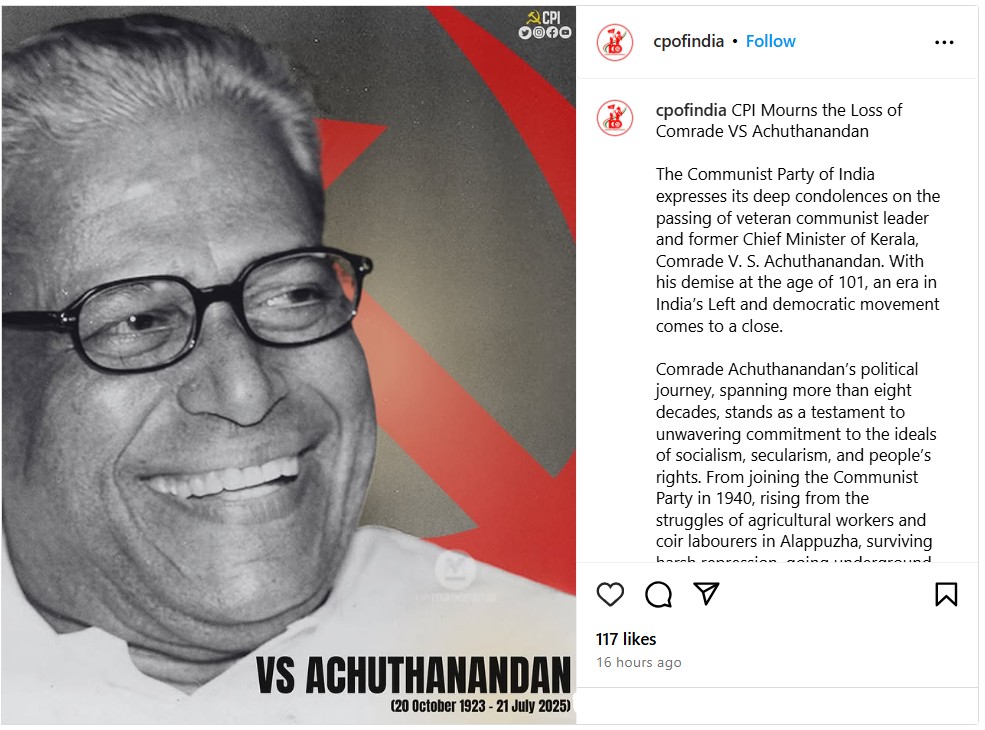

Red Salute to Comrade V. S. Achuthanandan!
Veteran communist leader and Former Kerala Chief Minister V. S. Achuthanandan passed away at the age of 101 on July 21. His life of struggle and unwavering dedication to the cause of the people will forever be an inspiration. pic.twitter.com/lfEDkh1PTC
— CPI (M) (@cpimspeak) July 21, 2025
Who Was V.S. Achuthanandan?
V.S. Achuthanandan began his political journey as a trade union activist, deeply involved in workers’ and land rights movements. He played a prominent role in the historic Punnapra-Vayalar uprising and went on to become one of the most beloved and influential leaders of the Communist Party of India (Marxist) in Kerala, maintaining strong grassroots support throughout his political career. He also served as the Chief Minister of Kerala and was widely regarded as the face of the CPM in the state for decades.
A Nationalist Voice Within the Communist Ranks And the Price He Paid
During the 1962 Sino-Indian war, while the Communist Party of India (CPI) leaned heavily in favor of China, V.S. Achuthanandan stood out by taking a position that, though patriotic by today’s standards, was considered “anti-party” at the time. His support for Indian soldiers during a time of national crisis led to severe internal repercussions within the party.
At just 39 years of age and already a Central Committee member, Achuthanandan was imprisoned in Thiruvananthapuram Central Jail along with other CPI leaders, many of whom had been arrested by the Indian government due to the party’s open support for China during the war. While behind bars, he proposed a small but meaningful gesture, that jailed party members donate blood for Indian soldiers and contribute their saved rations toward the national defense fund. This suggestion was made during a routine party meeting inside the jail.
However, the proposal met immediate resistance. O.J. Joseph, the jail committee convener who would later serve in the Rajya Sabha, firmly rejected the idea. Determined to push the initiative forward, Achuthanandan raised the matter again in the next meeting. A heated debate ensued, eventually escalating into a scuffle between two factions those supporting Achuthanandan and those aligned with Joseph.
The incident didn’t stay confined within prison walls. K. Anirudhan, a fellow inmate who would later become a Member of Parliament, informed the jail warden, and news of the altercation soon reached the press. Senior Communist leaders, including Jyoti Basu, were alerted. E.M.S. Namboodiripad, one of the top figures in the party, directed K.P.R. Gopalan to investigate. As tensions rose, Achuthanandan eventually withdrew the proposal.
Yet, the controversy didn’t end there. After his release in 1965, a party worker filed a formal complaint against him for “anti-party activities.” An internal inquiry committee found him guilty, accusing him of acting contrary to the party’s ideological line. By December of that year, the Kerala state committee ratified the decision to demote him from the central leadership to a branch-level position. He was transferred to the Alappuzha district secretariat, where he spent a year in relative political isolation.
Commenting on the disciplinary action, senior Kerala CPM leader M.M. Lawrance said, “Achuthanandan acted on his own without party approval. By supporting the government, which, at the time, was cracking down on the Communist movement, he violated party discipline.”
In hindsight, Achuthanandan’s stance was one of principled nationalism. But within the rigid ideological framework of the CPI during the Cold War, his patriotic impulse came at a steep personal and political cost.
Despite this, he was elected to the Kerala Legislative Assembly multiple times – in 1967, 1970, 1991, 2001, 2006, 2011, and 2016 and served as the Leader of the Opposition thrice. Achuthanandan was also Chief Minister from 2006 to 2011. He remained a Politburo member from 1985 until his removal in 2009, when internal party disputes came to a head. Even in 2015, on the Alappuzha conference, the party passed a resolution branding him a “comrade with an anti-party mindset.”
Subscribe to our Telegram, WhatsApp, and Instagram channels and get the best stories of the day delivered to you personally.