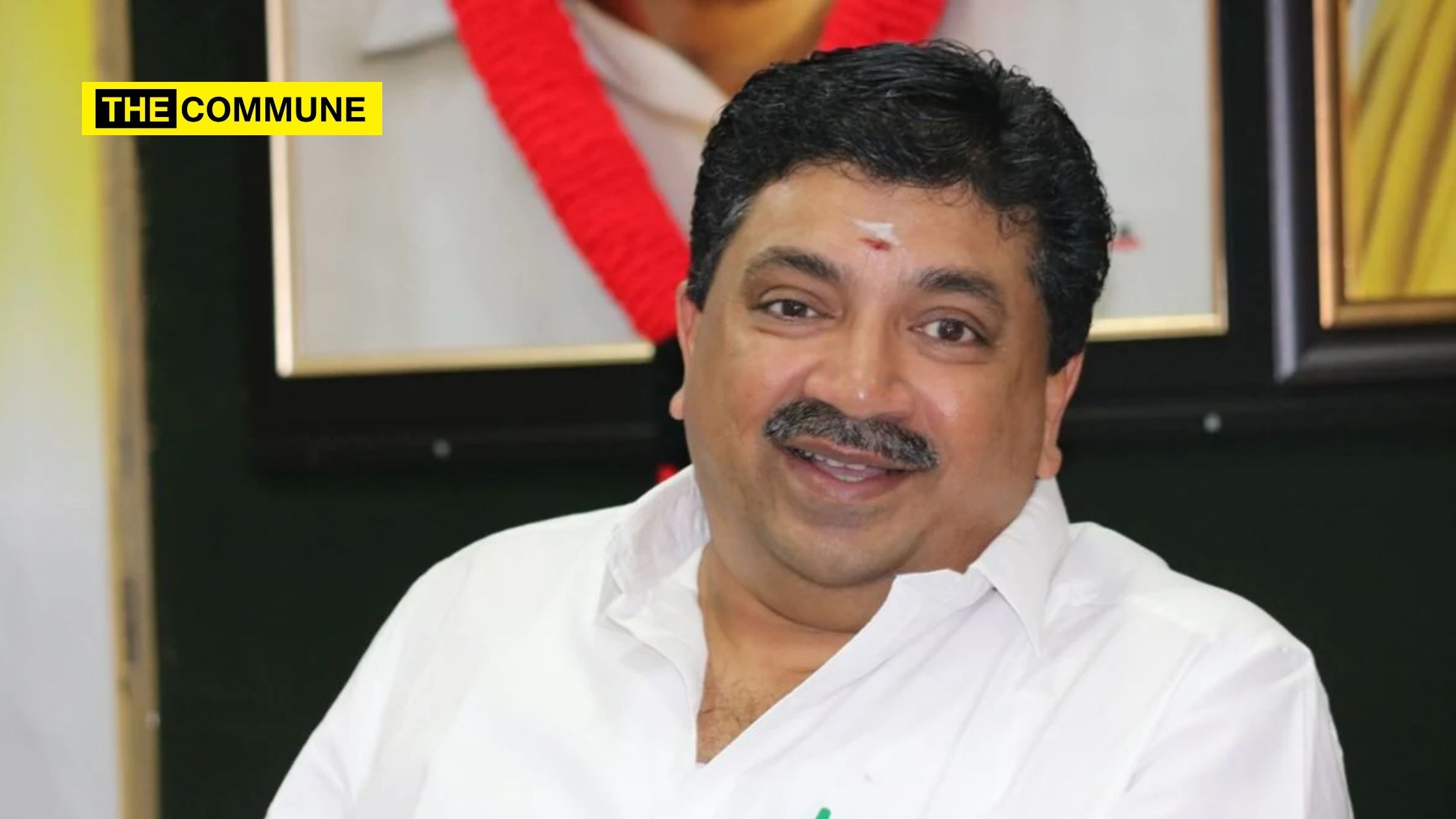
A political and media confrontation has unfolded in Madurai Central constituency after a journalist Vinodh Arulappan publicly criticised DMK candidate Palanivel Thiagarajan’s governance record, triggering a sharp rebuttal from the minister and a wider debate on accountability.
Vinodh Arulappan, who stated that he had spent four days on the ground in the constituency, wrote on X that he was reflecting the voices of residents and not endorsing any candidate. He asserted that voter judgment would ultimately depend on satisfaction with PTR’s performance. He further alleged that instead of addressing public concerns, PTR had chosen to target and discredit journalists reporting unfavourable ground sentiment, calling such behaviour an attempt to intimidate the press.
Arulappan shared a video of PTR and said, “Dear PTR, As a journalist, I have been on the ground for four days in Madurai Central constituency and I am reflecting on what the people of your constituency are saying. I am not here to endorse any candidate contesting in Madurai Central. If people are satisfied with your work, they will vote for you; if not, they will choose someone else. It is as simple as that. I have no agenda, nor any association or business alignment with the so-called individuals you referred to & I have never even met them. You are, in fact, one of the politicians I have interviewed the most since your entry into Tamil Nadu politics. If I am not mistaken, I was the first journalist to record a visual interview when you decided to contest from Madurai Central in 2016. I have written a lot about you in the past, acknowledging your work, not based on your claims, but on the voices of the people. Now that those voices are not in your favour, your response is to target and attempt to discredit journalists like me. The way you are speaking now is not just irresponsible, it is a direct attempt to intimidate and silence journalists who refuse to fall in line with your narrative. This crosses a clear line and cannot be ignored. As for my next pursuit, yes, it will remain journalism till my very last day. Instead of making baseless attacks, you would do better to focus on your campaign and address the concerns of your own constituency. I will continue to reflect the people’s voice and question the establishment & those in power, without fear or favour, as I always have.”
Dear PTR,
As a journalist, I have been on the ground for four days in Madurai Central constituency and I am reflecting on what the people of your constituency are saying. I am not here to endorse any candidate contesting in Madurai Central. If people are satisfied with your… pic.twitter.com/6McsaGkXNm
— Vinodh Arulappan (@VinodhArulappan) April 11, 2026
PTR then followed the attack with an eight-point lecture heavy on constitutional theory, light on accountability, that a PhD from MIT Sloan, a Lehmann Brothers alumnus, a fourth-generation political dynast, and a man who served as Tamil Nadu’s Finance Minister probably did not need to deliver to a working journalist. He wrote, “Stop playing the victim card. A few questions: 1) Is maintaining roads the responsibility of the State Government or the Local Body (Madurai Corporation)? I’ll make it easy for you, it is the Local Body (Madurai Corporation). 2) When Federalism is a core principle of our party, how can be be two-faced, like many of you “freelance journalists”. Just as we condemn the Union interfering in our State Govt, State MLA’s & Ministers should NOT interfere in the Local Bosy, unless in exceptional situations. So why am I asked to take responsibility for the performance, or lack thereof, of the Madurai Corporation? 3) Leaving that aside, is P. T. Rajan road – whose condition you bemoan – even in my Constituency? I’ll make it easy for you – it is not. So why do you use it’s condition to condemn my capabilites or performance? 4) So….you condemn my performance as an MLA or Minister, based on a road not in my Constituency, and whose maintenance is related to the Madurai Corporation, not my role at all. 5) Were you, and are you still not, following the template of wild accusations of the unwitting Candidate in my Constituency, who has no idea of the Constitutional separation of roles and responsibilities? (Those seeing this post, please check this person’s timeline). 6) Do you know that steps I took as FM (6th State Finance Commission related, among others) have helped Madurai Corporation (indeed all local bodies) double Annual Revenues? Does that it make it more likely that they can improve infrastructure like roads, or not? Of course the answer is yes. Why did you not give me any credit for it? 7) Would it not be an abuse of power to direct the Madurai Corporation to prioritize a road named after my grandfather? 8) Are you in regular contact with the infamous press broker Parthiban Kumar, who is engaged in the aforementioned candidate’s media management campaign? Anyway, it is not worth having any further conversation with you…let’s go our separate ways…”
Stop playing the victim card. A few questions:
1) Is maintaining roads the responsibility of the State Government or the Local Body (Madurai Corporation)? I’ll make it easy for you, it is the Local Body (Madurai Corporation).
2) When Federalism is a core principle of our party,… https://t.co/3FYJXj9lP2
— Dr P Thiaga Rajan (PTR) (@ptrmadurai) April 12, 2026
The lecture, however, inadvertently revealed something more interesting than PTR intended.
PTR’s response reduced the concerns of Madurai’s citizens into a jurisdictional flowchart. Roads? That’s the Corporation. The Corporation? That’s the Local Body. The Local Body? Not my department. It is a response that would make a bureaucrat proud and a voter furious.
Ward Councillors bear primary responsibility for garbage collection, street cleaning, and local roads.
The Mayor holds city-wide sanitation and waste system oversight.
The Commissioner (an IAS officer appointed under State government controls) handles execution, staff, and contracts
MLAs carry responsibility for funding, escalation, and policy push.
Ministers and Departments control budget allocation and oversight of local bodies.
PTR’s position as a minister explicitly grants him “control over local bodies.” He is not a bystander to Madurai Corporation’s failures. He is, constitutionally and administratively, part of the oversight chain. The federalism argument he deploys against journalists is the same one he conveniently discards when claiming credit for the 6th State Finance Commission’s role in doubling Corporation revenues.
To keep a city good, the responsibility doesn’t stop with citizen or sanitazion workers. A person who know how the hierarchy works in India just pass the dysfunctional urban sanitation to local body when there is much to do by everyone!!
Any election this will impact. https://t.co/HGdlQjnTFx pic.twitter.com/gunf0vTDyI
— Arul Murugan (@arulmuru182002) April 12, 2026
PTR’s federalism argument rests on the 74th Constitutional Amendment (1992), which assigned 18 civic functions to Urban Local Bodies under Article 243W and the 12th Schedule. He is textually correct. But Tamil Nadu’s ground reality exposes the argument as selective. The same amendment’s Article 243X grants municipalities taxation powers; Article 243Y mandates State Finance Commissions to ensure fiscal devolution. Tamil Nadu constitutes its SFCs and then implements their recommendations partially, leaving corporations executing state decisions with state money, their grants predominantly tied to salaries and power bills rather than infrastructure priorities. That is not devolution. That is supervised administration with a constitutional letterhead.
Article 243X grants municipalities taxation powers. Article 243Y mandates State Finance Commissions to ensure fiscal devolution.#TamilNadu constitutes its SFCs. What it does not do is implement their recommendations fully. Grants remain predominantly tied to salaries and power…
— Shankar Prakash A (@shankarprakasha) April 12, 2026
Water supply and sewerage which are core civic functions remain with TWAD, a state parastatal, not the Corporation. The Municipal Commissioner answers to the state, not the Mayor. Urban planning sits outside ULB control entirely. PTR’s own state government holds the money, the commissioner, and the parastatals. Then it points at the Mayor when cities rot.
In perhaps the most unintentionally revealing moment of his response, PTR asked whether it would be an “abuse of power” to direct the Corporation to prioritise P.T. Rajan Road – the road named after his grandfather. The question answered itself. A road bearing a family name in a constituency a family has represented across generations, in a city the family calls home, remains in a state of disrepair and the MLA’s response is to cite conflict-of-interest as the reason he cannot intervene. The dynasty is invoked for prestige; accountability for the dynasty’s own street is outsourced to the Corporation.
In Jaihindpuram, Madurai, a 2.93 km stretch remained an unpaved mud road for nearly three years disrupting shopkeepers, pedestrians, schoolchildren, and daily commuters. The Corporation’s explanation: underground pipe-laying by TWAD, a state parastatal outside local body control.
Bad roads aren’t just an inconvenience—they’re a public health crisis.
🚨 In #Madurai, the 2.93 km stretch between #Jainhindpuram and #Keerathurai (which I have observed) has remained a mud road for ≈3 years, according to a resident who has lived in this locality for 2… pic.twitter.com/5ttNyyco4n
— Shankar Prakash A (@shankarprakasha) February 15, 2025
On 31 May 2025, CM Stalin conducted a roadshow through Madurai ahead of the DMK General Council meeting. The roadshow passed through Jaihindpuram. The road that had resisted repair for three years was laid overnight. The excuse that had served three years did not survive one political itinerary. This is not local body failure. It is the state’s infrastructure fragmentation made visible — and then made invisible, on demand.
Now only it makes sense the road has been laid in this stretch as the @CMOTamilnadu is visiting #Jaihindpuram, #Madurai today!
Would be nice if infrastructure improvements happened based on public need rather than political visits. The people here have been dealing with bad… https://t.co/GysjsQAl99
— Shankar Prakash A (@shankarprakasha) May 31, 2025
The corporation may cite underground pipe-laying as the reason the road remained unpaved for three years. That pipe-laying is TWAD’s work, a state parastatal.
The local body did not control the timeline. The state did.
Then the CM visited. The road was laid overnight, TWAD’s… pic.twitter.com/Gemv3f0vTx
— Shankar Prakash A (@shankarprakasha) April 12, 2026
PTR asked why he received no credit for steps taken as Finance Minister that helped Madurai Corporation double its annual revenues. It is a fair question, but it cuts both ways. If he claims credit for revenue doubling, he must also answer why a Corporation flush with doubled revenues still cannot maintain basic roads and sanitation in the city his family has politically represented for generations.
A man who studied public finance at MIT Sloan, who managed risk at Lehmann Brothers before its spectacular collapse, and who presented multiple state budgets to the Tamil Nadu Assembly knows precisely how institutional responsibility is structured. He does not need a civics lesson. He needs to stop pretending that he does not already know the answer to every question he is posing.
There is one final contradiction PTR’s lecture cannot survive. His own Ward 56 constituency report lists 14 road and road repair works funded through his MLA Constituency Development Scheme. His Madurai Central report further lists BT Roads laid under MLACDS funds from 2016 to 2025.
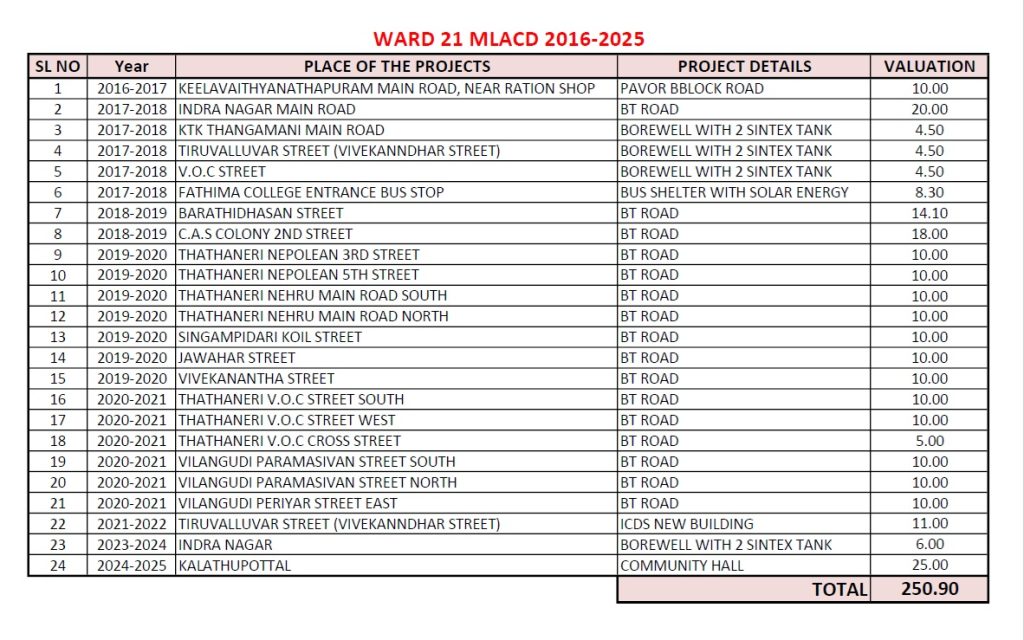
Roads are a 12th Schedule function – local body territory by his own argument. Yet he spent his legislator’s fund on them and listed them as achievements. The constitutional separation he invokes to avoid blame was never observed when building a record. Why does an MLA fund roads at all? Because Tamil Nadu’s ULBs are starved of untied funds – a structural condition the state government, which PTR served as Finance Minister, created and perpetuated. The MLACDS fills the gap the state engineered. The MLA takes the credit. When roads fail, the Corporation takes the blame.
The same system that allows an MLA to claim credit for roads also allows him to deny responsibility for them. That contradiction is not administrative – it is political.
Subscribe to our channels on WhatsApp, Telegram, Instagram and YouTube to get the best stories of the day delivered to you personally.