


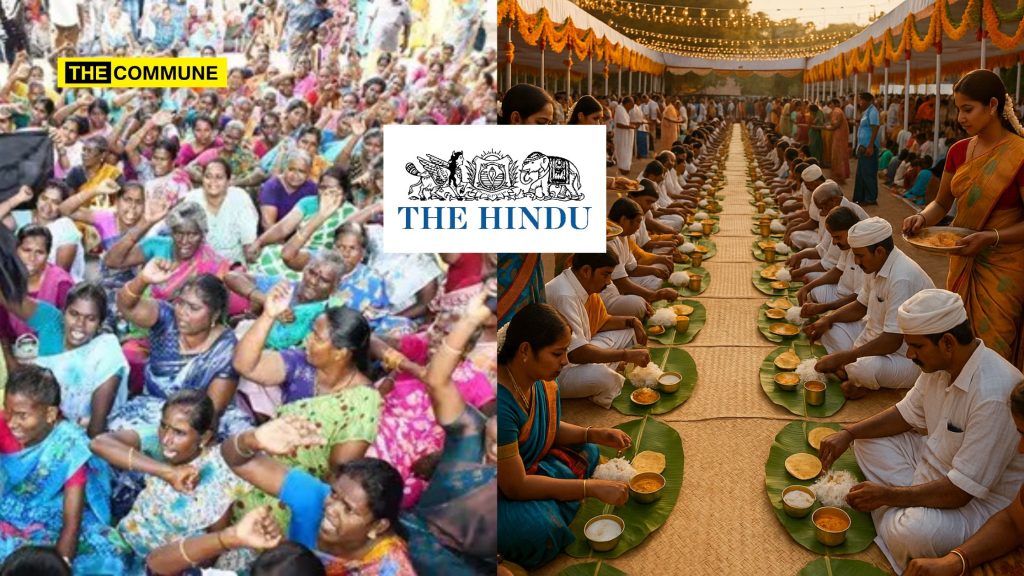
A one-day Annadhanam (community meal) organized by Hindu residents of Panchampatti village in Tamil Nadu’s Dindigul district conducted on government land with the express permission of the Madurai Bench of the Madras High Court sparked large-scale protests from the local Christian majority. Over 500 members of the community blocked roads, raised black flags, and surrounded the Collectorate demanding that the event be cancelled.
Yet, The Hindu, in a striking example of editorial euphemism, described the entire episode as “womenfolk belonging to a Christian community assembled expressing their disappointment over the permission granted to serve annadhanam.”
Majority Christian families in a Tamil Nadu village create chaos over a High Court order simply allowing Hindus to hold a one-day Bhandara on govt land.
How does @the_Hindu report it?
“Christian community expressed their disappointment…” pic.twitter.com/dyTD2qOgNA
— Swati Goel Sharma (@swati_gs) November 5, 2025
The High Court had earlier made it clear that the ground in question was gramamatham land, a public space under state ownership, and could not be monopolized by any single community. Justice G.R. Swaminathan, who delivered the judgment, reminded officials that freedom of religion under Article 25 is a fundamental right and that maintaining law and order is the state’s duty, not an excuse to restrict religious activity.
Despite this categorical ruling, Christian groups in the village, numbering over 2,500 families compared to about 100 Hindu households, reacted by staging a mass protest. Women and church members marched to the Dindigul Collectorate, attempted to surrender their ID cards, and demanded that the ground be officially renamed as a “Pascha Ground,” asserting that it had been used for Easter gatherings for over a century.
Officials confirmed that the protesters blocked roads and refused to disperse until District Collector S. Saravanan and SP A. Pradeep intervened. More than 100 police personnel were deployed, and cases were filed against several demonstrators who had gathered at the Annadhanam site the previous night.
The High Court had specifically ruled that “a public ground should be available for the use of all communities or none”, rejecting the claim that one faith could claim exclusive rights over public land. The judge even acknowledged the Christian community’s long tradition of Easter use but said that apart from that specific period, others too must be allowed access.
While the Annadhanam concluded peacefully under police protection, the way The Hindu framed the incident, reducing a 500-person road blockade and a coordinated identity-card protest to “disappointment”, raised questions once again about the journalistic integrity of the publication.
Critics argue that The Hindu’s report diluted both the scale of the agitation and the principle at stake: that the High Court’s order was about equal access to public land and religious fairness, not sectarian privilege. What was essentially a defiance of a court ruling was presented instead as a “community expressing its feelings.”
Had 500 people from the Hindu community blocked roads in defiance of a High Court order, the incident would be condemned and calls for “tolerance” and what not would have come up, add to this, debates on prime time in news channels while being described as a major law and order crisis and not a softened “expressing disappointment.”
Subscribe to our channels on WhatsApp, Telegram, Instagram and YouTube to get the best stories of the day delivered to you personally.