


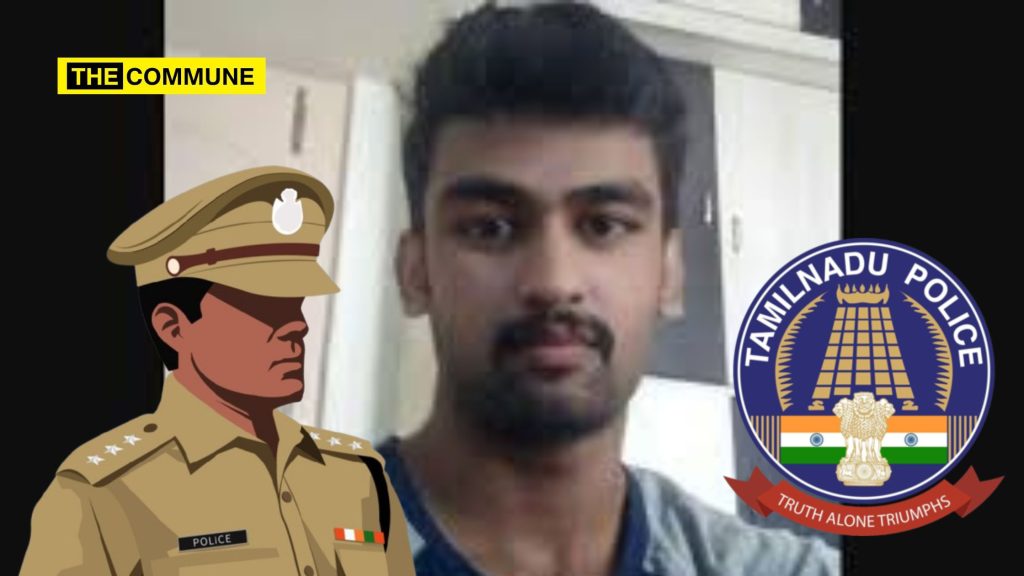
In a verdict that delivers a staggering blow to the pursuit of justice, the Supreme Court on Wednesday acquitted S. Dashwanth in the 2017 rape and murder of a seven-year-old girl, unleashing a torrent of anguish and raising terrifying questions about the competence of the Tamil Nadu police.
While the legal outcome is an acquittal, the story told by the apex court is not one of Dashwanth’s innocence, but of a catastrophic systemic failure so profound that it rendered a conviction legally impossible. The court did not find a saint; it found a case so badly botched by the Dravidian Model police that a man once sentenced to death for a heinous crime had to be set free.
“We are of the view that the prosecution has miserably failed to prove the vital circumstances, that is, last seen together, suspicious […] of the appellant captured in the video footage of the CCTV camera, the confessional disclosure statement, the FSL report […] which constituted the entire edifice of the prosecution case on which the conviction of the appellant was based. The impugned judgment is set aside. The appeal is allowed. The conviction and sentence awarded to the appellant are hereby set aside. Appellant is acquitted. He shall be released from custody forthwith, if not wanted in any other case”, the Court ordered.
A Heinous Crime, A Hollowed-Out Case
The case stemmed from a parent’s worst nightmare. On 5 February 2017, the seven-year-old daughter of CSD. Babu and Sridevi went missing from their apartment complex. Her charred body was discovered days later. The prosecution alleged that Dashwanth, a neighbour, lured the child, sexually assaulted her, murdered her, and then burned her body to destroy evidence.
However, the Supreme Court systematically dismantled the state’s case, not by vindicating Dashwanth, but by exposing how the police and prosecution violated the law to secure a conviction, ultimately ensuring its collapse.
“Grave Doubt” and “Planting” of Evidence
The judgment paints a picture of an investigation riddled with concoction and coercion:
A “Concocted” Last-Seen Story: The court found the sole “last seen” witness, Murugan, wholly unreliable. His claim of seeing Dashwanth with the child was disclosed only after a two-month delay, even though he was part of the initial search party. The court concluded this was a later fabrication to “lend credence to the otherwise weak case.”
A “Fictional” Confession: In a damning finding, the court revealed that a Village Administrative Officer was informed by police before Dashwanth’s official arrest that he would confess to the rape and murder. This, the court held, proved the confession was a pre-written script, extracted under coercion during illegal detention. The subsequent “recoveries” of the victim’s ornaments were labeled “planted” to fit this script.
Forensic Evidence with a “Broken Chain”: The DNA evidence, a potential cornerstone of the case, was rendered “redundant”. The prosecution failed to maintain a proper chain of custody for samples, with an unexplained four-month delay in collecting Dashwanth’s blood. The court noted a “strong possibility” this delay “may have been utilized to manipulate the samples,” making the forensic reports unreliable.
A “Sham” Trial That Sealed the Failure
Beyond the investigation, the Supreme Court highlighted a “total failure of justice” in the trial process, violating Dashwanth’s fundamental right to a fair trial under Article 21 of the Constitution.
Charges were framed against Dashwanth on 24 October 2017, without a defence lawyer being present or appointed for him. The mandatory copies of prosecution documents were not provided to him until 13 December 2017. A legal aid lawyer was appointed on December 13, and the trial commenced just four days later, with 30 witnesses examined and the case concluded in a mere month and a half. The court held that the lawyer had “no reasonable and effective opportunity to prepare.”
The trial court delivered its conviction and death sentence on the very same day, without calling for any reports on mitigating circumstances or a psychological evaluation, reducing the sentencing exercise to a “mere formality.”
The court stated that for a trial to be fair, “an effective opportunity to defend must be provided.” This was denied, making the entire process a “mere formality.”
A Chilling Precedent and a Family’s Agony
This acquittal follows another for Dashwanth, in the murder of his own mother, Sarala in December 2017, for which he had been acquitted earlier this year. Sources indicated the state did not appeal that acquittal as the evidence had “no merit,” further questioning the police’s investigative rigor in cases involving the same individual.
The Supreme Court was forced to make a painful but legally necessary decision. As the bench observed, “The legal framework does not permit the Courts to punish an accused person based merely on moral convictions or conjectures.”
The outcome is a travesty. A little girl was brutally raped and murdered. Yet, due to the very authorities tasked with delivering justice, no one will be held accountable. The verdict is not an exoneration of Dashwanth, but a devastating indictment of a system that failed at every turn, leaving a family without justice and a society questioning whether anyone is safe when those who enforce the law break it.
(With inputs from The New Indian Express)
Subscribe to our channels on Telegram, WhatsApp, and Instagram and get the best stories of the day delivered to you personally.