


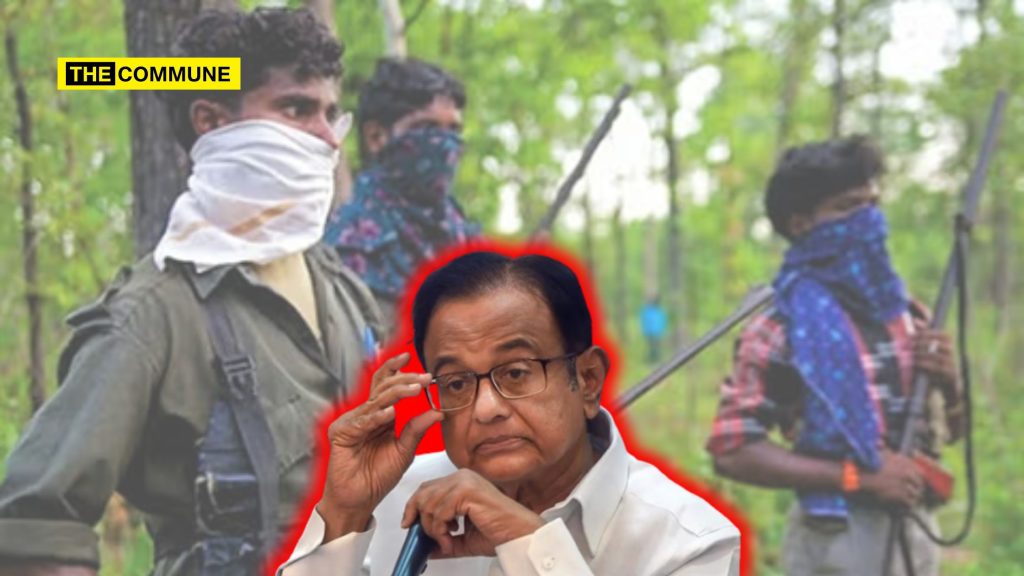
Just a few days ago, the news about the outlawed Communist Party of India (Maoist) declaration of a unilateral, one-month ceasefire expressing readiness for conditional peace talks with the central government broke.
This development invites a stark comparison between the previous UPA government’s approach to left-wing extremism and the current administration’s unwavering stance under Prime Minister Narendra Modi and Home Minister Amit Shah.
The UPA and Chidambaram’s Stance: A Willingness to Talk, Without Surrender
In May 2010, in the immediate aftermath of the brutal Dantewada massacre where 76 CRPF personnel were killed by Maoists, then Union Home Minister P. Chidambaram found himself at the centre of India’s most pressing internal security debate. On one hand, the UPA government had launched Operation Green Hunt to confront the armed insurgents; on the other, Chidambaram was under pressure to open a dialogue with the Naxals.
That month, Chidambaram took his case directly to students at Jawaharlal Nehru University (JNU), traditionally a stronghold of Left politics. The event, organised by the Congress-backed National Students’ Union of India (NSUI), was titled “Naxalism: Threat to Indian Democracy and Internal Security.” Speaking at the packed School of Social Sciences auditorium late in the evening, the Home Minister received a mixed reception of applause and protests.
Addressing the Maoist insurgency, Chidambaram described it as both a serious law-and-order issue and a problem rooted in socio-economic grievances. He assured students that the government was prepared to review mining contracts in tribal areas and that New Delhi was not blind to the economic causes feeding the rebellion.
But his most striking line came when he made clear that the government’s invitation for talks did not require Maoists to first surrender their weapons.
“It is a serious law and order issue. There are socio-economic causes that we will address, the talks for dialogue. The government is willing to relook at the mining contracts. I was the first minister in this government who said we are ready for talks, we are not asking you to lay down arms because we know you won’t do that, because you believe in armed liberation struggle, you will not lay down arms,” Chidambaram told the students.
What was UPA?
Chidambaram in May 2010, after Naxals massacred 76 CRPF men
He is at JNU
He is explaining he only wants Naxals to talk
He is NOT calling them to lay down weapons, because they believe in armed liberation
Today Naxals begging for mercy…sab hawa nikal gayi pic.twitter.com/LkdCWn08K9
— Abhishek (@AbhishBanerj) September 19, 2025
It was an unusual admission: the Home Minister of India acknowledging that Maoists would never give up their arms yet still offering to negotiate. The statement underlined the UPA’s two-track policy of both military operations and conditional dialogue.
More than a decade later, with Maoist influence has significantly eroded in India and leaders seeking to negotiate from a position of weakness, Chidambaram’s 2010 outreach reads as a moment when the State tried to engage the insurgency at its peak.
(With inputs from NDTV)
Subscribe to our channels on Telegram, WhatsApp, and Instagram and get the best stories of the day delivered to you personally.