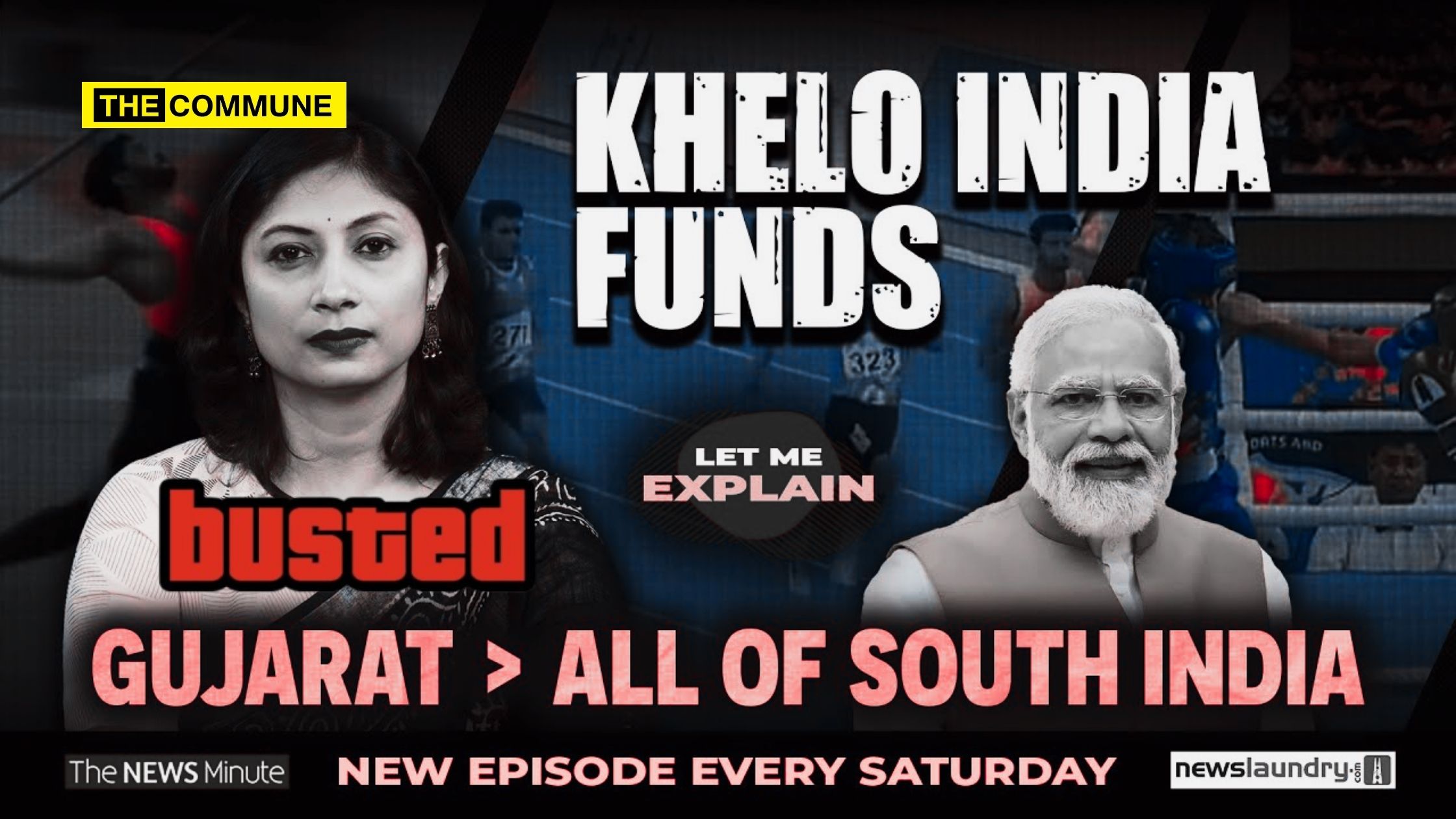
In a recent video published by The News Minute (TNM) under the Let Me Explain series, their journalist Pooja Prasanna alleged a pattern of political favouritism in the Union government’s flagship sports development initiative — Khelo India. They claimed that BJP-ruled states such as Gujarat and Uttar Pradesh received disproportionately high funding, while opposition-ruled states like Tamil Nadu and Kerala were allegedly sidelined.
However, a deeper examination of official documents, sports ministry records, and performance data tells a more nuanced story. This report dissects the flaws in TNM’s assertions and reveals how selective data presentation distorts public perception.
Claim 1: BJP-ruled states are favoured in Khelo India allocations.
The News Minute’s video asserted that BJP-ruled states like Gujarat (₹606 crore) and Uttar Pradesh (₹500 crore) received disproportionate Khelo India funds while opposition states were sidelined. While they have mentioned the BJP-ruled states in the video, somehow the narrative is set such that it makes the viewer think the Central government is giving step-motherly treatment to other states.
The video mentions that despite being home to Olympian Rudrankksh Patil who the gold medal in the men’s 10m air rifle shooting event at the ISSF World Cup 2025 Buenos Aires in April 2025, it was allocated only ₹87.43 crore, ranking just above non-BJP Punjab (₹78.02 crore).
The video fails to mention that funds for Gujarat were primarily for building mega-projects like Ahmedabad’s Sports Enclave.
While they did mention the Khel Sahayak issue, why did TNM not consider it as an issue when the coaches protested delayed salaries and 8-month contracts (vs. 11-month promises). Is this favouritism as per TNM’s standards?
Claim 2: Tamil Nadu and other opposition states are penalized.
TNM suggests that Tamil Nadu receives poor funding despite strong performance
It is very easy to cherry pick such facts to suit one’s narrative. But the truth is that:
- Tamil Nadu has 18 Khelo India Academies, 38 Centres, and 1 State Centre of Excellence.
- Union Ministry clarified in 2024: “There is no pending proposal under consideration from Tamil Nadu for new Khelo India Centres.”
- The state is already a beneficiary of prior rounds and has alternative funding for new projects via non-Khelo India schemes.
Existing infrastructure density explains lower recent allocations. As clarified by the Union Ministry, the question of active rejection of new proposals does not stand valid.
Understanding The Allocation Mechanism
Contrary to political interpretations, the Ministry of Youth Affairs and Sports follows a defined methodology. A few months ago, DMK Rajya Sabha MP P. Wilson raised ‘concerns’ over the disparity in fund allocation and sports infrastructure development under the Khelo India scheme in Tamil Nadu. In response, the Union Ministry of Youth Affairs and Sports clarified that funds under the Khelo India programme are allocated scheme-wise, not state-wise, and emphasized that the submission and evaluation of proposals is an ongoing process.
In response to my Parliamentary question on the development of sports infrastructure under the Khelo India Scheme, regarding:-
(a) whether States like Uttar Pradesh and Gujarat have been allocated more than ₹400 crores for the development of sports infrastructure under Khelo… pic.twitter.com/54YbSkf4E6— P. Wilson (@PWilsonDMK) March 18, 2025
This was evidenced by:
- Andhra Pradesh: ₹237 crore worth of proposals rejected from 2021–2023.
- Haryana, a BJP-governed sporting powerhouse, received just ₹66 crore due to low proposal volume.
What TNM Didn’t Tell You
Performance vs. Allocation: A Non-Linear Correlation
TNM implies poor-performing states received more funding. But medal tallies don’t tell the whole story.
- Tamil Nadu fielded 13 athletes at the 2024 Olympics, all supported under the TOPS (Target Olympic Podium Scheme) – independent of state allocations.
- Bihar, once a low-priority state, surged from 21st to 15th place in Khelo India rankings by investing in niche sports like Rugby 7s – backed by targeted funding.
- Rajasthan, a Congress-ruled state until 2023, received ₹107 crore but bagged fewer medals than Tamil Nadu, which had only ₹29.5 crore allocated.
- Athletes from “low-fund” states like Tamil Nadu (13 Olympians) and Manipur (multiple medalists) consistently access elite programs like TOPS, which provides ₹50,000/month stipends, foreign coaching, and training support regardless of home-state funding.
Funding supports infrastructure and institutional building, not just immediate performance.
Gujarat’s ₹606 crore allocation includes high-cost, event-specific investments:
-
- FIFA U-17 Women’s World Cup venues
- Sardar Patel Stadium revamp under Ahmedabad Sports Enclave
And despite high funding, Gujarat’s khel sahayaks (sports teachers) protested for months over delayed salaries and incomplete contracts, undermining claims of privilege, as mentioned above.
Maharashtra’s Olympic medalist Rudrankksh Patil received no state-specific privilege – a BJP-governed state that didn’t make TNM’s cut.
Also, state projects like Coimbatore hockey stadium or Ramanathapuram synthetic track can utilize state budgets or non-Khelo India central schemes (e.g., Urban Infrastructure Development). It is not necessary that the centre keeps spoonfeeding the states for every single project. Had the DMK government repealed the Kalaignar Magalir Urimai Thogai Thittam, those funds nearly about 1000 crores and upwards could be diverted to better projects that will help the state come up further.
TNM’s narrative cherry-picks optics while ignoring other important information.
Systemic Reforms In Progress
The Sports Ministry has implemented key reforms to address fairness and transparency:
- Mandatory video recordings of selection trials
- Anti-age fraud initiatives
- Integrity Officers posted at national camps
- All fund approvals require technical feasibility reports and are published on Ministry portals
- Uniform scholarships of ₹6.28 lakh/year for 2,781 Khelo India Athletes across all states – irrespective of regional allocation
Additionally, the Draft National Sports Governance Bill promises further structural accountability in national sports administration.
The Takeaway: The Real Picture Is More Complex
The Khelo India initiative is not without flaws, but attributing fund distribution to partisan bias oversimplifies a layered reality:
- States with poor infrastructure receive higher allocations to balance regional inequities
- States with robust existing frameworks, like Tamil Nadu, require fewer new investments
- Proposal quality and event-readiness are the primary drivers – not party alignment
Here are some numbers that TNM must consider:
For the financial year 2025-26, the Ministry of Youth Affairs and Sports was allocated a record ₹3,794 crore by the government. Of this, ₹2,191.01 crore is earmarked for Central Sector Schemes, with the flagship Khelo India Programme receiving a substantial ₹1,000 crore. This marks a 130.9% increase from the ministry’s allocation of ₹1,643 crore in 2014–15, reflecting the government’s growing commitment to nurturing sporting talent and infrastructure across the country.
Launched in 2016–17, the Khelo India – National Programme for Development of Sports was launched in 2016-17 under PM Modi. The programme aims to foster both mass participation and excellence in sports, targeting communities in both rural and urban areas.
Key milestones so far include:
- Approval of 326 new sports infrastructure projects worth ₹3,124.12 crore.
- Establishment of 1,045 Khelo India Centres (KICs) to support grassroots-level training.
- Notification of 34 Khelo India State Centres of Excellence (KISCEs) and accreditation of 306 sports academies.
- Support for 2,845 Khelo India Athletes (KIAs), who receive coaching, equipment, medical support, and a monthly out-of-pocket allowance.
All this was not possible under the previous UPA regime. Maybe TNM would want to do an expose on that era?
Instead of blindly questioning the Modi government just to set a narrative, The News Minute can make use of its journalistic abilities to question the ruling DMK and asking questions that matter – especially when it comes to such issues. Why not use state funds, MP funds, MLA funds to boost sports activities and other infrastructure in Tamil Nadu? Will TNM dare to ask this of its masters?
Subscribe to our channels on Telegram, WhatsApp, and Instagram and get the best stories of the day delivered to you personally.