


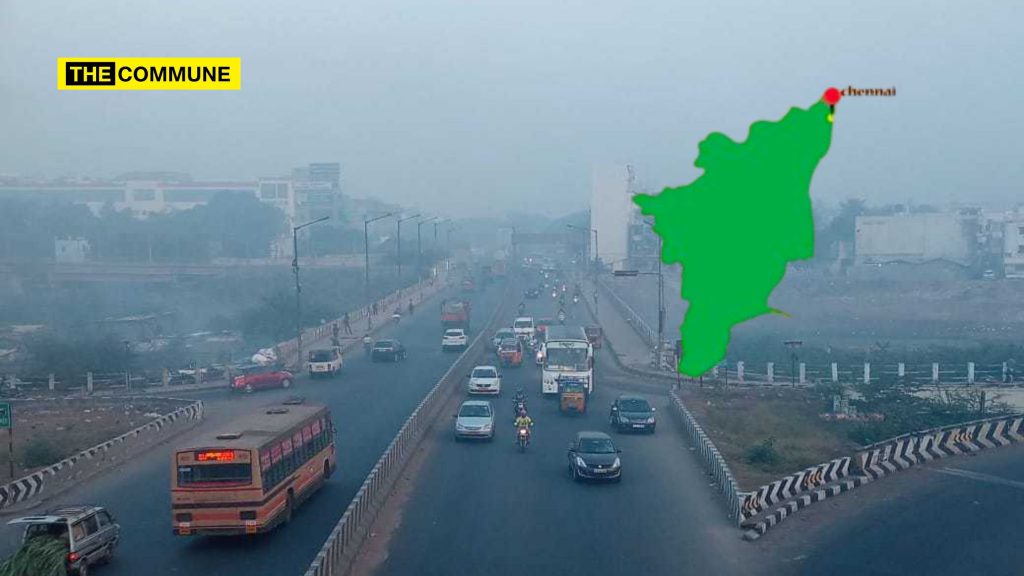
Chennai has been ranked at the bottom among million-plus cities in the Swachh Vayu Survekshan 2025, the annual air quality management ranking released by the Ministry of Environment, Forest and Climate Change (MoEF&CC) on Tuesday.
The city finished 41st out of 41 large cities with a score of 115.3, far behind the top-ranked Indore, which secured a perfect score of 200. Other cities such as Jabalpur, Agra, and Surat also featured in the top three, earning the title of ‘National Clean Air City’.
The survey, part of the National Clean Air Programme (NCAP), assessed 130 cities across categories based on population. Cities were evaluated on parameters such as road dust management, vehicular and industrial emissions control, construction dust, solid waste burning, and public awareness campaigns.
While Chennai performed poorly, Tamil Nadu’s Tiruchy secured the 9th rank in the million-plus category with a score of 186, becoming the only South Indian city in the top 10. Madurai fared little better than Chennai, ranking 40th with a score of 116.1. In the smaller cities category, Thoothukudi was placed 36th out of 40 with 125.6 points.
Officials attributed Chennai’s poor performance to persistent issues such as vehicular emissions, construction and road dust, and weak waste management practices. Despite receiving ₹474.65 crore under NCAP and utilising ₹384.76 crore, including ₹337 crore on solid waste collection, little progress was made in tackling road dust and construction-related pollution.
Environmentalists pointed to rapid urbanisation, high dependence on private vehicles, and limited integration of public transport as key contributors to rising pollution levels. They stressed the need for measures such as expansion of public transport, faster transition to electric vehicles, stricter control of construction dust, and adoption of cleaner industrial fuels.
Government officials claimed that Chennai’s PM10 levels had shown a marginal dip but admitted shortcomings in dust management. They noted that while a few road dust collectors and water sprinklers had been deployed, their coverage was inadequate, and in many areas manual sweeping continued to worsen dust pollution.
(With inputs from The New Indian Express)
Subscribe to our channels on Telegram, WhatsApp, and Instagram and get the best stories of the day delivered to you personally.