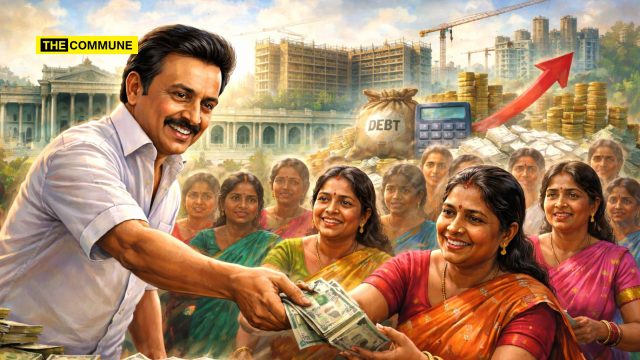
The DMK government’s announcement of cash assistance to women beneficiaries under the Kalaignar Magalir Urimai Thogai scheme has drawn criticism, with concerns being raised over the state’s fiscal position, debt levels, and governance priorities.
The government credited ₹5,000 to around 1.31 crore women, covering entitlements for February, March, and April along with an additional ₹2,000 ‘summer relief’ component. The disbursal, made ahead of elections, appears politically timed to generate voter goodwill.
At the same time, it has been acknowledged that financial assistance reaching economically vulnerable women can provide household relief. However, questions have been raised about the funding model behind the transfer.
Employment Problems Plaguing Tamil Nadu
Tamil Nadu faces a serious manpower gap in core services. In the police, against a requirement of roughly 1.24 lakh personnel, around 13,000 sanctioned posts remain unfilled. Thousands of youth who trained and prepared for police jobs are still waiting, with “no money” (for salary) cited informally as the underlying reason for not filling posts.
In the health department, doctors’ associations have claimed that about 60% of the 18,000 doctor posts in government hospitals are vacant. As a result, many primary health centres across Tamil Nadu function without adequate staff, forcing patients to run to district headquarters hospitals even for basic care.
This pattern is not isolated: across roughly 41 departments, funds are reportedly squeezed, recruitments are delayed or frozen, and the machinery of government is weakened while headline doles expand.
Debt Vs Revenue
Tamil Nadu’s 2025–26 Budget has a total outlay of about ₹4.39 lakh crore. Revenue receipts are projected at roughly ₹3.3 lakh crore, resulting in a substantial fiscal deficit of around ₹1.07 lakh crore that will be financed through borrowings. Against this backdrop of structural deficit, the government has also expanded welfare and pre-election measures — including the ₹5,000 special transfer under the Magalir Urimai scheme, and revisions in government employee pay — adding further pressure on the state’s finances.
This pushes the effective total funding requirement to about ₹1.05 – 1.07 lakh crore beyond normal revenue, leaving the state dependent on a combination of higher taxes, higher tariffs on utilities and fresh borrowing.
For states and countries, keeping the fiscal deficit within about 3% of GSDP is considered broadly healthy and necessary to retain credibility with banks and global lenders. When Stalin assumed office, Tamil Nadu’s deficit ratio was around 3%. Subsequent budgets have pushed this to about 3.5%, and the latest election‑driven commitments can push it further towards higher.
A higher deficit ratio directly affects the state’s ability to borrow on favourable terms and indirectly affects private industry, entrepreneurs and youth seeking loans, because financial institutions closely track a state’s fiscal health before committing funds.
Tamil Nadu’s debt stock when Stalin took over stood at around ₹5 lakh crore. In about four to five years, the government has borrowed an additional (roughly) ₹4.5 lakh crore, taking the total debt close to ₹9.4 lakh crore. With the latest round of borrowing-linked schemes, debt is now heading towards the ₹10 lakh crore mark.
The state is already paying roughly ₹70,000 crore every year as interest alone on outstanding loans. Additional election‑time spending funded through borrowing will push this interest bill up by another estimated ₹10,000 crore annually. This is not an abstract number: loans are taken in the name of the people, and the burden will be repaid through their taxes, tariffs and reduced services.
Debt Vs Spending
This combination of high debt and populist spending directly constrains three critical areas: departmental funding, infrastructure, and industrial development and jobs.
Departmental funding shortfalls are already visible in unfilled police and health posts, undermining law and order and basic public health.
On infrastructure, between several hundreds of villages across Tamil Nadu face water scarcity every year. With adequate capital investment and planning, this water stress could be systematically reduced, but funds are not prioritised for such long-term works.
Urban and semi-urban areas face chronic issues: proper drainage networks are often confined to central parts of Chennai; second‑tier cities lag even further behind; and road infrastructure has seen little meaningful expansion in the last four years.
In industrial policy, Tamil Nadu has failed in recent years to bring in major new factories or large-scale industrial projects, even as other states aggressively acquire land, build dedicated infrastructure, and offer power and policy support. Electricity tariffs and other costs have been raised in ways that actively discourage industrial investment, including in sectors relying on renewable energy, pushing potential investors away instead of drawing them in. If the state had focused on industrial corridors, ready land banks and investor-friendly conditions, at least 5–10 lakh families could realistically have seen significant income improvement through quality employment.
All This Will Dawn Upon You As Higher Taxes And Poor Governance
The ₹5,000 transfer is timed immediately before elections and stacked as a lumpsum to maximise emotional impact on voters. The underlying political calculation is clear: once money arrives in accounts, many voters will feel gratitude, temporarily forget four years of weak fiscal management and jobless growth, and vote on the basis of immediate benefit rather than long-term consequences. Meanwhile, structural issues such as rising debt, high interest outgo, unfilled vacancies, underfunded departments, stalled infrastructure and an industrial slowdown are left unaddressed and, in fact, worsened.
Last Word
Supporting poor women is not the problem; cash assistance of ₹5,000 or even ₹10,000 can be sustainable if the state has a revenue surplus and simultaneously expands its own revenue through real economic growth, efficient tax collection and productive investment. The problem in Tamil Nadu today is a model where revenue is not meaningfully increasing, borrowing is soaring, core sectors are starved of funds, and yet high-visibility cash schemes are multiplied for electoral gain. This approach secures a short-term political dividend while mortgaging the future of the very families and youth whose votes are being courted.
Subscribe to our channels on Telegram, WhatsApp, and Instagram and get the best stories of the day delivered to you personally.