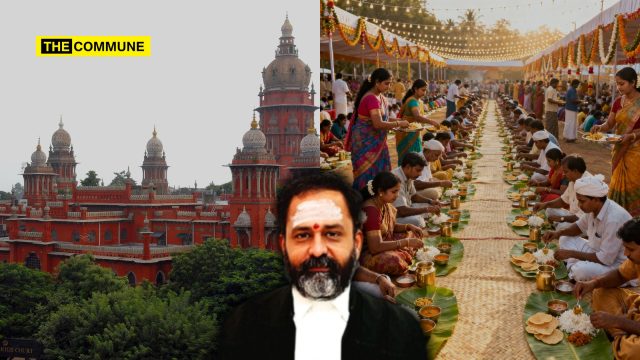
The Madurai Bench of the Madras High Court has delivered a significant ruling on religious freedom and the public’s right to access common land. The court granted permission to a Hindu organization to organize an Annadhanam (community meal) in Dindigul district, despite objections claiming the venue had been exclusively used for Christian Easter events for more than a hundred years. Citing Article 25 of the Indian Constitution, the court affirmed that the freedom to practice and propagate one’s faith is a protected fundamental right.
The bench emphasized that local officials and the police are obligated to safeguard this constitutional right rather than curtail it on the pretext of potential “law and order” problems. It noted that maintaining order is the responsibility of the police, not an excuse to deny citizens their lawful freedoms.
The judgment arose from a petition filed by a devotee who had sought permission to hold an Annadhanam near the Kaliyamman Temple on a public ground. His request was denied by local authorities, who instead suggested conducting the event on a public road. Finding this arbitrary and discriminatory, the petitioner approached the High Court. When questioned, the police justified their refusal by claiming the event might trigger disturbances.
During the proceedings, the court learned that a permanent stage had been constructed on one side of the ground about a century ago, and local Christian groups traditionally used it for Easter festivities. Members of that community argued that Hindus had never been allowed to conduct religious activities on the site. A 2017 peace committee meeting had also recorded an understanding that only “customary events” would continue there.
Justice G.R. Swaminathan, presiding over the case, examined the land’s ownership and found that the open area was classified as gramamatham—public land under panchayat control—and therefore belonged to the state. The judge held that any land owned by the government must remain open for all citizens, irrespective of faith or community.
He reasoned that denying access to a group solely because of its religion would constitute discrimination prohibited under Article 15 of the Constitution. In his words, “A public ground should be available for the use of all communities or none.” The court thus rejected the idea that Christians could use the ground for Easter but Hindus could not use it for Annadhanam.
At the same time, Justice Swaminathan clarified that the Christian community’s exclusive use of the ground during Easter must be respected, and no other event should be permitted during that period.
The judgment also took note of the demographics of the village, which comprises roughly 2,500 Christian families and 400 Hindu families. The court criticized the authorities for citing community opposition as a reason to deny permission, calling it “a very sorry state of affairs.” The judge further stressed the need for interfaith goodwill, remarking that all religious festivals should be occasions for participation, not exclusion.
In a touching personal reflection, he said, “When a Christian friend celebrates Christmas, I should greet him first,” recalling how a Muslim friend once made vegetarian Nonbu Kanji so he could share in the meal. “Such is the beauty of our culture,” he observed, adding that this spirit of mutual respect is essential for communal harmony.
Ultimately, the court overturned the authorities’ rejection order and directed the Tahsildar to grant permission for the Annadhanam at the requested public ground. The petitioner, however, was instructed to handle all logistical arrangements and to restore the venue to its original condition after the event.
Source: LawChakra
Subscribe to our channels on WhatsApp, Telegram, Instagram and YouTube to get the best stories of the day delivered to you personally.