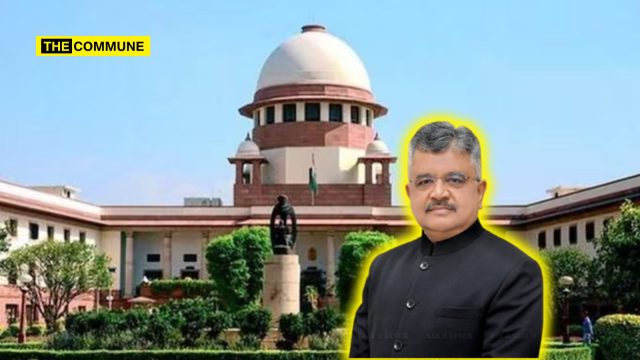
Solicitor General Tushar Mehta on Thursday, 21 August 2025, confronted the Supreme Court with a pointed analogy, asking whether the legislature could fix a timeline for the judiciary to complete a trial, while defending the governor’s discretion in acting on bills passed by state assemblies.
The remarks came during a hearing on the ongoing disputes between several states and their governors over delays in granting assent to legislation.
On the third day of the hearing, Solicitor General Tushar Mehta, appearing for the Centre, submitted that a governor’s options on a bill – whether to grant assent, withhold it, return it to the assembly, or reserve it for the President’s consideration, were “non-justiciable” matters that should be resolved through political mechanisms rather than judicial scrutiny.
Mehta argued before a five-judge bench comprising Chief Justice B R Gavai and Justices Surya Kant, Vikram Nath, P S Narasimha and A S Chandurkar that “there are hundreds of aspects that a governor examines while taking a decision on a bill and SC does not have the wherewithal to examine the validity of such considerations while arriving at a decision.”
This prompted the CJI to ask: “If a governor does not do what the Constitution mandates him to do and sits over a bill without taking a decision for years, should courts be powerless to examine such inaction? What will happen to the federal democratic set-up? What happens to the will of the people? And, what does an elected govt in a state do?”
Justices Surya Kant and Narasimha also questioned the implications of indefinite inaction. “The court may not go into the aspect of why a governor takes a particular action on a bill. But if the governor does not take any action for a very long period, can the situation be remediless? If the aggrieved state moves SC, should it keep silent? There cannot be a vacuum in the Constitution,” they observed.
Responding, Mehta said that constitutional impasses of this nature had historically been resolved through political channels. “There had been such impasses between governors and states. They were resolved through political statesmanship of the CM concerned, the PM and the President. Solutions have been found in the political set-up. If a timeframe is required to be prescribed for a governor to act on a bill, Parliament will decide,” he said.
The solicitor general added: “Every problem of the country need not have to be resolved by SC. The political set-up and heads of the other branches of governance are equally capable of resolving political issues through a collaborative exercise.”
While agreeing that courts must exercise restraint, the CJI cautioned against judicial overreach. “If SC, as custodian of the Constitution, finds a constitutional functionary refusing to discharge his/her functions without valid reasons, should it be powerless to act? Judicial activism should not become judicial adventurism or judicial terrorism. I have always said separation of powers must be respected,” Chief Justice Gavai remarked.
Mehta maintained that while the apex court had the authority to interpret the Constitution, it could not impose timelines where the Constitution was silent. He asked rhetorically: “If a trial in a criminal case is pending for decades and a person approaches the President saying justice has been denied to his son, should the President declare him innocent and end the trial? Can the legislature fix a timeline for the judiciary to complete a trial in a case?”
He further argued: “Whether the governor should grant assent, withhold, return the bill to assembly or reserve it for President’s consideration are all actions which are non-justiciable. There are no judicial standards by which the SC can test the validity of governor’s action on Bills. SC does not have the wherewithal to decide the validity of political decisions.”
Citing the principle of separation of powers, Mehta underlined that no organ of governance should intrude upon the core functions of the other. “The National Judicial Appointments Commission was unanimously passed by Parliament and ratified by two-thirds of the state and yet it was struck down by SC terming the presence of a single member from the executive in the panel for selection of judges as an interference in judicial independence,” he said, adding that if even one executive presence was deemed interference, it would be impermissible for the judiciary to impose deadlines on governors.
He concluded by stating that the deliberate silence of the Constitution on fixing any timeframe for a governor’s action on bills could not be altered by judicial intervention.
(With inputs from Times of India)
Subscribe to our channels on Telegram, WhatsApp, and Instagram and get the best stories of the day delivered to you personally.