


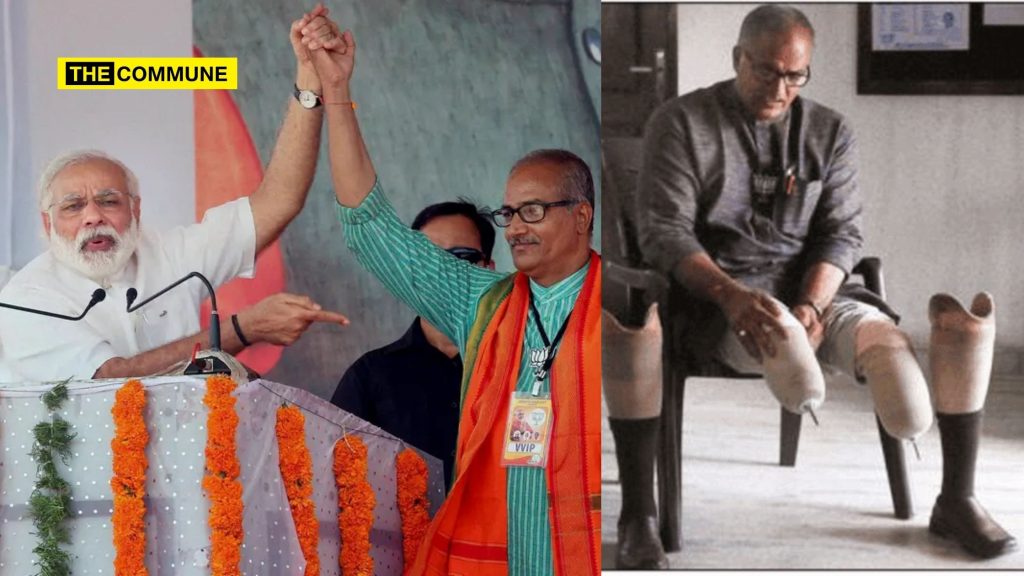
On a humid evening in Kannur, Sadanandan Master arrived home in his wheelchair. A small boy tugged at his kurta and asked: “Master, how did you walk before?” With a gentle smile, Sadanandan rolled up his pant leg to reveal his prosthetic limb and quietly replied, “These were mine once—before that night in 1994.” This simple exchange, recounted by local village bloggers, encapsulates the humility and quiet strength he embodies.
Kerala is often hailed as a beacon of literacy and political consciousness. Yet, beneath this progressive veneer lies a red corridor stained by decades of political violence—much of it targeting Hindus for simply asserting their identity. In this fraught landscape, few figures embody the kind of quiet resilience and moral courage that C. Sadanandan Master does.
Early Life
Born in Perinchery, Mattanur, Kannur—a CPI(M) stronghold—Sadanandan was raised in a Communist household: his father a CPI(M) sympathizer and his elder brother active in SFI. Sadanandan himself joined the SFI until the mid-’80s. But as he pursued higher education, he began questioning Marxism’s relevance to India. Influenced especially by Akkitham’s Bharata Darshanangal, he gravitated toward RSS ideology and began participating in shakha activities in Kannur, eventually serving as district Sah Karyawah for RSS.
Sadanandan served as a high‑school social studies teacher at Sree Durga Vilasam HSS, Peramangalam, Thrissur since 1999. He earned his B.Com from Gauhati University and B.Ed from Calicut University. Beyond teaching, he became vice‑president of the Kerala National Teachers Union and edited its journal Deshiya Adhyapaka Vartha He also served as RSS Kannur district boudhik pramukh, involved in ideological outreach at the grassroots.
The Night That Changed Everything: January 25, 1994
On that fateful evening, while returning from discussing his sister’s wedding plans, Sadanandan was ambushed by CPM cadres near Perinchery. At just 30 years old, both his legs were savagely chopped off. His attackers left him bleeding on the road, forbidding others to come to his aid, and fled the scene. Only after hours did the police arrive. His severed limbs were brought to hospital by a close friend to preserve the crime scene.
This case was initially registered under TADA, the first of its kind in Kerala. When LDF returned to power in 1996, the TADA provisions were withdrawn. In 2003, eight CPM cadres were convicted and sentenced to life imprisonment.
The Kerala High Court upheld life terms in February 2025 for the convicted CPM cadres, increasing the fines to ₹50,000 per person and stating that the punishment was in fact lenient for the crime’s severity.
The Road To Resilience
Surviving such an attack would break most people. But Sadanandan did not vanish into bitterness or obscurity. He returned—not with anger, but with an unshakable belief in the power of words, ideas, and democratic resistance. He never once called for violence in return. Instead, he chose to speak—about the need to end Kannur’s cycle of bloodshed, about building bridges between communities and ideologies, and about the importance of education and reform.
Before politics took over his life, Sadanandan was a dedicated teacher. He worked in schools in Mattanur and later in Thrissur. Even after the attack, he continued to engage with the world of education—serving as vice-president of the National Teachers Union and editing its journal Deshiya Adhyapaka Vartha. He also became associated with the Bharatiya Vichara Kendram, the RSS’s intellectual wing in Kerala, where he contributed to policy and ideological debates.
According to writer Advaita Kala, Sadanandan lay silent in hospital, refusing food, even his books offered no comfort. His wife had to feed him. Yet, his friend’s act of carrying those severed legs on his shoulders to the hospital—so no one could deny the crime—became a silent testimony of hope amidst horror . Over six months later, he walked again—with prosthetic legs—and gradually re‑entered public life.
Within a year, he married Vanitha in 1995.
Political Entry
In 2016, Sadanandan contested the Kerala Assembly election as a BJP candidate from Koothuparambu—ironically, one of the most politically sensitive constituencies in Kannur.
His campaign drew national attention when Prime Minister Modi introduced him at a rally, asking: “What crime did Sadanandan Master commit that his legs were cut off?” That moment elevated his narrative beyond regional politics to national conscience.
His 2016 vote share of ~14.2% (20,787 votes) was among BJP’s best in Kannur. He didn’t win, but victory was never the point. His candidacy itself was a statement: that ideas matter more than muscle, and that even in the face of unimaginable cruelty, one can choose to rise through dialogue, not destruction.
Till mid July 2025, he served as the BJP’s Kerala state vice president.
Entering Rajya Sabha
On July 12, 2025, President Droupadi Murmu nominated him to the Rajya Sabha under Article 80(1)(a), recognizing his contributions to education and public service. The Gazette notification listed him alongside other eminent figures.
C. Sadanandan Master is not just a symbol of survival but a portrait of moral resilience.
He stands as a teacher, survivor, thinker, and now legislator.
Subscribe to our channels on Telegram, WhatsApp, and Instagram and get the best stories of the day delivered to you personally.