


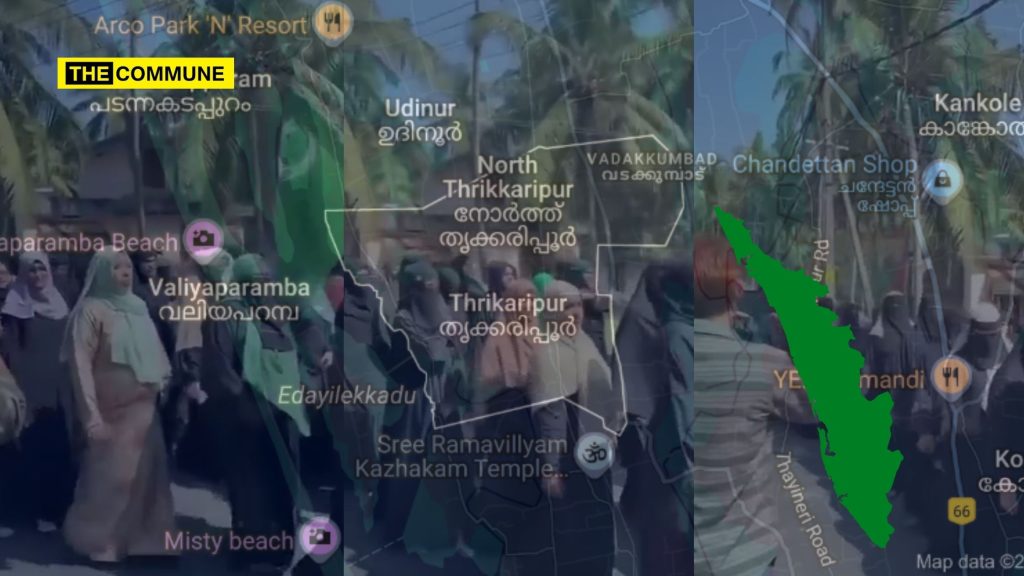
As Kerala gears up for its high-stakes local body elections, all eyes are on key battlegrounds like the Thrikarippur locality in Kasaragod district. This area, split into North and South Thrikarippur, serves as a fascinating microcosm of the state’s complex demographic and political dynamics.
A recent video of women covered from head to toe in the Islamic attire of burqa while filing nomination at Thrikarippur, it was reported that the entire UDF (Congress) team was made up of these women. That brings us to the question of the changing demographics in Kerala, especially in this region in Kasargod.
This is not Kabul… not Karachi… not Dhaka…
This is Kerala, Kasaragod, Thrikarippur.!!For the local body elections, UDF’s (Congress) entire nomination team walks fully covered in burqa.
Not a single other face. Not a trace of diversity.
Just one community, one dress, one… pic.twitter.com/wUQv7cgVIK— MAHARATHI (@MahaRathii) November 24, 2025
The Locality: A Tale of Two Halves
Thrikarippur is administratively divided into two separate census towns: North Thrikarippur and South Thrikarippur. Together, they form a significant population center with an estimated 59,700 residents in 2025. This reflects substantial growth from the 2011 census figures, underscoring the area’s development.
How the Demographics Define the Landscape
The most defining characteristic of Thrikarippur is its religious composition, which sharply differs between its northern and southern halves. As per the 2011 census the demographics is as follows:
South Thrikarippur is a clear Muslim-majority area, with Muslims constituting 53.88% of the population. Hindus are a significant minority at 45.46%, with very small populations of Christians and other groups.
North Thrikarippur, in contrast, presents a more balanced picture. Here, Hindus form a slim majority at 53.08%, while Muslims make up 45.23% of the population.
This demographic split is crucial for understanding the political undercurrents in the region, where community-based voting often plays a pivotal role.
A Distinct Social Profile
Beyond religion, Thrikarippur exhibits other notable social indicators. South Thrikarippur has an astonishingly high sex ratio of 1225 females per 1000 males, significantly above the state average. The locality is also highly literate, aligning with the Kasaragod district’s average of over 90%, indicating a well-educated and engaged electorate.
The Political Crucible
The demographic divide directly fuels the political contest. The region is a high-stakes battleground where the three major fronts in Kerala—the CPI(M)-led Left Democratic Front (LDF), the Congress-led United Democratic Front (UDF), and the BJP-led National Democratic Alliance (NDA)—are locked in a fierce triangular contest.
The UDF, and specifically the Indian Union Muslim League (IUML), draws its core strength from the Muslim-majority areas, making South Thrikarippur a key stronghold. The party has historically held significant influence in Kasaragod and views maintaining control here as a matter of pride. Meanwhile, the BJP is working to make inroads, particularly in the Hindu-majority North Thrikarippur and in areas where the political competition is direct, hoping to capitalize on its position as the main opposition in several local bodies.
When the Political Battle Unfolds
This ongoing political struggle is set to culminate with the upcoming local body elections. Kasaragod district, including Thrikarippur, will vote in the second phase on December 11, 2025. The results, to be declared on December 13, will determine the future governance of these localities and provide a critical preview of the political mood ahead of the state assembly polls in 2026.
In essence, Thrikarippur is more than just a locality; it is a dynamic and closely watched arena where Kerala’s demographic realities and intense political rivalries intersect, making it a key bellwether in the state’s continuously evolving political narrative.
Subscribe to our channels on WhatsApp, Telegram, Instagram and YouTube to get the best stories of the day delivered to you personally.