


Image Source: NDTV
High-resolution satellite imagery accessed exclusively by NDTV reveals devastating structural and strategic damage inflicted on multiple Pakistani military air installations during India’s precision strikes conducted under Operation Sindoor on 10 May 2025. These images, provided by Maxar Technologies and analysed by renowned geospatial intelligence researcher Damien Symon of Intel Lab, show extensive destruction at Pakistan’s Murid, Nur Khan, Sargodha (Mushaf), Jacobabad, Bholari, Sukkur, and Rahim Yar Khan air bases.
Good morning, it’s clear now that the IAF put a precision deep ‘bunker buster’ munition smack into a PAF underground special weapons facility at Murid Air Base on May 10. And looks like everything inside has cooked off, burning the surface. Did this force Pak to seek ceasefire? pic.twitter.com/z36D8zVfy3
— Shiv Aroor (@ShivAroor) May 28, 2025
Murid Air Base: Underground Facility Nearly Hit
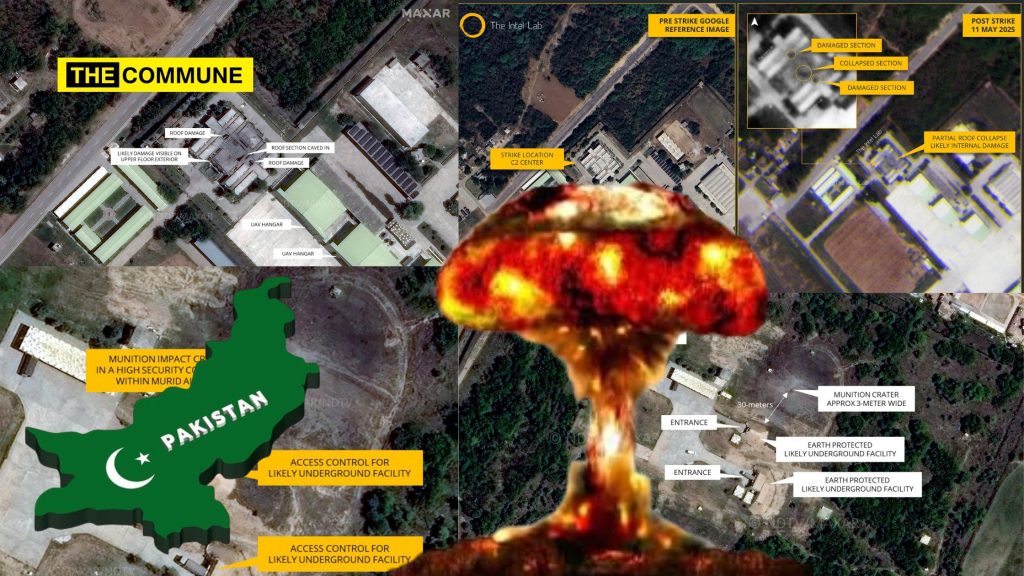
The most telling damage is at the Murid Air Base, located in Pakistan’s Chakwal district, approximately 150 km from the Line of Control in Jammu and Kashmir. Satellite images show a three-meter-wide crater just 30 metres north of an entrance to a likely underground facility — a highly secured compound within the airbase.
Breaking now on @ndtv New, high resolution images of the strikes on Murid – May 10. 📸:@Maxar pic.twitter.com/J4e8Kx0nch
— Vishnu Som (@VishnuNDTV) May 27, 2025
According to Symon, the targeted zone is “the most guarded complex within Murid Airbase,” enclosed within a 250m x 250m double-fenced area, equipped with four guard towers, an internal security cabin, and gated access control. The heavy security perimeter and earth-covered entryways suggest that this was not an ordinary installation but a “special weapons” underground storage site—potentially housing sensitive or high-value military assets.
Breaking the strike target down for those wondering what this facility at PAF #Murid was all about
1) 250Mt x250mt area Double Fenced compound.
2) 4 Guard towers + Security cabin& gate control inside
a PAF base , most PAF airmen would not
have had entry
1/n https://t.co/udINaH8s3J pic.twitter.com/X1etCioTpM— Ninjamonkey 🇮🇳 (@Aryan_warlord) May 27, 2025
Additionally, the presence of earth-protected entrances and the design of the facility indicate hardened operational shelters or storage for special equipment. The compound is about 680 meters from the main runway, connected via internal roads to six Hardened Aircraft Shelters (HAS) and a surface ammunition depot.
Further analysis indicates signs of burn marks and a small penetrator entry, pointing to the use of a deep-penetration bunker-buster munition. The internal detonation appears to have led to a “cook-off” — an explosion of stored munitions — inside the underground vault. The blast doors reportedly contained the explosion, but the resulting heat scorched vegetation on the roof, further confirming internal combustion.
Size & Scale of blast clearly indicates would've liquidated anything inside the maintenance hangar hit . Expect concussion & blunt force trauma to ATC personnel & people around the facility including in adjoining hangar as well . Easily 50+ casualties here . pic.twitter.com/TlhyRgjhH8
— Ninjamonkey 🇮🇳 (@Aryan_warlord) May 27, 2025
An additional image shows a truck parked at what appears to be a second underground entrance, potentially in the process of removing sensitive materials or special weapons to a safer location.
In short #Murid 2 was a "Special weapons" underground storage that was hit by a deep penetrator bunker buster causing whatever was inside to "cook off" inside. The Blast doors contained the blast , heat inside however burnt off the vegetation on the roof of the store penetrated. pic.twitter.com/4ouGdeZrTO
— Ninjamonkey 🇮🇳 (@Aryan_warlord) May 27, 2025
A 2019 post by intelligence analyst Damien Symon further corroborates the strategic significance of Murid Airbase in Pakistan. He noted that the base was “almost certainly now a special weapons delivery station,” citing visible infrastructure consistent with such a role. The post highlighted multiple layers of security, including fencing within an already heavily secured perimeter, and pointed to a massive underground facility equipped with guard towers. An inset image showed a connecting tunnel under construction at the time. Additionally, Symon identified special aircraft hangars directly connected to the runway, suggesting the presence of a dedicated mating and storage area for special weapons, along with restricted zones inaccessible to regular base personnel.
Murid Airbase #Pakistan is almost certainly now a special weapons delivery station. Fencing evident within an already fenced and heavily secure base include:
1) massive Underground facility with guard towers (with connecting tunnel shown in inset during construction) pic.twitter.com/wBP22gpSNN— Damien Symon (@detresfa_) October 7, 2019
Structural Damage to Command and Control Building
A second strike at Murid targeted a building believed to house a command-and-control node, located near a UAV complex. The pre-strike image from 16 April 2025 shows an intact facility, whereas the post-strike image from 10 May 2025 reveals a collapsed roof and stressed outer walls, possibly due to concussive force.

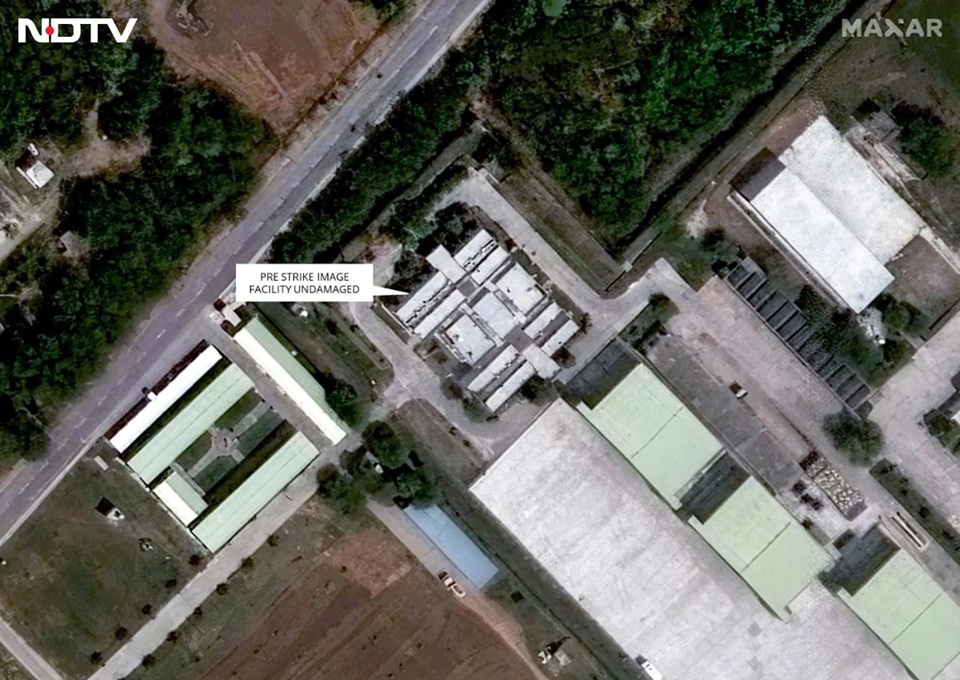
Image Source: NDTV
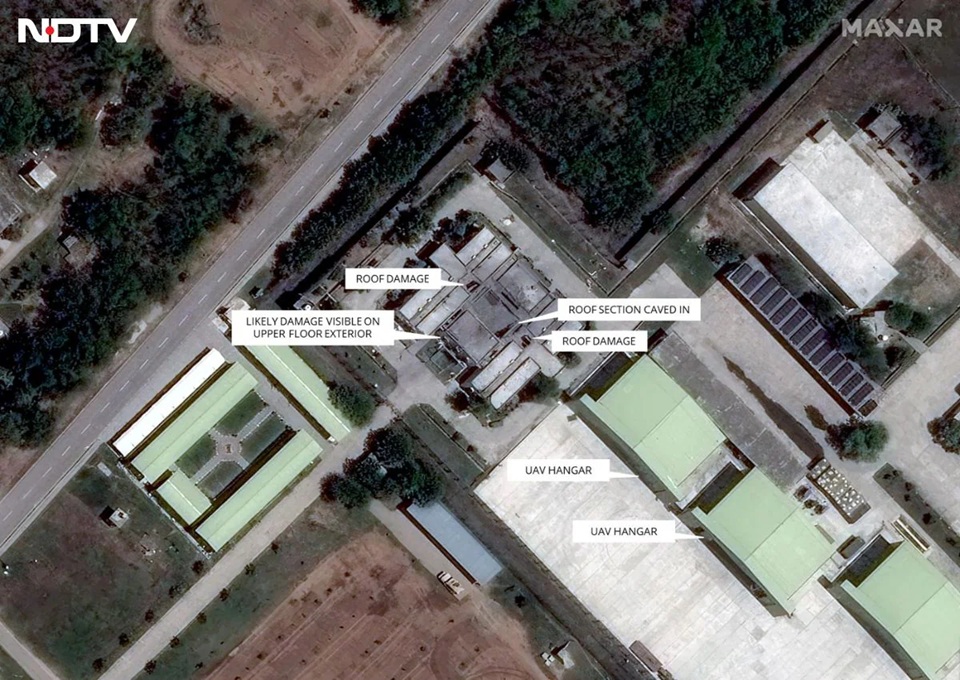
Image Source: NDTV
It is observed that such damage could have caused significant internal structural compromise, especially to the upper floors. The building’s proximity to UAV hangars suggests operational importance, and the scale of the blast indicates a high probability of casualties among air traffic controllers and adjacent hangar staff, possibly exceeding 50 personnel, according to military analysts.
Nur Khan Air Base: Command Trucks and Facility Obliterated
At the Nur Khan Air Base, located between Rawalpindi and Islamabad — Pakistan’s military and political nerve centers — India executed another surgical strike. Pre-strike satellite imagery from April 25 showed two special-purpose trailer trucks, suspected to be mobile command and control centers, parked intact.

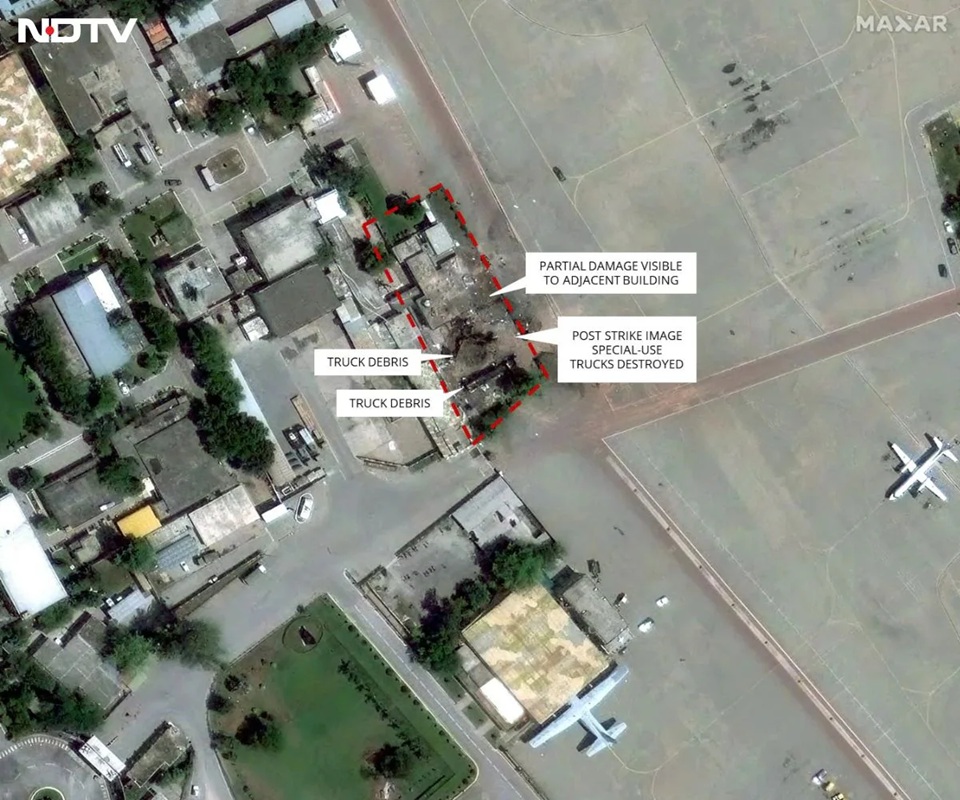
On 10 May 2025, satellite images revealed both trucks had been completely destroyed, with visible debris scattered nearby and partial damage to an adjacent building. By 17 May 2025, a week after a declared ceasefire, follow-up imagery captured Pakistan’s clean-up operation at the site.
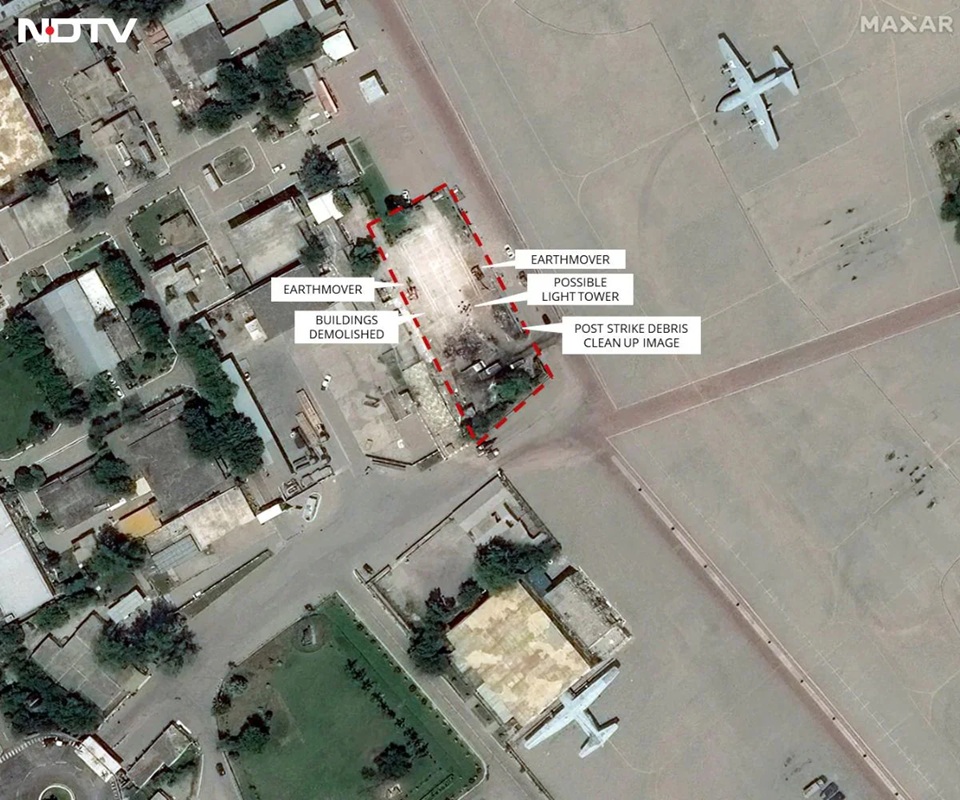
Damien Symon noted that beyond the trucks, the adjacent 7,000-square-foot facility was also demolished. This points to a larger operational impact than initially assessed, rendering the site unrepairable for Pakistan’s Air Force due to the internal structural devastation.
Jacobabad and Bholari Air Bases: Hangars Destroyed
In Jacobabad, satellite imagery confirmed that aircraft hangars were directly hit. Debris is visible around the destroyed structure, indicating that maintenance and repair facilities suffered crippling damage. Hangars serve as vital protection for aircraft and support crews.
At Bholari Air Base, Indian strikes caused severe damage to the hangar roof, as shown in Maxar’s 11 May 2025 imagery. This base, key to forward aerial operations in Sindh, saw its operational infrastructure seriously compromised.
Sukkur Air Base: Structural and Vegetation Damage
Further south, Sukkur Air Base, located west of India’s Rajasthan border, also faced significant damage. Imagery from May 10 captured severe structural collapse, scattered debris, and vegetation burns — likely a result of fire or the blast itself. Analysts suggest a burn scar is visible adjacent to the impacted building, indicating intense post-strike heat or ignition.
Rahim Yar Khan: Cratered Runway
At Rahim Yar Khan, a strategic installation in Punjab province, India’s strikes left a large crater on the runway, rendering it inoperable for aircraft takeoffs or landings. Runway denial is a classic objective in such strikes to paralyze air mobility.
Sargodha (Mushaf) Air Base: Dual Runway Cratering
One of Pakistan’s premier airbases, Sargodha, also known as Mushaf Airbase, was targeted with precision. Indian munitions created craters in two locations: one at a runway intersection and another on the main runway. Imagery from May 10 shows both sites severely impacted, suggesting a deliberate effort to paralyze the base’s operational readiness.
Strategic Analysis and Implications
The images substantiate claims of India’s deep-penetration capabilities, high-precision munitions, and strategic targeting acumen. Each of the bases hit played a critical role — either in logistics, UAV operations, special weapons storage, or as command hubs.
The strike on Murid’s underground bunker is particularly significant, as it demonstrates India’s willingness and ability to hit deep strategic targets — sites previously assumed protected even within heavily fortified bases.
These actions were part of a “measured and calibrated” response to prior escalations, executed under Operation Sindoor, according to Indian officials.
The scale of damage, precision, and choice of targets suggests a broader message: India now possesses the technological and operational sophistication to strike deep into enemy territory, neutralizing high-value military infrastructure while controlling escalation.
(With inputs from NDTV)
Subscribe to our channels on Telegram, WhatsApp, and Instagram and get the best stories of the day delivered to you personally.