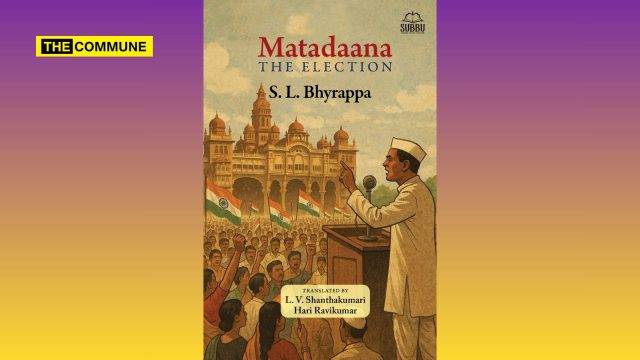
This book review comes during despondent times of S. L. Bhyrappa’s (SLB) passing and unification with the elements. I had picked this book up as this is the latest offering from Subbu Publications, and SLB’s works are always an attraction. First of all, the English translation is top-notch, with the core essence of the culture and times retained as compared to the Kannada original. The language is quite simple and lucid, with some quintessential Kannada words quoted in their original form. This effort has ensured that non-Kannada speakers can fully savour the richness of this fantastic composition.
MataDana means Voting in Kannada. However, the literal meaning is Daana, i.e., gift or bestowing a charity/favour of Mata, i.e., Vote. Quite literally, the name itself is laden with so many interesting facets of the novel. The story is set in the rural setup of Karnataka and deals with the lives and times of a few of the characters. Dr. Shivalingappa, a young and idealistic doctor whose mind is set on being a social reformer rather than one to benefit from his medical education. As a human, he puts society at large ahead of personal comforts or, for that matter, personal priorities. The book is about a few of the characters directly or indirectly connected to this central character and an election that changes the lives of each of these in an irreversible manner.
First and foremost, the book is a sharp reflection of society. S. L. Bhyrappa turns philosophical and asks some very hard questions about the society we inhabit, the values we profess, and what we practice and the overall destination of life. As one proceeds with the book, one may start to wonder if the author was a clairvoyant. The happenings around the election, the words spoken about the choice of candidates etc, reminds one of a similar recent “civil society movement” that emphasised very similar lines. SLB clearly articulates the various faults in society wherein the simplicity of a few well-meaning individuals is sacrificed at the altar of politics.
Is politics only about money? As we know, political affiliations translate into familial bonds cemented through marriages. This has been a practice for centuries, and it’s no different in this novel, where marriage becomes a tool to forge some new alliances.
SLB blends some very interesting topics into the narrative like the use of homemade remedies and highlighting the efficacy of the same through the well-meaning Allopathic doctor. Dr. Shivappa is someone with whom many of us relate – a simple, common man with everyday troubles of survival, but rich with values. There is a political undercurrent of the unification of Karnataka, which places the timeline of the novel around 1955-56. SLB also provides some very impactful commentary on social topics like caste reservations or regional factionalism within a political party.
In one of the instances, a wonderful poetic metaphor in the form of Bhima’s taunts to Duryodhana is employed to describe a similar conflict situation. However, the most impactful portions of the book are towards the end, where things take a very serious turn for a few of the characters. Ramalinge Gowdru undergoes a serious of philosophical contemplations and reflections on certain events upto that point, which hold a very strong mirror to the society. The portion of the book where he debates and conflicts with himself in the mind about certain choices he is about to make is deeply insightful, but disturbing at the same time.
The storytelling is quite unique, where there is one general narrative till the election, after which the author forks into separate perspectives from each of the central characters and merges the narrative towards the end. Dr. Shivappa’s transition from a young, idealistic citizen to a more practical social animal is laden with lessons for the modern reader.
The best part of the book is the transformation of the character, Rangalakshmi, from a timid girl to a person who asserts their decision, much against societal norms, to taking some hard decisions in her own life and carving a new life for herself. I feel people read this book to understand how truly women’s liberation happens. The book ends with a beautiful crescendo. One needs to be aware that this book was written in 1965, set in 1955-56. Considering the conservative nature of the society, SLB displays amazing courage to introduce divorcee remarriage into the narrative and fittingly ends the book with the same.
This book can be read just as a story or as a reflection of the society with its various fractures. However, SLB clearly brings out the human spirit that can transcend these barriers and achieve newer goals that could be considered impossible. Absolutely masterful storytelling. Very highly recommended read.
Gee Vee is an engineer and avid fan of itihasas, puranas and books.
Subscribe to our channels on Telegram, WhatsApp, and Instagram and get the best stories of the day delivered to you personally.