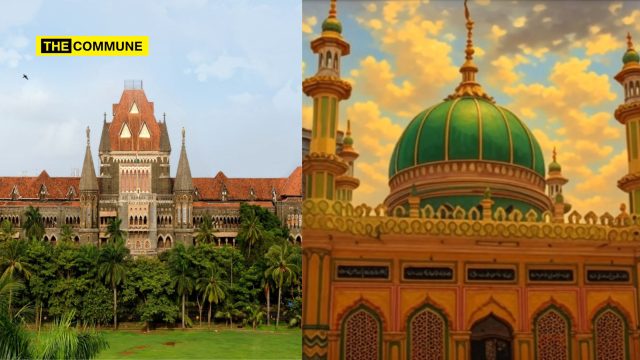
The Bombay High Court has dismissed an application filed by the Gazi Salauddin Rehmatulla Hoole alias Pardeshi Baba Trust seeking recall of its earlier order directing the demolition of an allegedly illegal Dargah structure in Thane district. The bench firmly held that mere “mob fury” or “footfall of people” on a piece of land cannot establish the legality of a religious structure.
A division bench of Justices Ajay Gadkari and Kamal Khata, while passing the order on 9 July 2025, noted that the Trust had expanded the structure, originally just 160 sq. ft. to over 17,610 sq. ft. without obtaining municipal permissions or demonstrating lawful ownership of the land. The land in question is privately owned, and the court held that the Trust had “usurped” the property without any valid legal claim.
“In our view, the Applicants have neither paid any consideration for acquisition of the land nor have taken any permission for constructing the structure. It is clearly a usurpation of rights based on a mere Notice publication by the Assistant Charity Commissioner. We find no merit in the contention that, by virtue of a Public Notice by the Assistant Charity Commissioner, one can claim ownership of structures and lands and thereby preempt the rightful owners from claiming the right to their property or objecting to illegal constructions being done on their property,” the court observed.
The High Court had originally passed the demolition order on 30 May 2025, upholding the Thane Municipal Corporation’s (TMC) decision to remove the unauthorised structure. However, following an interim order by the Supreme Court on June 17 granting liberty to the Trust to seek recall of the High Court order, the matter was re-heard.
The Trust argued that the structure existed before 1982 and that only 3,600 sq. ft. of the construction was under question, not the entire 17,610 sq. ft. as addressed in the High Court’s earlier order. However, the bench rejected the submission and reiterated that the Trust failed to prove any legal right over the land or the construction.
“We are unable to accept that a mob fury and the mere footfalls of people on a particular piece of land based on an assertion that, this is a Dargah can prove that it is a legal structure. This is a classic case of a usurpation of the land and such a method and for such a usurpation, the Court cannot grant its imprimatur,” the bench ruled.
The court also pointed out that the civil suit judgment dated April 5, 2025, passed by the Joint Civil Judge (Senior Division) at Thane, had found that the Trust had encroached upon the suit land and failed to prove ownership or adverse possession. In fact, the civil court’s judgment confirmed that the Dargah mentioned in a 1982 government gazette was situated elsewhere, not on the disputed property.
“The Judgment also clearly shows that the Defendants have failed to prove their title to the suit land either by a conveyance or by adverse possession. Interestingly, the Judgment observed that, the contention of the Applicant was that the present Writ Petition was regarding a different property and not the same as Dargah. Therefore, the Applicant has himself admitted that the Dargah pointed out in the Government Gazette of the year 1982 is on a different property and not on the property for which the Writ Petition was filed and Orders were passed,” the bench stated.
The bench further held that the TMC had followed due process and issued notices to the Trust prior to demolition, which were not responded to. “It is evident that, they have not been able to produce a single piece of evidence to suggest that there was any structure owned or possessed by the Trust. The only contention raised by the Applicant is that, when they issued a Public Notice through the Charity Commissioner claiming ownership of the structure as a Dargah, there were no objections taken by anybody. The Trust being certified was therefore declared as the owner of the structure. This in our view can never be the basis of ownership of any structure on anybody’s land. The Applicants have not produced any document whatsoever to show ownership of the land or the structure at all. In our view, they have encroached upon the land and claimed rights on a structure that was never theirs,” the court remarked.
The judges clarified that entries in land records such as 7/12 extracts do not by themselves confer ownership. “The existence of a structure in a 7/12 extract cannot be evidence of anything whatsoever. Entry in the 7/12 extract cannot and does not prove anything as such,” the court stated.
They added, “Admittedly, there is no permission taken by the Applicants for even a one single square feet of construction. Admittedly, the so-called structure has been increased to a humongous structure of more than 20,000 sq. ft. Such a party in our view cannot claim any equities… He must state and produce all facts and documents on record to prove his ownership as well as the permissions taken for construction of a structure.”
Reiterating the legal position, the bench concluded, “The Trustees entirely failed in proving (i) that, they own the land or (ii) they have taken permissions from the Municipal Authorities to construct even a square inch on the land. In our view therefore, the Applicants have no right over the structure now constructed illegally or even the structure on the Petitioner’s land.”
Accordingly, the court dismissed the application to recall the May 30 order and allowed demolition to proceed.
(With inputs from LiveLaw)
Subscribe to our channels on Telegram, WhatsApp, and Instagram and get the best stories of the day delivered to you personally.