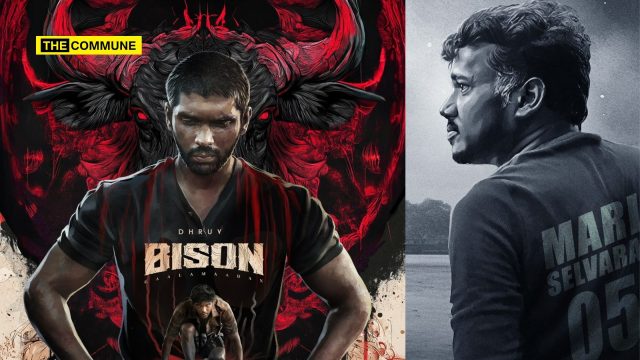
In his pre-release interview with Sudhir Srinivasan, Mari Selvaraj spoke of offering the people of his region and community a bird’s-eye view — showing them how he sees them, from the perspective of an outsider who has journeyed far in his evolution as a filmmaker.
And that’s precisely what he does in Bison Kaalamaadan. He lays bare how impulsive rage has kept old flames smoldering, how small grievances are fanned into generations-long conflicts, and how this cycle shapes the lives of those trapped within it.
Mari Selvaraj’s Bison Kaalamaadan isn’t just a film — it’s an act of cinematic courage. Set against the volatile socio-political backdrop of southern Tamil Nadu during the Pasupathi Pandian–Venkatesh Pannaiyar era, Mari blends historical realism with haunting fiction. The result is a deeply rooted, emotionally stirring tale that looks caste, conflict, and identity straight in the eye — without flinching, without sermonizing.
Right from the opening frame, Mari signals that we are in for something audacious. The first shot — a breathtaking bottom-up view of the inside of a cylindrical high-rise, with identical floors circling upward — evokes the horns of a bison stacked behind one another. Something like this:

It’s both a literal and symbolic tunnel: the viewer being drawn into the world of the Bison, and a visual metaphor for the odds the protagonist must rise above. As a big fan of Mari’s visual grammar, I was hooked – this is the world of Bison, and we’re being pulled right into its spine.
At its heart, Bison Kaalamaadan tells the story of Kittan (Dhruv Vikram), a young man from a so-called “untouchable” community whose life revolves around kabaddi — a sport built on touch. Mari uses this irony brilliantly, turning the game into both metaphor and battleground. Kittan’s journey is one of discrimination, betrayal, and redemption — but not in the simplistic “oppressor versus oppressed” binary we’ve been fed by recent Dravidianist narratives.
Mari does something far more honest and courageous. He holds up a mirror to his own community, revealing the caste prejudices that thrive even among those who are generalized as “oppressed”. Kittan faces discrimination and violence both from members of his “rival” community but also from within — from an extended family member, a caste zealot who rallies behind the Dalit leader Pandiarajan. And Mari doesn’t resort to token symbolism or virtue signaling. He doesn’t show someone cutting a poonool to make a statement. Instead, he stages a far more powerful image — the PT teacher snipping away the caste-marker threads of red-green, green-blue, yellow-red. The message lands quietly yet firmly: on the kabaddi ground, caste doesn’t speak — talent does. It’s a moment of profound self-introspection and rare honesty, one that few filmmakers in Tamil cinema would dare to attempt.
And yet, it’s people from the so-called “rival” communities who lift him higher. The PT teacher (Madankumar Dakshinamoorthy) who first encourages him, Kandasamy (Lal) — a kabaddi coach from the “dominant” caste who spots his talent and breaks bread with him — and Kaandippan (Azhagam Perumal), whose home proudly displays a portrait of freedom fighter Arthanareesa Varma, all become agents of change in Kittan’s life for the better.
This is where Mari Selvaraj’s brilliance truly shines. He doesn’t villainize. He doesn’t glorify. He humanizes. Even when Kandasamy’s relationship with Kittan fractures under the weight of social violence, Mari refuses to demonize him. Instead, he lets pragmatism and pain coexist — Lal’s Kandasamy isn’t evil, just trapped in a brutal world order. And even in separation, he ensures Kittan’s growth by recommending him to another club. It’s rare empathy in today’s polarizing cinematic landscape.
Cinematically, Bison Kaalamaadan is a masterclass in pace and tension. Despite running close to three hours, the film never drags. The rapid-fire edits, the claustrophobic camera work, and Nivas Prasanna’s tense score create an atmosphere thick with urgency and danger. The qualifying match sequence, intercut with Kittan’s father dancing in a trance before their clan deity, stands as one of Mari’s most powerful visual montages — a scene where religion, sport, and emotion merge into something almost transcendental. The pounding Rajamelam that we heard in Karnan and Dhruv’s fierce energy make it pure goosebump cinema.
Like every Mari Selvaraj film, animals in Bison Kaalamaadan carry deep symbolic weight. From Karuppi the dog in Pariyerum Perumal to the tied donkey in Karnan, the pigs in Maamannan, and the cow that wanders into a banana plantation in Vaazhai, Mari has always used animals as living metaphors — pivots that elevate the story, heighten the tension, and mirror the human condition. In Bison, it is a goat that pisses inside a bus.
Dhruv Vikram delivers a deeply committed performance, his physical transformation as a kabaddi player evident in every move. But it’s Pasupathi who owns the film. It wouldn’t be unfair to say that he’s the real hero. His portrayal is extraordinary — every flicker of his eyes, every muscle under his cheek tells a story of trauma, endurance, and pride. His performance alone is reason enough to watch Bison Kaalamaadan.
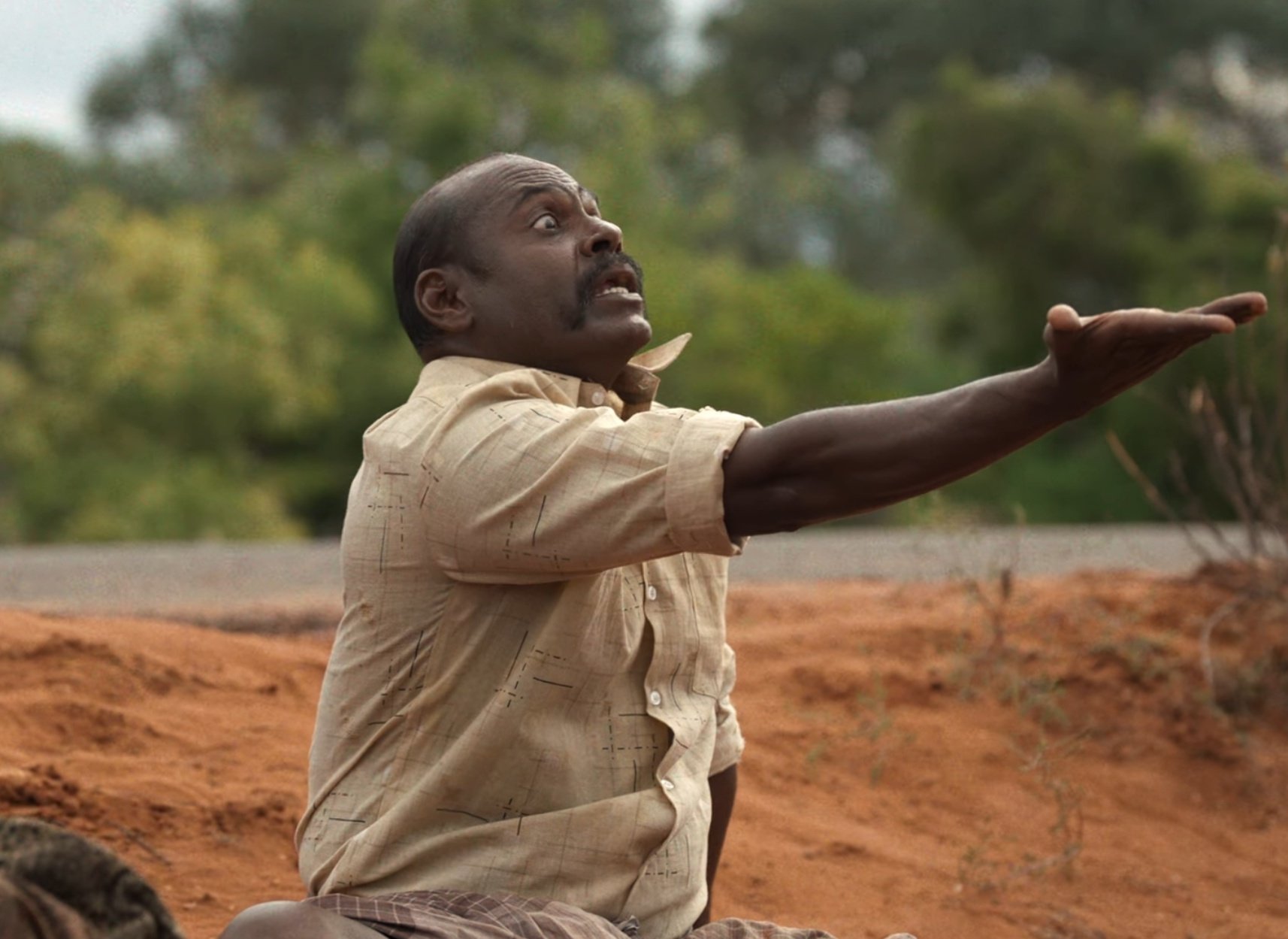

Lal and Ameer have also done their job quite well giving a sense of what the rivalry between Pasupathi Pandian and Venkatesh Pannaiyar would’ve been like.
What’s perhaps most striking about Mari’s evolution is how he rejects the tired Dravidianist clichés that plague modern Tamil cinema. There’s no Brahmin-bashing. No north-versus-south sloganeering. No preachy political inserts. In fact, a Tamil man casually speaking Hindi becomes a quiet but powerful moment — a reminder that embracing another language isn’t betrayal, and that identity and inclusivity can coexist without bitterness.
And then comes the final image — the Indian tricolour flying high. It’s not jingoism, but a visual of triumph and unity. After all the blood, discrimination, and chaos, the flag becomes a symbol of transcendence — of belonging to something larger than caste, creed, or conflict. When was the last time you saw a Tamil film end with the Indian flag shown with such dignity, such purity?

And underpinning it all is Mari’s central message — that anger, when channelled right, can be transformative. For Kittan, anger births achievement; for Mari, it births art. The film stands as a testament to what righteous fury can create when guided by compassion and self-awareness.
“Everything that you speak out loud, let it be spoken from within the seeds”
Those were Mari’s opening words in the video of Naan Yaar song from Pariyerum Perumal — and with Bison Kaalamaadan, he has done exactly that. He has spoken from the roots, from the soil that shaped him.
As noted in my review of Vaazhai, Mari Selvaraj is a gifted filmmaker at the height of his cinematic mastery and storytelling craft — a storyteller who should continue to chronicle his life, his journey, and his community’s struggles through such deeply rooted, resonant tales.
Kaushik is a film buff and political writer.
Subscribe to our channels on Telegram and Instagram and get the best stories of the day delivered to you personally.