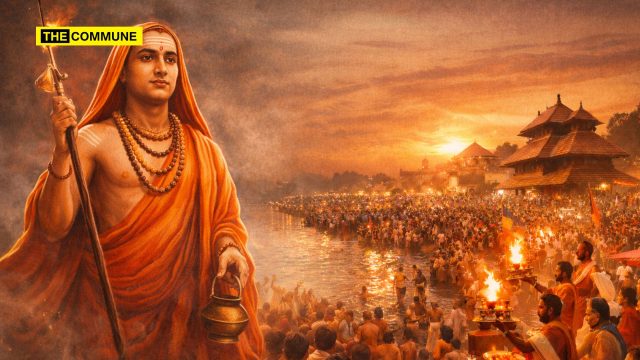
In January 2026, something unprecedented is happening on the banks of the Bharathapuzha River in Malappuram, Kerala. After more than two centuries of silence, the sacred sound of Vedic hymns once again echoes across ancient pilgrimage grounds. The Maha Makham Mahotsavam, Kerala’s first-ever Kumbha Mela-style gathering, has begun, running from 18 January to 3 February 2026, at Thirunavaya’s Navamukunda Temple.
This is not a northern import or a newly invented spectacle. It is the revival of an old Hindu institution that once stood at the heart of Kerala’s religious, political, and civilisational life. Long before modern borders separated Tamil Nadu and Kerala, and long before colonial rule dismantled Hindu public institutions, Thirunavaya was one of the most important pilgrimage centres in South India.
The return of Maha Makham raises a simple but uncomfortable question: how did such a central Hindu tradition disappear from public memory and why is its revival meeting resistance even today?
Bharathapuzha: The Dakshina Ganga Of Kerala
The Bharathapuzha, locally known as Nila, is Kerala’s second-longest river. Originating in the Western Ghats of Tamil Nadu, it flows through the heart of Kerala before meeting the Arabian Sea near Ponnani. In Hindu tradition, the river is revered as Dakshina Ganga, the Ganga of the South.
According to Puranic belief, Parashurama, the Vishnu avatar credited with creating Kerala, performed the first yajna for universal welfare on its banks. The river has therefore always been seen not merely as a water source, but as sacred geography.
A central belief associated with Bharathapuzha is that during the month of Magha (January-February), the sanctity of all major holy rivers – Ganges, Yamuna, Godavari, Saraswati, Narmada, Indus, and Cauvery – are believed to manifest in its waters. This belief made ritual bathing at Thirunavaya during Magha one of the most important religious acts in Kerala, comparable to bathing at Prayagraj or Haridwar in the north.
Maha Makham: The Lost Festival That Defines Kerala’s Spiritual Past
A Festival Older Than Modern Kumbha Mela
While the Kumbha Mela tradition of the north of India was formally systematized in the 8th century by Adi Shankaracharya, Kerala’s Maha Makham predates this systematization and represents an independently evolved tradition within the broader Hindu cosmology.
The Maha Makham festival, held once every twelve years on the banks of the Bharathapuzha at Thirunavaya, functioned as Kerala’s equivalent to the northern Kumbha Melas. It served not merely as a religious gathering but as a council of governance, a trade fair of continental significance, and a space for the renewal of cosmic and political order.
The Duodecennial Cycle And Sacred Kingship
The twelve-year cycle of Maha Makham was tied to a complex system of sacred kingship and governance that was unique to Kerala. Unlike the more hierarchical monarchies of the north or contemporary Chola and Pandya kingdoms, Kerala’s political system during the Chera period operated through a rotating form of ritual royalty centered on the Maha Makham.
According to historical sources preserved in Kerala’s temple records and Sangam-era texts:
- The Priesthood’s Role: The Nambudiri Brahmins held supreme religious and administrative authority. Every twelve years, they would gather at Thirunavaya to select or affirm a new Perumal (supreme ruler) for the next dozen years.
- The Candidate Selection Mechanism: Aspiring Perumals would compete, but not through democratic vote, rather, through a system of ritual combat and ceremonial challenge. The candidate had to “force his way” through warrior contingents (the Chavers – elite swordsmen sworn to death before defeat) and ideally, kill the sitting Perumal to establish his rightful claim. If he succeeded, he was crowned for the next twelve years. If he failed, the sitting Perumal continued.
- The Mamankam Spectacle: The Maha Makham evolved over time into the Mamankam, a 28-day festival spectacular that combined:
- Religious ceremonies: Vedic yajnas and pujas led by the foremost scholars
- Political theater: The selection and coronation of the new Perumal
- International commerce: A grand trade fair attracting merchants from China, Arabia, Greece, and Rome
- Military displays: The warrior clans of Kerala demonstrating their martial prowess
- Cultural performances: Music, dance, poetry recitations, and philosophical debates
The Great Mamankam: A Transaction Between Sacred And Secular
The Mamankam was, in essence, a transaction between three forces: the priesthood (Brahmins), the warrior class (Nairs and other martial communities), and the merchant classes (the trading guilds of Kerala). All three had to consent to the selection of a new Perumal for the Mamankam to be considered legitimate and binding.
The last Chera Perumal to rule, Cheraman Rama Varma Kulasekhara (ruled c. 1089–1124 CE), survived three consecutive Mamankams at Thirunavaya – an extraordinary feat indicating either his martial prowess, his political acumen, or the respect he commanded. He ruled for 36 years. After his reign, Kerala’s political structure fragmented. The Perumals’ power declined, and regional chieftains (Udaiyavars) and Brahmin oligarchies increasingly took control.
Eventually, the right to conduct Mamankam passed from the Chera Perumals to the Valluvakonathiri (rulers of the Valluvanad region in northern Kerala). But over subsequent centuries, even this practice waned, particularly as the Zamorins (rulers of Calicut) rose to dominance and the spice trade routes shifted.
The Mamankam’s Tragic Decline: Zamorin Rivalry And Colonial Disruption
By the 16th century, as Portuguese, Dutch, and eventually British colonial powers began fragmenting Kerala’s maritime trade networks, the cultural foundations supporting the Mamankam eroded. The rise of the Zamorins, who were rival to the Valluvakonathiris, made the Mamankam a site of violent contestation rather than ceremonial consensus. Chavers (the elite warriors) began being sent to assassinate the Zamorin at Mamankam gatherings, leading to bloodbaths.
The last recorded Mamankam took place in the 18th century. After that, colonial governance, Christian missionary expansion, and the eclipse of traditional Kerala kingship rendered the festival obsolete. For over 250 years, the Maha Makham lay dormant.
The Chera Dynasty: Tamil Nadu’s Link To Kerala’s Spiritual Roots
To understand the significance of Kerala’s Maha Makham, it is necessary to look back at the Chera dynasty, one of the three great Sangam-era kingdoms alongside the Cholas and Pandyas. The Cheras ruled over a region that today spans both Tamil Nadu and Kerala, long before modern political boundaries divided the two.
Between the 3rd century BCE and the 5th century CE, the Chera kingdom encompassed western Tamil Nadu’s Kongu region, the Malabar coast, the Palakkad Gap that connected the coast to the Tamil interior, and the fertile river basins of the Bharathapuzha. This geography allowed the Cheras to control both inland trade routes and major ports, making them powerful intermediaries in the Indian Ocean trade network and one of the wealthiest dynasties of their time.
This prosperity translated into strong patronage of religion and learning. Sangam literature describes the Cheras as supporters of Tamil poets and devotional traditions, while also engaging deeply with Sanskritic and Vedic practices. Rather than choosing between the two, the Cheras fostered a synthesis of Tamil devotional culture and Vedic-Brahminical ritual. This fusion became the foundation of Kerala’s Hindu civilisation.
As Chera political authority declined, religious leadership in Kerala gradually shifted to a Brahmin-led, Vedic-oriented order. Nambudiri Brahmin institutions systematised temple worship, preserved ritual traditions, and established Kerala as a major centre of Advaita philosophy. It was within this Hindu framework that institutions like the Maha Makham took shape, serving as periodic assemblies where religious authority, political legitimacy, and economic life came together.
The Cheras, therefore, did not merely rule a territory. They forged a shared civilisational space linking Tamil Nadu and Kerala—one in which language, ritual, devotion, and commerce coexisted. The revival of Maha Makham at the Bharathapuzha is best understood as a return to this older, integrated Hindu order, not the creation of something new.
Adi Shankaracharya: The Spiritual Architect Who Systematized Hindu Renewal
Kerala’s centrality to Hindu civilisation is inseparable from Adi Shankaracharya. Born in Kaladi, Shankaracharya unified Hindu philosophy through Advaita Vedanta at a time when Buddhism, Jainism, and internal fragmentation posed serious challenges to Sanatana Dharma.
More importantly, Shankaracharya created durable institutions, mathas (Sringeri Matha (South, in Karnataka), Dwarka Matha (West, in Gujarat), Puri Matha (East, in Odisha), and Badrinath Matha (North, in Uttarakhand) and akharas, that preserved Hindu learning, ritual, and monastic discipline across the subcontinent. These institutions ensured that Hindu civilisation survived not merely as belief, but as organised public life.
Shankaracharya’s Connection To Kerala And The Chera Legacy
Crucially, Adi Shankaracharya was himself a product of the cultural synthesis the Cheras had begun centuries earlier. He was born into a Nambudiri Brahmin family in Kerala, spoke Tamil, studied both Vedic Sanskrit and Tamil philosophy, and benefited from the intellectual ecosystem that Kerala’s Hindu elite had cultivated.
What connected Shankaracharya to the Maha Makham and Kumbha Mela traditions was his decision to systematize and institutionalize Hindu renewal through regular assemblies of scholars and ascetics.
The Formalizing Of Kumbha Mela And The Akhara System
Tradition attributes to Adi Shankaracharya the creation of the Akhara system – formal monastic orders tasked with preserving and propagating specific schools of Hindu philosophy and practice. Shankaracharya himself established the Juna Akhara, one of the oldest and largest Shaivite monastic orders.
The Kumbha Mela became institutionalized partly through Shankaracharya’s philosophical framework and the akhara system he established. The Kumbha Mela transformed from an ancient, loosely organized pilgrimage into a systematically organized gathering overseen by philosophical orders (akharas) that used the occasion for scholarly debate, ritual renewal, and the initiation of new ascetics.
What Shankaracharya did for North India (systematize and formalize Hindu intellectual and spiritual renewal) had an earlier parallel in Kerala with the Maha Makham. Both traditions were responses to the same challenge: how to preserve Hindu civilization’s unity and vitality in the face of internal fragmentation and external pressure.
The Modern Revival: Why Now? Why Kerala?
The Juna Akhara’s Strategic Initiative
The decision to revive Kerala’s Kumbha Mela in 2026 came from the Juna Akhara, the same monastic order that tradition attributes to Adi Shankaracharya himself. The Mahamandaleshwar of the Juna Akhara leading this initiative is Swami Anandavanam Bharathi, a Keralite who is only the third person from Kerala to achieve this rank within the order.
Significantly, Swami Anandavanam’s personal journey mirrors the philosophical tensions animating the revival:
- Former radical activist: He was once an SFI (Students Federation of India) leader, the student wing of the communist movement in India
- Spiritual awakening: He eventually “parted ways from red ideology to embrace the saffron order”
This biography is not incidental to the story. The revival of the Kerala Kumbha Mela represents a spiritual reassertion that Hindu civilization possesses resources for meaning-making and collective identity that secular left ideology does not.
Why The Kerala Kumbha Mela Was Revived
The Juna Akhara has described the Kerala Kumbha Mela as a revival of an old Hindu tradition, not the creation of a new one. According to the Akhara, Thirunavaya’s Maha Makham, held during the time of Cheraman Perumal, was Kerala’s equivalent of the Kumbh Mela and once occupied a central place in the region’s spiritual life.
By restoring the festival at the Bharathapuzha, the organisers say they are reclaiming a tradition that faded due to political decline and colonial disruption, not because it lost religious relevance. The revival highlights the fact that South India, like the North, had large-scale Hindu pilgrimage assemblies rooted in Sanatana Dharma.
The choice to organize the 2026 Kumbha Mela is the first step in a twelve-year cycle that will continue through 2038, when the next full Maha Makham will be held, marking the completion of the traditional duodecennial (twelve-year) period.
The Magha Timing: Synchronization With Tamil Nadu’s Kumbakonam
It is noteworthy that Tamil Nadu’s Kumbakonam also holds a similar Maha Makham every twelve years, also tied to the Magha star’s prominence. This creates a pan-South Indian synchronization: Kerala (Thirunavaya), Tamil Nadu (Kumbakonam), and potentially other southern sites, are now positioning themselves as participating in a southern analog to the four-site North Indian Kumbha Mela circuit.
It is a reminder to people that major Hindu pilgrimage traditions have existed in South India for centuries, not only in the northern parts of the country.
Conflicts, Controversies, And The Politics Of Revival
The revival of the Kerala Kumbha Mela has not been without obstacles. In early January 2026, the Thirunavaya village officer issued a stop-work notice halting the construction of a temporary bridge across the Bharathapuzha River, citing violations of the Kerala River Conservation Act, 2001. Officials stated that no prior permission had been obtained for the work, which involved construction activity within the river zone.
Organisers responded by pointing out that most of the work had already been completed with the knowledge of local authorities and in the presence of police officials. They alleged that the sudden halt was the result of procedural delays and administrative confusion. Eventually, conditional permission was granted to resume preparations, subject to environmental and safety safeguards.
The revival effort also faced resistance beyond Kerala. The DMK government in TN, refused permission for a ceremonial chariot carrying the Sri Chakra from Tiruppur to travel to Thirunavaya for the Kumbha Mela. Organisers said the chariot procession was an important symbolic component of the event, linking the revival to older South Indian spiritual traditions. The refusal was seen as another administrative hurdle placed in the path of the festival.
What This Revival Means For Hindu Civilisation
The return of the Maha Makham at Thirunavaya restores a major Hindu tradition that had disappeared from public life for over two centuries. It reminds people that Kerala and other parts of South India once hosted large, organised pilgrimage assemblies of their own, equal in scale and sanctity to the better-known Kumbh Melas elsewhere.
The revival also reconnects the festival to Kerala’s historical roots. Maha Makham was closely tied to the Chera rulers, under whom present-day Kerala and parts of Tamil Nadu formed a single cultural and economic sphere. Holding the festival once again on the banks of the Bharathapuzha draws attention to the river’s earlier role as a centre of religious, political, and public life.
The association with Adi Shankaracharya strengthens this continuity. Born in Kerala and active across the subcontinent, Shankaracharya helped shape Hindu religious institutions and philosophy. His presence in the legacy of Maha Makham underlines that Kerala was not peripheral to Hindu history but one of its formative centres.
Bharathapuzha Remembers
The Kerala Kumbha Mela of 2026 is not about creating a new festival. It is about restoring an old one that had faded due to political changes, colonial disruption, and the breakdown of traditional institutions. The rituals, the location, and the timing all draw from older practices connected to the Bharathapuzha and Thirunavaya.
The revival has also faced practical challenges, including environmental rules and administrative restrictions, showing how ancient religious practices now operate within modern systems of governance. Despite these constraints, the festival has gone ahead, marking a return of public religious life to a site that once held great importance.
For devotees, the gathering is a chance to reconnect with a forgotten part of Kerala’s religious past. For others, it offers a clearer picture of how Hindu traditions in South India developed and why their revival continues to hold meaning today.
Subscribe to our channels on Telegram, WhatsApp, and Instagram and get the best stories of the day delivered to you personally.