


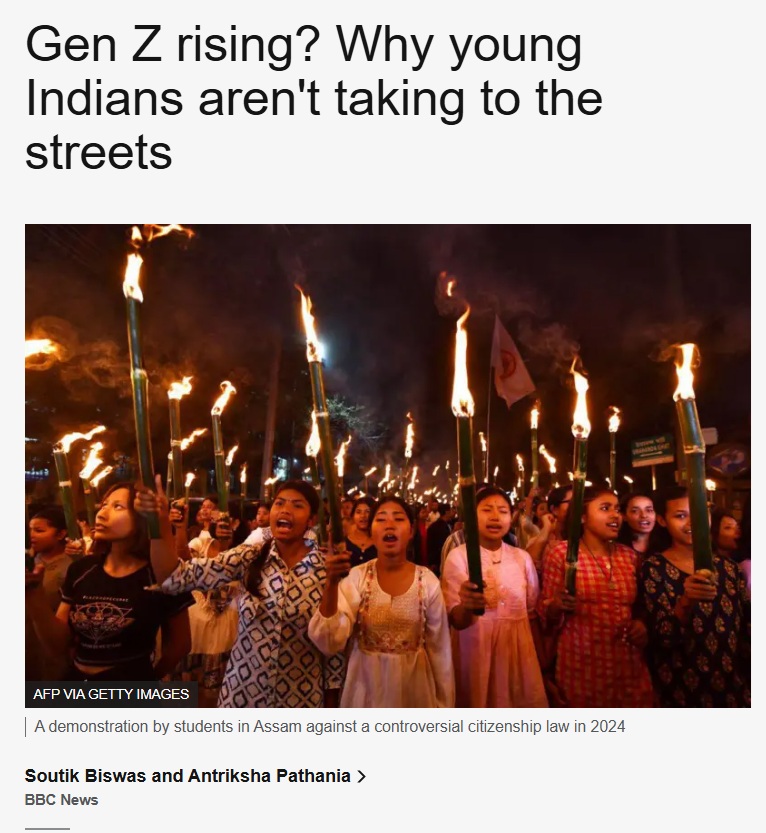
The BBC’s latest piece, “Gen Z rising? Why young Indians aren’t taking to the streets”, reads less like a report and more like a wistful manifesto wishing India’s youth were angrier. It paints a picture of a “restless and hyper-connected” Generation Z, supposedly on the brink of rebellion, while lamenting that they haven’t yet taken to the streets like their peers in Nepal or Bangladesh.

But behind the romantic language lies a familiar Western gaze – one that struggles to reconcile India’s democratic stability and economic momentum with its own nostalgia for chaos-driven political change.
The Subtext: Why Isn’t India Burning Yet?
The article begins by juxtaposing India’s calm with youth uprisings in neighbouring countries. In Nepal, “young protesters brought down a government in 48 hours.” In Bangladesh, youth “brought regime change.” The suggestion is clear: India’s Gen Z, too, should be doing something similar.
This rhetorical device of comparing democratic India to unstable political systems in South Asia is plain provocation. The BBC calls India’s Gen Z “restless” and “aware of corruption,” then wonders why they are not “rebelling.” It never occurs to the writers that awareness in a democracy does not have to manifest as street violence.
Reality Check: India’s Gen Z Is Building, Not Breaking
India’s youth are not apathetic; they’re pragmatic. They are innovating, launching start-ups, upskilling, migrating for global opportunities, and participating in electoral politics through digital advocacy and entrepreneurship.
The BBC romanticises protest as the only legitimate form of youth engagement. But in India, millions of young people channel their frustration into innovation, civil service preparation, or community initiatives. They are not disinterested; they are simply too busy doing the hard work of building a future to indulge in performative rage.
The “Anti-National” Frame – Another Lazy Trope
Predictably, the piece invokes the “fear of being branded anti-national” as a key reason why youth don’t protest. This is a lazy and overused Western trope that flattens India’s nuanced civic discourse into an authoritarian caricature.
Yes, public dissent comes with scrutiny, as it does in any democracy, but India remains one of the most politically noisy nations on earth. From student groups and digital campaigns to issue-based movements on climate, caste, and gender, young Indians speak up every day without fear. The BBC’s claim that youth are “afraid” is not based on evidence; it’s based on narrative convenience.
BBC’s Selective Amnesia on Violence and Accountability
When the article mentions protests against the Citizenship Amendment Act (CAA), it conveniently omits the violence that accompanied them – police injuries, arson, and deaths or the political groups that exploited those movements. To the BBC, protest equals progress, even if it destroys public property or divides communities.
This is part of a larger pattern in Western media coverage of India: glorifying disorder as “democracy in action” while downplaying civic resilience and institutional functioning as signs of “suppression.”
Diverse, Decentralised, Democratic – Not Dysfunctional
India’s Gen Z is indeed diverse – linguistically, socially, economically, and that’s precisely why there isn’t a single “uprising.” That’s not weakness; that’s democracy. The BBC treats diversity as fragmentation, when in fact it’s a reflection of how power and protest are distributed in India’s federal system.
Unlike smaller states where discontent concentrates into rebellion, India’s scale ensures that political churn is constant, electoral, and peaceful.
The Real Story the BBC Missed
India’s youth are not quiet because they’re afraid; they’re quiet because they’re working. They are driving the country’s booming digital economy, spearheading the gig revolution, topping global education enrollments, and contributing to India’s rise as the fastest-growing major economy.
They are not dreaming of toppling governments; they are dreaming of launching companies, buying homes, and securing their futures.
The BBC, meanwhile, seems nostalgic for the era of street revolutions, as though India’s stability is somehow disappointing. But to the young Indians building startups, coding apps, and preparing for UPSC exams, the real revolution is already underway — and it’s powered by ambition, not anger.
Subscribe to our channels on Telegram, Instagram and YouTube to get the best stories of the day delivered to you personally.