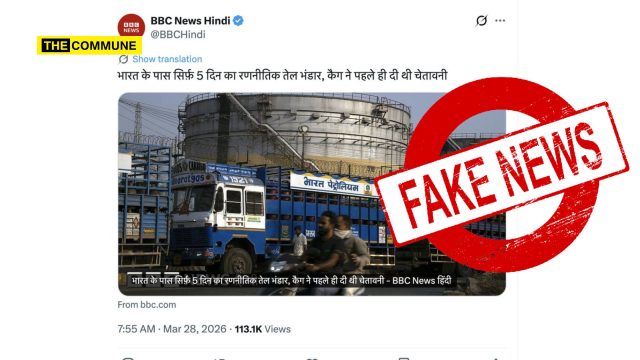
BBC Hindi, the Indian-language service of Britain’s state-funded public broadcaster, published a report on March 27–28, 2026, claiming that India’s strategic petroleum reserves could meet only approximately five days of national demand – a claim that has since been officially flagged as misleading by the Press Information Bureau and widely condemned by government officials, economists, and media observers, as reported in OpIndia.
The article, citing a Comptroller and Auditor General (CAG) audit, stated that India’s Strategic Petroleum Reserve (SPR) caverns were less than one-third full, presenting it as a critical vulnerability in the country’s energy security particularly in the context of geopolitical tensions in West Asia and the risk of a disruption in the Strait of Hormuz.
The news report has since been deleted.
What BBC Hindi did not tell its readers was the full picture.
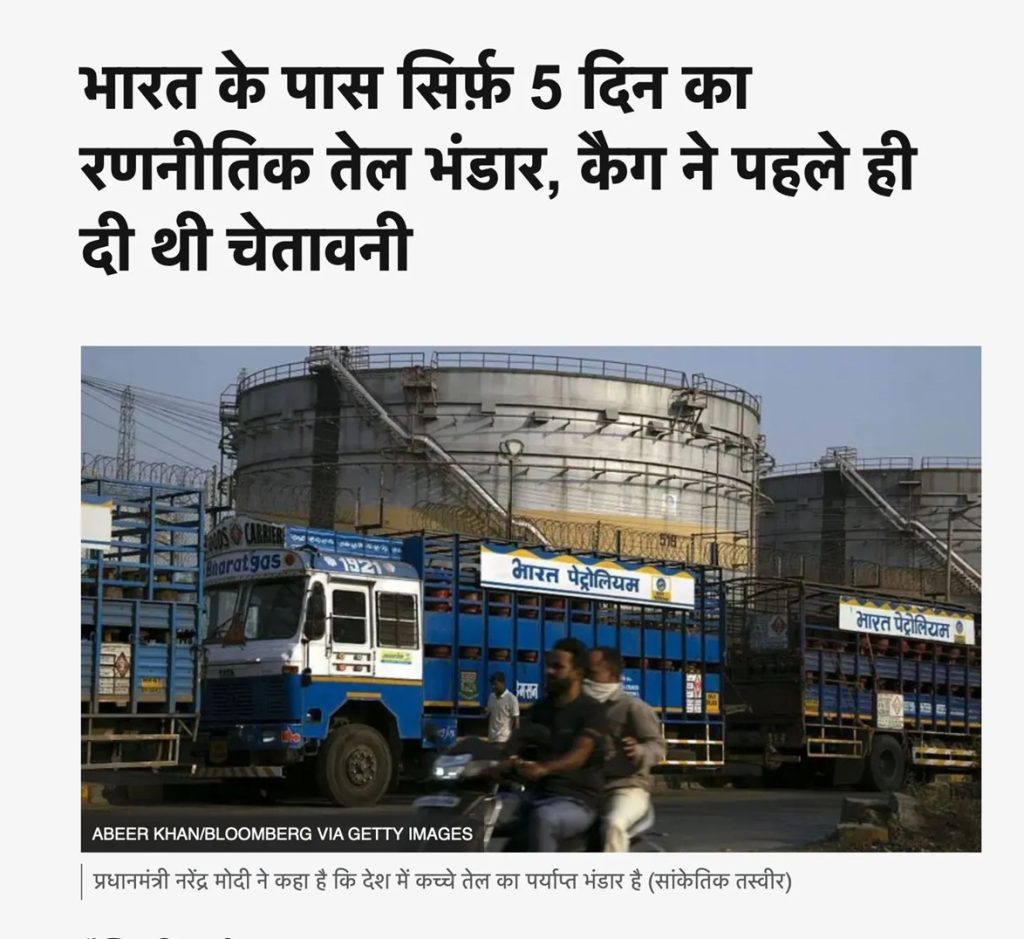
The Number BBC Hindi Chose Not to Publish
India’s total petroleum buffer, when all components are counted, amounts to approximately 74 days – not five. The 5-day figure refers solely to the emergency SPR caverns, which are designed as a last-resort strategic backstop, not as a primary supply mechanism. Once operational stocks held by Oil Marketing Companies (OMCs), crude oil in transit, and refinery inventories are included, the total available buffer stands at around 74 days – a fact confirmed by the Indian government and publicly available through multiple official sources.
PIB Fact Check formally labelled claims built around the 5-day figure as “#Misleading”, confirming that current stock cover across all components stands close to 60 days and that no shortage of petrol, diesel, or LPG exists anywhere in the country.
📣 कुछ सोशल मीडिया पोस्ट में यह दावा किया जा रहा है कि भारत के पास ‘सिर्फ़ 5 दिन का रणनीतिक तेल भंडार’ मौजूद है।#PIBFactCheck:
❌ यह दावा भ्रामक है।
✅ भारत की कुल भंडार क्षमता 74 दिनों की है और अभी लगभग 60 दिनों का स्टॉक उपलब्ध है। इसमें कच्चे तेल का भंडार, उत्पाद भंडार और… pic.twitter.com/U9QHQ4hCEY
— PIB Fact Check (@PIBFactCheck) March 28, 2026
BBC Hindi published the 5-day figure. It did not publish the 74-day figure. They chose to peddle an anti-India propaganda.
India’s Supply Chain: The Reality BBC Hindi Buried
While BBC Hindi leaned into West Asia-related risk to frame its report, it completely omitted the steps India has already taken to neutralise that very risk.
Union Petroleum Minister Hardeep Singh Puri confirmed that India has already procured crude volumes exceeding those dependent on the Strait of Hormuz route. More strikingly, 75% of India’s crude imports now arrive via routes entirely outside the Strait of Hormuz — up from 55% just months ago. The country has diversified its sourcing to over 40 nations, including the United States, Russia, Norway, and Algeria. LPG production has increased by 28% in a short span.
These are not minor footnotes. They are the central facts of India’s energy security story in 2026. BBC Hindi chose to omit all of them.
The CAG Figure: Legitimate Concern, Illegitimate Framing
To be precise: the underlying CAG finding has some merit. India’s SPR caverns currently sit at approximately 64% of their 5.33 MMT capacity, a gap that the government itself has acknowledged needs to be addressed. Raising this as a policy concern is entirely valid journalism.
But responsible reporting would have placed that 64% cavern fill level in its correct context – as one layer of a multi-tiered petroleum security system, not as the entirety of India’s fuel reserves. BBC Hindi presented the emergency reserve shortfall as India’s total energy exposure. This kind of framing plays to the anti-India gallery, that the BBC belongs to.
Deleted Post, Lasting Damage
Following widespread backlash, the BBC Hindi social media post amplifying the report was deleted. The original article was subsequently updated. But screenshots had already been shared across platforms, the 5-day figure had already been cited in hundreds of posts, and the panic narrative had already entered the broader information ecosystem.
The Petroleum Ministry did not hold back in its response, warning that spreading false information about essential commodities is punishable under Indian law.
In an era of hybrid information warfare, state-funded foreign media operating in domestic languages carries an asymmetric potential for harm. A single alarmist post about oil shortage, stripped of context, and timed against a geopolitical flashpoint, can accomplish what no diplomatic statement can easily undo.
The question is no longer whether BBC Hindi made an error. The question is why the same “errors” keep pointing in the same direction.
Subscribe to our channels on WhatsApp, Telegram, Instagram and YouTube to get the best stories of the day delivered to you personally.