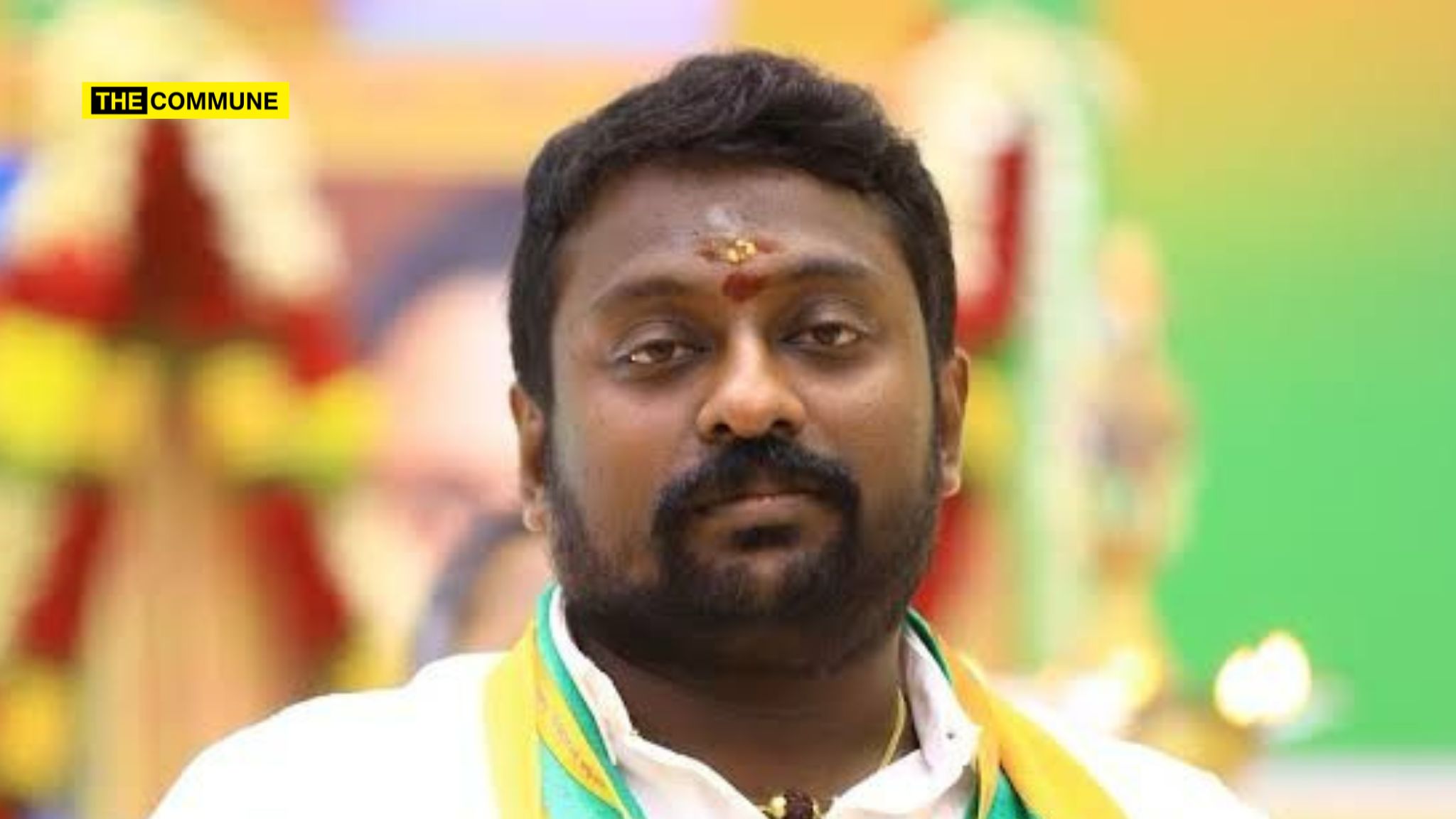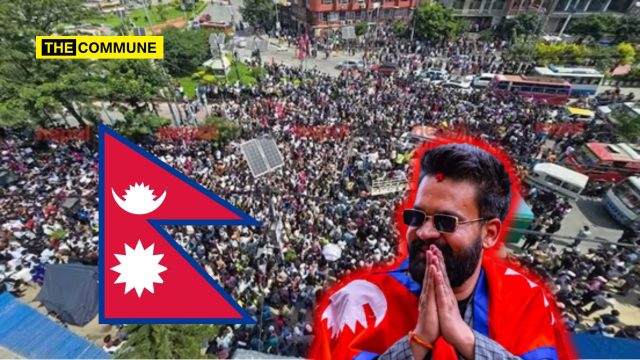
In the wake of a seismic GenZ-led protest movement that toppled the government of Prime Minister KP Sharma Oli and forced the resignation of President Ramchandra Paudel in Nepal, one figure has emerged from the chaos as both a symbol of hope and a subject of intense scrutiny: Balendra “Balen” Shah, the 35-year-old Mayor of Kathmandu. Once known for his incendiary rap lyrics, Shah now finds himself at the pinnacle of a youth-driven demand to lead the nation as interim Prime Minister.
His journey from a civil engineer and rapper to the most powerful independent politician in Nepal is a story of populist appeal, nationalist fervor, and allegations of foreign influence that has put the future of the Himalayan nation in a precarious balance.
From The Recording Studio To City Hall: The Rise Of A Populist
Balen Shah, was born on 27 April 1990, in Naradevi, Kathmandu, to a Newar Buddhist family of Maithil Madhesi origin. He currently serves as the 15th mayor of Kathmandu Metropolitan City. His father, Ram Narayan Shah, worked as an Ayurvedic practitioner, while his mother, Dhruvadevi Shah, was a homemaker who profoundly influenced his character and outlook. Balen Shah’s background is unconventional for a politician.
Shah attended V.S. Niketan Higher Secondary School for his 10+2 studies before pursuing a bachelor’s degree in civil engineering from Himalayan Whitehouse International College. He later obtained a master’s degree in structural engineering from Visvesvaraya Technological University (VTU) in Karnataka, India, establishing an educational connection with India that would later become part of his complex relationship with the neighboring country.
He first gained fame as a rapper, using his music as a vehicle for sharp social and political commentary.
His lyrics were direct attacks on the political establishment, with lines like, “All those who protect the country are fools. All the leaders are thieves, they are looting and eating the country.” Songs like ‘Balidan’ (Sacrifice) became anthems for a disillusioned youth, channeling widespread anger against corruption and ineffective governance.
In May 2022, leveraging this massive popularity, Shah ran as an independent candidate for the mayor of Kathmandu. In a stunning victory, he became the city’s first mayor to win without the backing of a major political party, a clear signal of the public’s thirst for an outsider. His campaign was not without controversy; he was accused of using a black blazer with the Nepali flag, a move that drew a complaint to the Election Commission but only served to bolster his anti-establishment image.
The GenZ Protests: Instigator Or Inspired Leader?
The events of September 2025 catapulted Shah from a local administrator to a national figure. The protests, initially sparked by a government ban on social media apps, were allegedly planned by Sudan Gurung, the founder of the NGO ‘Hami Nepal’. However, Balen Shah is widely seen as their primary promoter and beneficiary.
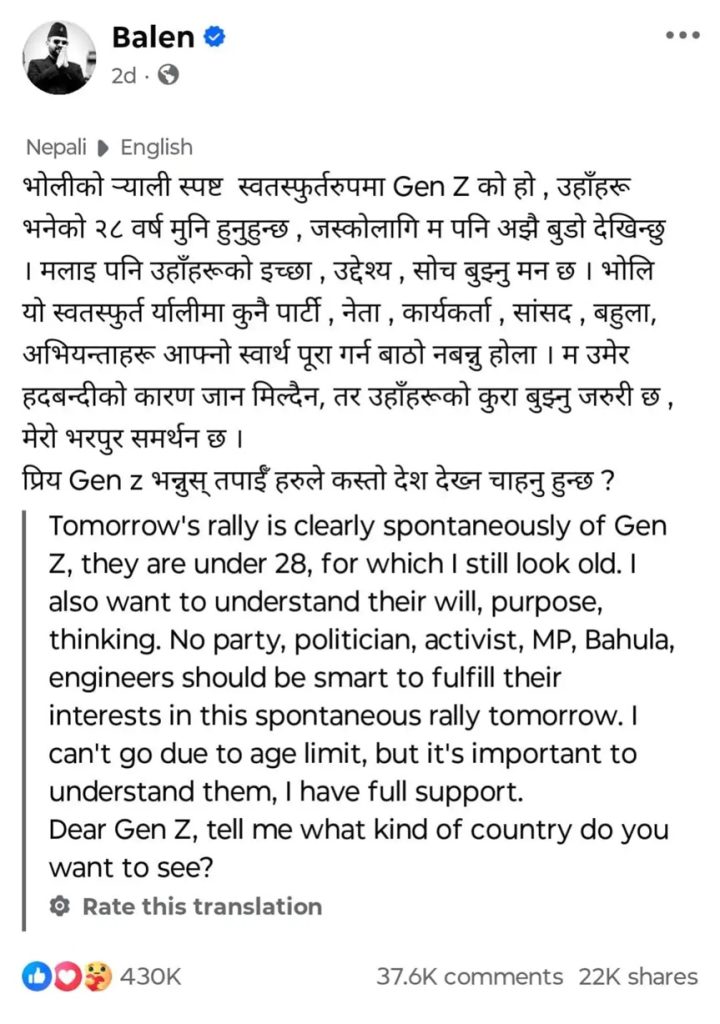
On 7 September 2025, Shah posted a pivotal message on Facebook expressing his “full support” for the planned GenZ demonstrations. He framed it as a spontaneous movement of the youth, cautioning established political parties against hijacking it for their own interests. While stating he could not attend due to the protesters’ age limit (under 28), his endorsement was a powerful catalyst.
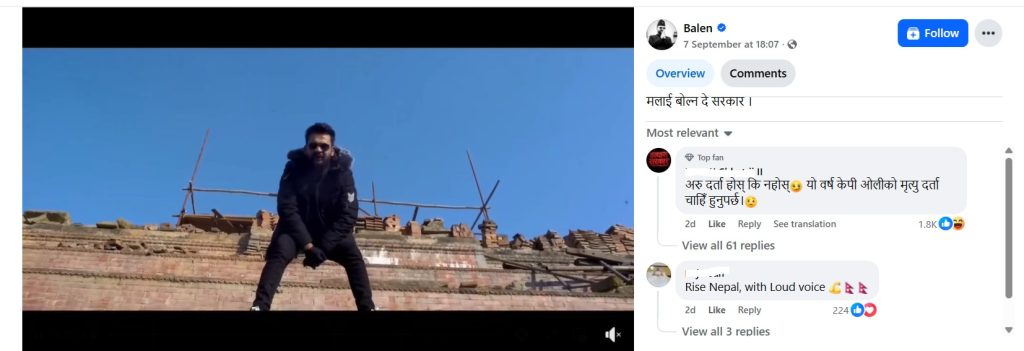
The following days saw massive, and later violent, protests across Nepal. As the demonstrations escalated from digital rights to demands for the government’s resignation, resulting in 19 deaths and over 300 injuries, Shah’s role evolved. His social media posts, including a repost of his anti-government song ‘Balidan’ with the caption “Sarkar mujhe bolne de” (Government, let me speak), were seen as fuelling the fire.
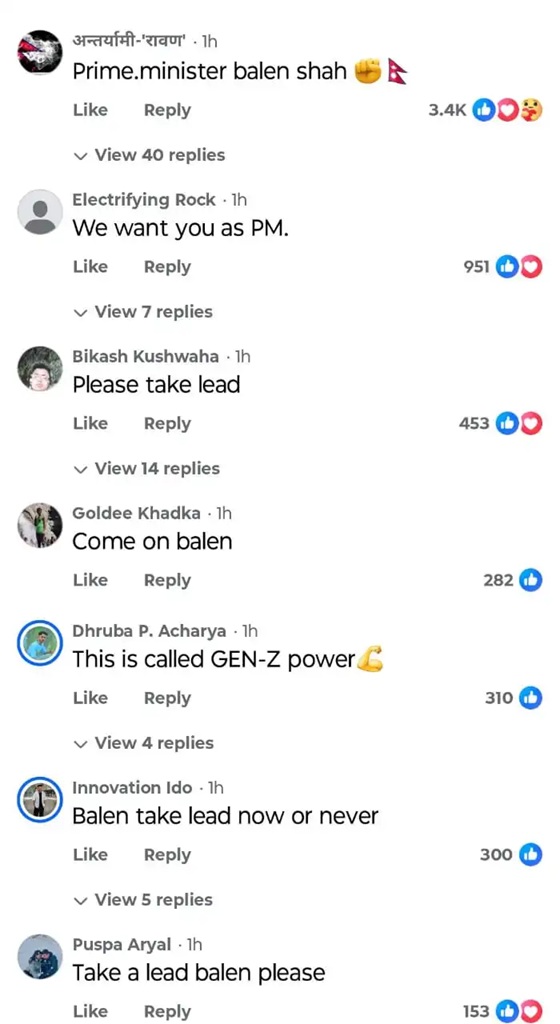
When the government fell on 9 September 2025, the chorus of support for Shah reached a fever pitch. His Facebook page was flooded with comments like “We want you as PM” and “Please take Lead Balen.”
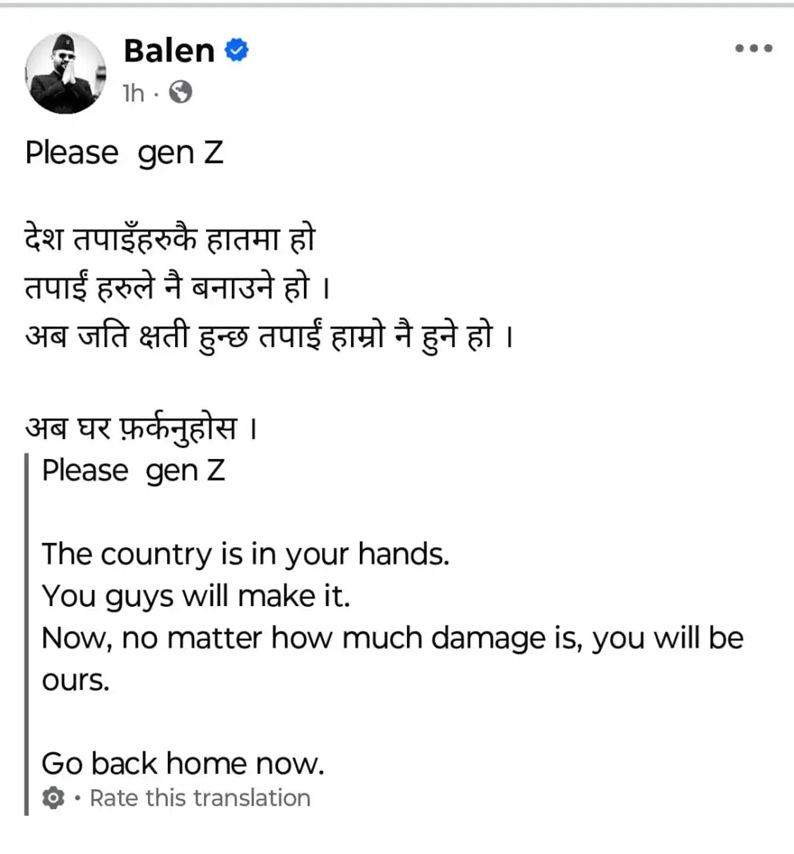
Local media began seriously touting him as the next Prime Minister. In a move to position himself as a statesman, Shah then appealed to the protesters, writing, “Please GenZ, the country is in your hands… Now, no matter how much damage happens, you will remain ours. Now go back home.”
A Complex Web Of Alleged Foreign Connections
Shah’s sudden rise to national prominence is shadowed by persistent questions about his international affiliations, with accusations pointing in two contradictory directions: towards both the United States and China.
Links To The United States:
Shah has maintained a visible and consistent relationship with the US Embassy in Nepal.
He first met US Ambassador Dean Thompson in 2022, with the ambassador sharing pictures of the meeting.
Great introductory meeting with Mayor of Kathmandu @ShahBalen yesterday. I particularly enjoyed discussing
the ways we can work together on cultural
preservation! pic.twitter.com/brEDyR7kq4— U.S. Ambassador Dean R. Thompson (@USAmbNepal) December 2, 2022
Reports emerged of another meeting in 2024 where the Ambassador Thompson reportedly invited Shah to visit America.
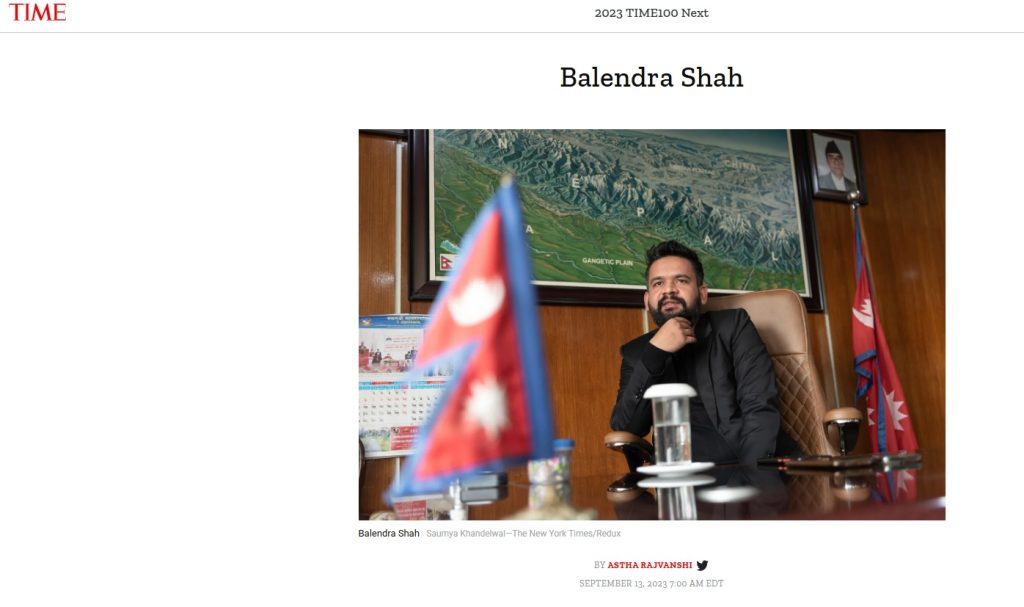
His recognition in international media, including being named in Time Magazine’s top-100 influential people of 2023 and coverage in The New York Times, is cited as evidence of his Western connections.
Links To China:
Conversely, Shah has also been accused of being an asset of Chinese intelligence (MSS).
Critics point to his frequent meetings with Chinese embassy staff and journalists before his mayoral election, alleging Chinese funding was instrumental in his victory.
However, on meeting Chinese ambassador Chen Song, he said: “The festivals celebrated by the citizens of #Nepal & #China can be similar, the dress and food can be similar & this relationship can be promoted at the civil level”, contrary to his Nepali existence dialogue.
8/9 pic.twitter.com/JOQYiq7GQ0— Nepal Correspondence (@NepCorres) June 9, 2023
In June 2023, he hung a controversial “Greater Nepal” map in his office that claimed parts of Indian territories (Uttarakhand, Himachal Pradesh, and Sikkim).
Nepal🚨 In response to the 'Akhand Bharat' mural in #India's new Parliament building, Kathmandu Mayor Balendra Shah has put up a new 'Greater Nepal' map in his office. pic.twitter.com/rMtEijGN2f
— OSINT Updates (@OsintUpdates) June 8, 2023
This move was widely celebrated and promoted by Chinese state-affiliated media handles on Weibo, who used it to criticize India.
On 9 June 23, a government Verified handle of "Communist China" was found promoting "Balen Shah's" Greater Nepal movement. Spitting venom on #BJP, the #CPC handle said: #India has the ambition to Annexe neighbors. Although #China has itself annexed #Tibet.
🔴Do Read Translation pic.twitter.com/BjBzvF3pTG
— Nepal Correspondence (@NepCorres) June 12, 2023
His policies as mayor, particularly a brutal crackdown on Kathmandu’s street vendors to make space for Chinese outlets, alienated his poor and middle-class support base and aligned with alleged Chinese interests.
– and what hurt the most to the Nepali community was that he ordered a brutal crackdown on Kathmandu’s poor street vendors and daily wage earners to make space for Chinese outlets. Many people lost their daily income and cursed Balen shah.
6/9 pic.twitter.com/oFK8K4dCYt— Nepal Correspondence (@NepCorres) June 9, 2023
Before the elections, he was often seen with #Chinese embassy staff and journalists in several restaurants, a typical cover, and practice of Chinese intelligence #MSS.
Who once talked about a common #Nepali people, caused havoc within less than a year of taking office.
4/9 pic.twitter.com/nPBG36pDJv— Nepal Correspondence (@NepCorres) June 9, 2023
Nationalist Agenda And Anti-India Stance
A consistent thread through Shah’s career is his vehement Nepali nationalism, which often manifests as anti-Indian sentiment.
In 2023, Balendra Shah announced that he called off his planned visit to China following the release of a new Chinese map on Monday, which depicts Limpiyadhura, Kalapani and Lipulekh – territories claimed by Nepal – as part of India.
His political stances include:
The Adipurush Ban: He threatened to ban Indian Bollywood films in Kathmandu over a dialogue in the film ‘Adipurush’ that referred to Sita as India’s daughter, only being overruled by Nepal’s Supreme Court.
The Map Controversy: The installation of the “Greater Nepal” map was a direct response to the “Akhand Bharat” mural in India’s new Parliament building, escalating a cartographic war between the two nations.
Rhetoric: He has consistently criticized Indian influence in Nepal, accusing Nepali institutions of being “Indian slaves” and protesting against what he terms “cultural intervention.”
⚡ Who is Balen Shah aka Balendra Shah and why do people consider him anti-India?
Popularly known as “Balen,” the 35-year-old is a rapper-turned-politician who has served as Kathmandu’s 15th mayor since May 2022. He won as an independent candidate, becoming the first to hold the… https://t.co/6vBAOmWXGL pic.twitter.com/N3cfb8p0q7
— OSINT Updates (@OsintUpdates) September 9, 2025
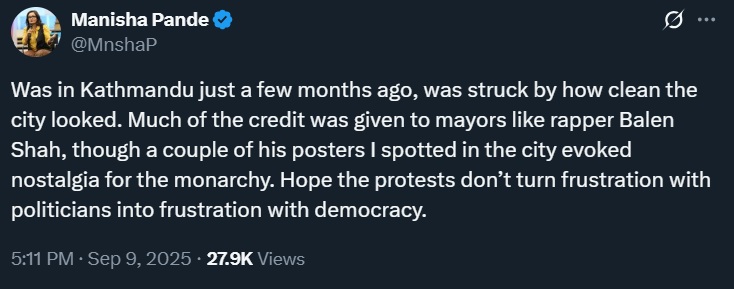
Interestingly, Newslaundry’s Manisha Pande praised his “administrative” capabilities because Kathmandu was very clean.
Controversies And Criticism As Mayor
Despite his populist image, Shah’s tenure as mayor has been fraught with controversy and accusations of hypocrisy and corruption. Critics allege:
He failed to resolve Kathmandu’s chronic solid waste management crisis despite promises, with accusations of misallocated funds. Funds for 250 public toilets and ambulances for the city were allegedly embezzled. His vow to remove illegal billboards turned into accusations of taking kickbacks from advertising companies.
𝐁𝐀𝐋𝐄𝐍 𝐒𝐇𝐀𝐇:
– Vowed to resolve Solid Waste Management but ate the allocated money
– Ate money allocated for 250 public toilets and ambulances for Kathmandu city
– Vowed to remove extra billboards but ended up taking kickbacks from advertising companies
5/9 pic.twitter.com/krsmwfPAb5— Nepal Correspondence (@NepCorres) June 9, 2023
Most damagingly, as mentioned above his crackdown on poor street vendors to allegedly accommodate Chinese businesses caused many to lose their livelihoods, leading to a significant backlash from his original support base.
Nepal: A Nation At Crossroads
Balen Shah stands at a historic juncture. To his supporters, he is the only incorruptible, strong leader who can break the cycle of failing traditional parties and represent the aspirations of Nepal’s youth. To his detractors, he is a dangerous populist, potentially manipulated by foreign powers, be it the West’s toolkit for regime change or China’s expansionist ambitions, whose nationalist rhetoric masks an agenda that is ultimately “anti-Nepal.”
The alliance between Sudan Gurung’s on-ground mobilization and Balen Shah’s charismatic promotion has proven potent enough to bring down a government. The question now is whether this partnership will succeed in installing Shah as Prime Minister and, if so, what direction a “Balen-led” Nepal would take. The world, and particularly regional powers India and China, are watching closely, aware that the stability of the entire region could be influenced by the rise of the rapper-turned-mayor who now dreams of leading a nation.
(With inputs from OpIndia)
Subscribe to our channels on Telegram, WhatsApp, and Instagram and get the best stories of the day delivered to you personally.