When writing history, it is essential that the author undertakes deep research into the subject, or at the very least possesses a sound familiarity with the historical and cultural landscape. When someone relies heavily on secondary sources, especially questionable ones, the result is often a half-baked work in which the underlying agenda becomes all too obvious. The article in The Print is one such example.
Written in the backdrop of the ongoing court case, the article attempts to portray Lord Ayyappa as merely a “local forest deity” who was later appropriated by the usual target of such narratives – “the Brahmins.” What is unfortunate is that the larger background, religious context, and historical evolution of the worship are completely ignored in order to sustain this superficial argument. The author also resorts to the familiar wordplay often seen in Dravidianist discourse: if the names are different, then the deities must be different. This is the standard line used to construct a theory of exceptionalism claiming, for instance, that Murugan is different from Karthikeya, Durga is different from Kotravai, and so on.
The very opening paragraphs of the article are riddled with factual errors. One striking example is the claim: “In Tamil Nadu, he is known as Ayyanar, and is more of a village protector-god.” Really? The deity has been known since ancient times as Shasta, and is worshipped under various names such as Ayyanar and Ayyappan. At its core, this is the worship of Shasta in different forms.
The name Shasta appears in Tamil sources from an early period, including Sangam literature. In fact, several Tamil poets bore names such as Saattan, which is the Tamil form associated with Shasta. To reduce Shasta merely to a “village protector-god” is therefore historically inaccurate. Shasta has been worshipped not only in village shrines, but also in major and urban temples. It is true that, over time, this form of worship became especially prominent in rural settings, but that does not define either its origin or its full historical character. The name itself is traditionally explained as “one who knows the many Shastras,” as noted by Adiyarkkunallar in his commentary on the Silappadikaram.
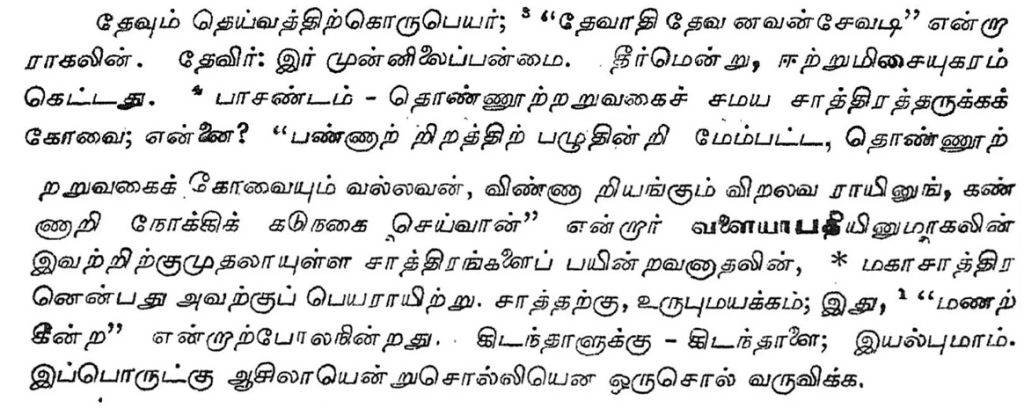
Definition of Shasta in Silappadhikaram commentary
The famous Kanchipuram Kamakshi Amman Temple also has a shrine for Shasta, and tradition holds that Karikala Chola worshipped there before embarking on his northern expedition. A well-known verse refers to this association.
கச்சி வளைக்கைச்சி காமகோட்டங்காவல்
மெச்சியினிதிருக்கும் மெய்ச்சாத்தன் கைச்செண்டு
கம்ப களிற்றான் கரிகாற்பெருவளத்தான்
செம்பொன் கிரிதிரித்த செண்டு.
Further, many Pallava temples had shrines dedicated to Shasta. Endowments made to Shasta temples were known as “Aiyan Bhogam,” and the administrators of such temples were called “Sattan Ganathar.” These details are attested in numerous inscriptions of the Pallavas, Cholas, and Pandyas. One such example is an inscription of Parthivendra Varman at the Uthiramerur Maha Shasta Temple. Significantly, the inscription uses both Ayyan and Shasta to refer to the same deity, clearly showing that these names were understood as referring to one and the same divine tradition.
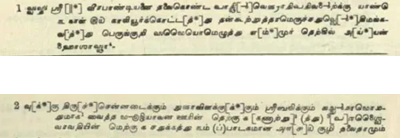
“Ayyan Mahashasta” says Parthivendravarman Inscription at Uttiramerur
Similarly, there is another inscription of Rajaraja I at Ukkal, dated to 1002 CE, which records grants made to the Mahashasta temple. It also notes that the transaction was registered in the presence of the Sattan Ganathar, the administrators of the temple.
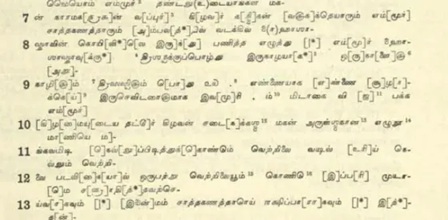
All this clearly establishes that Ayyanar/Shasta worship was not confined to village settings. Let us now turn to some of the other claims made in the article. It states: “Kalittokai, a compendium of early Tamil poems, mentions that Ayyan was revered by peasant chieftains called the Ay.”
This is again misleading. The Ay chieftains ruled parts of south Kerala from the Sangam age onward and cannot simply be reduced to “peasant chieftains.” They traced their lineage to the Yadavas said to have migrated from the north. They were also patrons of Vedic learning, Veda patasalas, and temples, as inscriptions such as the Parthivasekarapuram Copper Plates make clear. Therefore, even in the case of the Ay rulers, Ayyanar was not some marginal or folk deity detached from the Vedic framework; he was very much understood within that broader religious tradition.
Another line in the article claims that “the epic Silappadikaram mentions a hunter god known as Chattan and Ayyanar.” This is precisely the problem with writing from secondary sources without even undertaking basic primary verification.
Silappadikaram refers to Pashanda Sattan, who is described as one who knew the ninety-six shastras, hence the name, as noted earlier. Silappadhikaram mentions that Shasta was born as a Brahmin and did all the rituals for his parents.
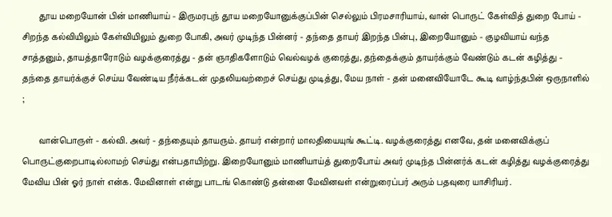
The text also states that there was a kottam, a temple for him, at Poompuhar, the great Chola port city. Where, then, does this “hunter god” interpretation come from? It is a reading imposed on the text rather than one grounded in it.
The article makes yet another factual blunder : “Ayyanar, on the other hand, is rarely mentioned in temple inscriptions in Tamil Nadu, as he had become a god of ‘lower’ castes, such as potters.” This is simply incorrect. The Kanyakumari inscription of Rajaraja I clearly refers to Shasta as a Vedic deity, without any ambiguity, and presents him as a deity worshipped within the mainstream religious fold. The inscriptional record does not support the simplistic caste-based reduction that the article attempts to impose.
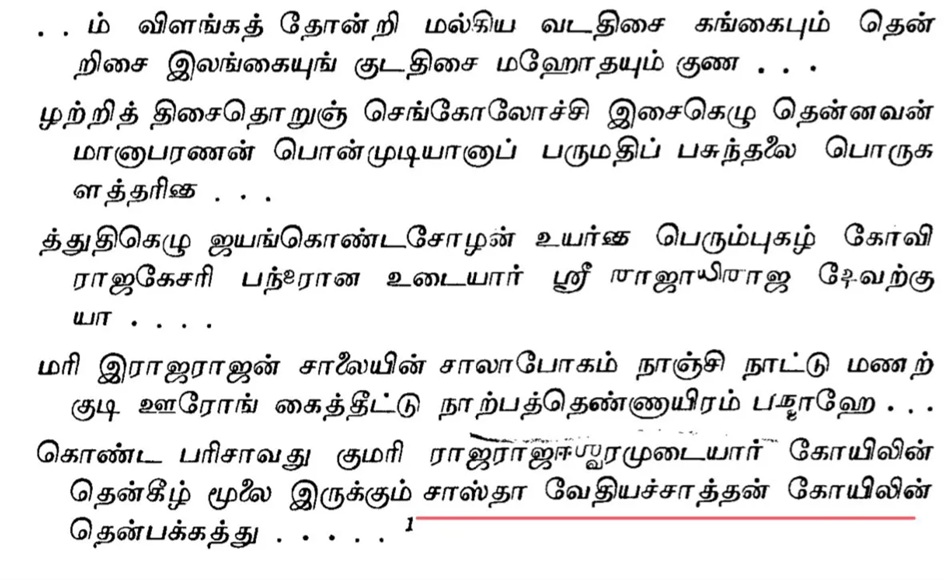
A blatant falsehood appears in the article’s claim that there is “a 13th century inscription from Srirangam attesting that a ‘Shudra-Devata’, probably Ayyanar, was installed by a Brahmin priest ‘to control erosion of the temple grounds and to prevent the interference of shudra elements by the river’.” The inscription is available in detail, and nowhere does it use the term “Shudra-Devata.”
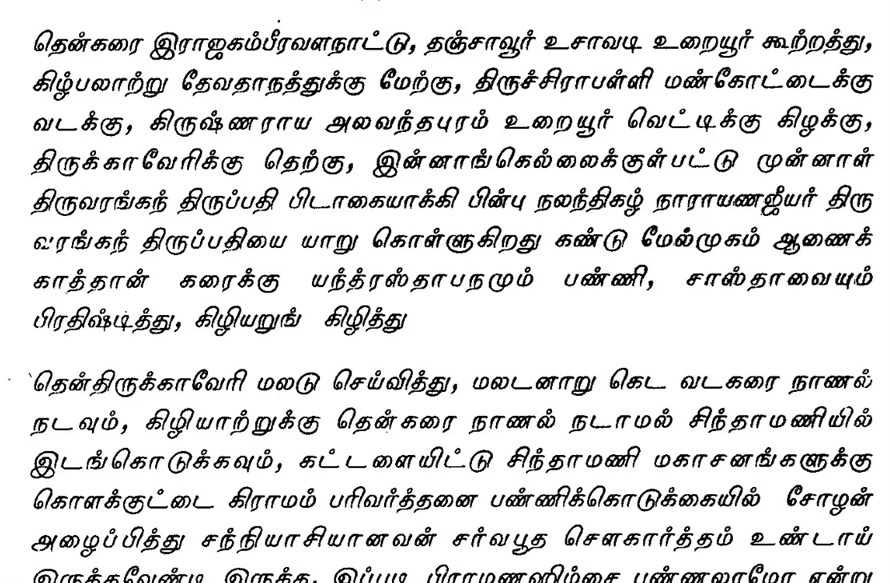
What it actually records is that, because the river repeatedly breached its banks, the Jeeyar performed the pratishtha of Shasta along with a yantra. That is all. This is precisely the level of “scholarship” on which the article is built: a meaning is invented and then passed off as epigraphic fact.
At one point, however, the author almost stumbles into reality by admitting: “Despite the divergence, Ayyanar and Ayyappa continued to influence each other. They share iconographic links.” In truth, Shasta, Ayyanar, and Ayyappan belong to the same deity tradition, with the same essential iconographic features. One would hardly find their vigrahas, right from the Pallava period onward, without the yajnopavita. As with many deities in Sanatana Dharma, the same god appears in different forms in different places according to local sthala puranas and devotional traditions.
Take Murugan as an example. At Palani, he is worshipped as Dandayudhapani; at Tiruchendur, as the divine warrior; at Tirupparankundram, in the context of his marriage to Deivayanai; and in many other temples, together with Valli and Deivayanai. In some places he is in a seated posture; in others, he stands. None of this means that the deity is different. The form varies; the deity does not.
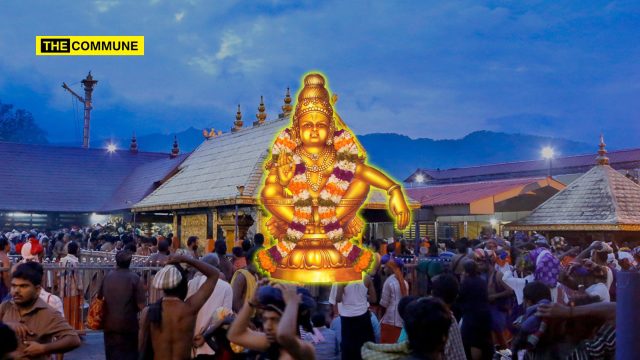
The same applies to Ayyanar/Ayyappan. He is worshipped in different forms in different temples. In many places, Ayyanar appears with his consorts Poorna and Pushkala. At Sabarimala, however, Ayyappan is worshipped as a brahmachari. Tradition associates this form with the later history of the region, including the movement of the Pandya line into Pandalam during the Chola–Pandya conflicts, and the belief that Ayyappan manifested there in that form. Accordingly, the temple came to worship him as a brahmachari, in keeping with that local sacred tradition. Yet, in the same Kerala, at places such as Aryankavu, the deity is worshipped together with Poorna and Pushkala. For anyone familiar with Sanatana Dharma, such variation is neither unusual nor contradictory; it is entirely natural within a living and layered sacred tradition.
There is therefore no justification for branding Ayyappa as merely a “tribal deity” simply because one form of Shasta is worshipped in a forest shrine. Ayyappa has, from the earliest period, been worshipped by people across social sections, and it is precisely this wide and unifying appeal that has made the temple a recurring target of controversy. The fact that the temple stands as a living symbol of Hindu unity is something that vested interests have found impossible to tolerate.
In sum, the article suffers not merely from a difference of interpretation, but from a serious weakness in method. It lifts selective claims from dubious secondary readings, ignores primary literary and inscriptional evidence, and then builds a sweeping argument on that fragile foundation. The result is a narrative that tries to detach Ayyanar/Ayyappan/Shasta from the broader civilisational and Vedic framework in which the deity has long existed. Tamil literary sources, temple traditions, and inscriptions from the Pallava, Chola, and Pandya periods all point in the opposite direction: Shasta was a well-established deity worshipped in major temples as well as village shrines, known by multiple names, and understood within a mainstream sacred tradition.
What we are really seeing here is an attempt to impose a modern ideological template upon a far older and more complex religious world. In that template, every local variation must be turned into a rupture, every difference in name into a different god, and every historical layer into a story of appropriation. But Sanatana Dharma has never functioned in such rigid compartments. The same deity can be worshipped in different forms, postures, and local traditions without losing essential continuity. To ignore this is not scholarship; it is distortion. A serious study of Ayyanar or Ayyappan must begin with the humility to read the sources in full, understand the tradition on its own terms, and resist the temptation to force history into a pre-decided ideological frame.
TS Krishnan is a Tamil scholar, historian and author.
Subscribe to our channels on WhatsApp, Telegram, Instagram and YouTube to get the best stories of the day delivered to you personally.