In the annals of ancient Tamil history, few figures embody the spirit of an era as vividly as Athiyaman Neduman Anji, the legendary king of the Sangam period. Ruling from his capital at Tagadur, identified with present‑day Dharmapuri in northern Tamil Nadu, Athiyaman stands as a testament to the valour, generosity, and cultural sophistication of the early Tamil kingdoms. His story, preserved in Sangam literature and corroborated by archaeological inscriptions, reveals a ruler caught between the ambitions of greater powers and his own commitment to protect his realm, even at the cost of his life.
The Athiyaman Dynasty: Ancient Pedigree and Imperial Recognition
The Athiyaman (also spelled Athiyan, Adhiyaman, or Adigaman) dynasty was one of the four major powers of ancient Tamilakam, the collective Tamil country, dating back to at least the 3rd century BCE. Their lineage was sufficiently prominent that the Maurya emperor Ashoka, in his famous edicts inscribed across India in the 3rd century BCE, mentioned them specifically as the “Sathiyaputhras“, meaning “Members of the Fraternity of Truth”, placing them on par with the three great Tamil kingdoms: the Cholas, Pandyas, and Cheras (Keralaputhras).
This recognition in Ashoka’s edicts is not mere ceremonial acknowledgment. It signals that the Athiyamans were recognized sovereigns with sufficient territorial extent and political weight to merit mention alongside the great imperial powers. The discovery of Tamil‑Brahmi inscriptions at Jambai in Tirukkoyilur, dating to the 1st century CE, confirmed that the “Sathiyaputhras” of Ashoka’s inscriptions were indeed the Athiyaman dynasty, ending scholarly debate and establishing their historical authenticity.
The dynasty’s seat was at Tagadur (modern Dharmapuri), a strategically important centre in the Mazhanadu region. Athiyaman’s territory stretched across what is now Dharmapuri, Krishnagiri, and Salem districts, a region of rolling hills and river valleys that commanded trade routes and agricultural wealth.
Athiyaman Neduman Anji: The Ruler
Athiyaman Neduman Anji or Athiyaman Neduman Anci, as the name appears in various Tamil literary sources, emerged as the most celebrated ruler of this dynasty, earning his place among the Kadai Ezhu Vallals (literally, “the last seven great patrons”), an elite circle of the most generous and powerful rulers of the Sangam age.
His reign, placed in the 1st century CE on the basis of literary, numismatic, and archaeological evidence, was marked by continuous conflict, diplomatic alliance, and a principled stand against imperial aggression. Though his kingdom was smaller than those of the Cholas or Cheras, Athiyaman commanded respect through his warrior prowess, his patronage of the arts, and his refusal to bend before larger powers.
Warrior King and Military Reputation
Athiyaman was, above all, a hardened warrior. The poet Avvaiyar, his contemporary and close associate, eulogised him in the Purananuru (an anthology of Tamil poems celebrating valiant kings) as: “Enemies! take care, when you enter the field of battle, Among us is a warrior, who is like a chariot wheel, made painstakingly by a carpenter, who tosses off eight chariots in a day!”
This is not poetic hyperbole alone but a reflection of his military renown. Athiyaman was a commander who led from the front, his weaponry worn and scarred from constant use – a sign of genuine battle experience, not ceremonial rule.
The War with Malaiyaman Thirumudi Kari (118 CE)
In 118 CE, Athiyaman faced a significant challenge when Malaiyaman Thirumudi Kari, another of the Kadai Ezhu Vallals, waged war on Tagadur. Kari’s ambition was grand: he sought to overturn the existing power balance and establish himself as an emperor of the stature of the Cholas. What drove him to Tagadur is not entirely clear, but the prize was the fortress town itself and control of the strategic Mazhanadu region.
In the fierce battle that followed, Athiyaman defeated Kari and seized Kovalur, a strategically important settlement. Though Kari would later regain Kovalur with the help of the Chera emperor Peruncheral Irumporai, Athiyaman’s victory demonstrated that despite his smaller army, his tactical acumen and courage could match more powerful rivals.
The Great Patron: Athiyaman and Avvaiyar
If Athiyaman’s martial prowess defined his public image, his patronage of the celebrated poet Avvaiyar reveals the depth of his character and his commitment to Tamil culture and letters. Avvaiyar, a poet of immense stature in the Sangam literary tradition, was not merely a court poet but a political and moral counsellor to kings. Her association with Athiyaman speaks volumes about the intellectual climate he fostered.
The relationship between king and poet has been preserved in Tamil literary accounts with touching detail. When Avvaiyar first visited Tagadur, Athiyaman was so charmed by her that he deliberately delayed presenting her with gifts, a customary royal gift to visiting poets in order to prolong her stay. Avvaiyar, initially not understanding this game, grew angry and condemned him in verse. When she later realized his true motive, her indignation turned to deep affection, and she made the decision to remain at his court as a close friend and counsellor.
On one memorable occasion, Athiyaman presented Avvaiyar with a rare gooseberry (nelli fruit), which was believed in ancient Tamil medicine to enhance longevity. His gesture was laden with meaning: he was ensuring that Avvaiyar would live long so that her literary genius and, through her, Tamil literature itself, would endure. The gift encapsulates Athiyaman’s understanding that a king’s true legacy rests not in conquest alone but in the patronage of culture.
Diplomacy in a Turbulent Age
Athiyaman lived in one of the most volatile periods of Sangam history. The rise of the great Chera emperor Peruncheral Irumporai cast a long shadow over the smaller kingdoms. Sensing the threat, Athiyaman pursued a strategy of alliance rather than isolated defiance.
He sent Avvaiyar as an envoy to the court of Ilantiraiyan, a Chola viceroy at Kanchi (Kanchipuram). The diplomatic mission was a calculated gambit: by aligning with the Chola power, Athiyaman hoped to create a counterweight to Chera aggression. Avvaiyar’s visit was successful; she was received with great ceremony by Thondaimān, the king of Thondai Nadu, who proudly displayed his archery prowess to her.
Avvaiyar, however, did not abandon her loyalty to her patron. When Thondaimān boasted of his weapons and martial skills, Avvaiyar cleverly deflected his advances with a subtle but cutting observation: his weapons gleamed because they had never seen blood, whereas Athiyaman’s arsenal was worn and scarred from countless wars. The implication was clear – Athiyaman’s experience and tested courage far exceeded mere display.
The Fall of Tagadur and Athiyaman’s Last Stand
Despite his alliances, Athiyaman could not stem the tide of Chera expansion. The great Chera emperor Peruncheral Irumporai (also known as Peruñcēral Irumporai), one of the most powerful rulers of the era, set his sights on Tagadur. The final conflict was inevitable.
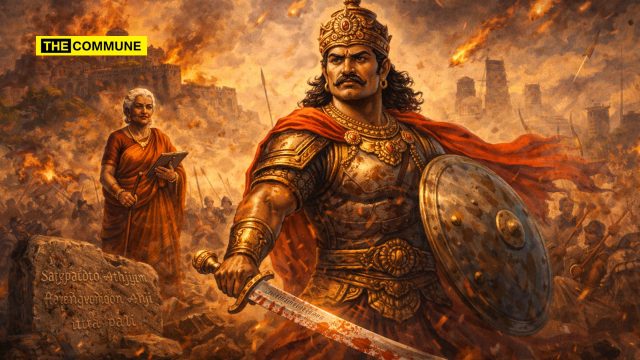
In the decisive Battle of Tagadur, Athiyaman, despite commanding a much smaller army, decided to fight rather than surrender or flee. He led his troops personally from the front, embodying the Sangam ideal of a king who shares the dangers of his soldiers. The battle was fierce and prolonged, as documented in the poetic work “Tagadur-Yāttarai” (The Song of the Tagadur Battle), composed by AricilKilār, the war bard of Peruncheral Irumporai himself.
In the end, Athiyaman fell in battle, fighting to the last for his kingdom. His defeat was not shameful; it was the death of a warrior. So great was the respect for his valour that even his enemy’s own court poet, AricilKilār, composed verses honouring Athiyaman’s heroic stand. In Sangam tradition, this was the highest tribute to be eulogised by the enemy’s own bard meant that one’s valour transcended partisan loyalty.
Avvaiyar’s Grief and Legacy
The death of her king and dear friend devastated Avvaiyar. She composed a series of elegies for him, preserved in the Purananuru, that express both her personal loss and her recognition of his greatness. One particularly poignant excerpt captures her anguish:
“If he had a little liquor, he would give it to us – Where is he now?
…If he had even a little rice, he shared it in many plates – Where is he now?
He gave us all the flesh on the bones – Where is he now?
Wherever spear and arrows flew, he was there – Where is he now?
…Father, mainstay, king – Where is he now?”
Yet Avvaiyar’s elegies are not mere laments. They also assert the eternal nature of Athiyaman’s fame. In another verse, she proclaims: “The fame of our sun‑like king, his white umbrellas cool as the moon, will not blacken, will not die!”
In this affirmation, we see the Sangam understanding that a king’s true immortality lies in the memory of his deeds and the affection of his people, preserved and transmitted through literature.
Historical Evidence and Archaeological Confirmation
The stories of Athiyaman and Avvaiyar, while rooted in Sangam literature, have been corroborated by archaeological discovery. The Tamil‑Brahmi inscriptions found at Jambai (Tirukkoyilur taluk, Viluppuram district) explicitly mention: “Satyaputō Athiyan Nedumān Añji itta Pali” – (The abode given by Athiyan Nedumān Añji, the Satyaputō)
These inscriptions, dated to approximately the 1st century CE, confirm that Athiyaman was not a mythical figure but a historical ruler who endowed religious and public structures. The fact that his name appears with the Mauryan title “Satyaputro” (a variant of Sathiyaputhra) demonstrates that he held the same status as rulers recognized by the Maurya empire itself.
Later Athiyamans and the Dynasty’s Continuation
Though Athiyaman Neduman Anji is the most celebrated, the Athiyaman dynasty did not end with him. Later rulers continued to govern portions of the Kongu and Arcot regions. In the 12th and 13th centuries CE, when the Chola empire had entered its decline, rulers like Vidukathazhagiya Perumal and Rajaracha Athiyaman commanded significant territories encompassing parts of modern Arcot, Tiruchchengode, and Salem districts – areas that stretched into Andhra Pradesh (Chittoor region).
However, the rise of the Hoysala empire in the Deccan eventually eroded the Athiyaman kingdom’s independence. By the late 13th century, with Vidukathazhagiya Perumal (ruled under Chola overlordship around the time of Kulottunga Chola III), the Athiyaman lineage lost its last foothold. After his reign, the dynasty faded from the historical record, though memory of its earlier glories persisted in Tamil literary tradition.
The Significance of Athiyaman’s Rule
What emerges from a study of Athiyaman Neduman Anji is a portrait of a Sangam‑age ruler who embodied the highest ideals of his time: martial prowess coupled with patronage of letters, strategic acumen balanced with honour, and a commitment to protecting his people even at the cost of his life. Unlike some of his contemporaries who sought to expand empires through relentless conquest, Athiyaman defended what was his, and in defending it, he achieved a kind of immortality that conquest alone could never grant.
His friendship with Avvaiyar, documented in both literature and, as historians have now confirmed, in the historical record, provides a model of the relationship between political power and cultural refinement. A ruler could be powerful, but his true legacy rested in the poets he protected and the literature they produced in his honour.
The inscriptions bearing his name, the poems eulogising his courage, and the memory of his generosity preserved in Tamil literary tradition ensure that Athiyaman remains a defining figure of the Sangam age. In the landscape of ancient Tamil Nadu, from Tagadur to the valleys of Krishnagiri and Salem, his name echoes as a reminder that greatness is not measured only in the size of one’s army or the extent of one’s territory, but in the respect one commands and the culture one nurtures.
DMK Govt’s Attempt To Erase Athiyaman’s Legacy
The removal of Athiyaman Neduman Anji’s name from the Yercaud hairpin bend is not an isolated administrative act; it reflects the ideological instinct of the DMK. E.V. Ramasamy repeatedly mocked and abused Sangam literature, including works like Silapathikaram, dismissing them as regressive and unworthy of reverence. It is therefore no coincidence that a Sangam-era king, praised by Avvaiyar and acknowledged in Ashokan records, is pushed out to make space for an icon who showed open contempt for Tamil civilisational texts. The DMK’s claim of safeguarding Tamil identity rings hollow when its actions systematically sideline ancient Tamil rulers. Athiyaman defended Tamil land with his life and preserved Tamil culture through patronage. Replacing his memory with that of someone who derided is a matter of shame for the DMK. Tamils will not and should not forgive.
Subscribe to our channels on Telegram, WhatsApp, and Instagram and get the best stories of the day delivered to you personally.