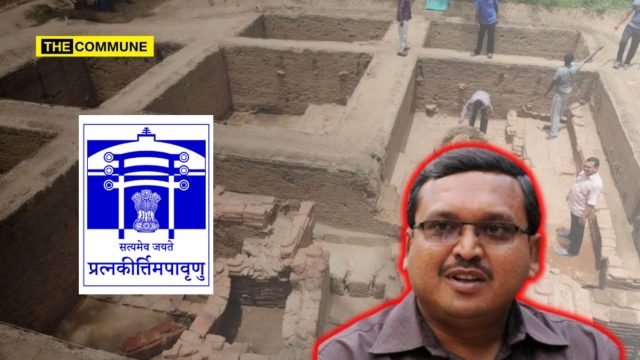
The Archaeological Survey of India (ASI) has issued a detailed and sharply critical evaluation of the Keeladi excavation report submitted by archaeologist K Amarnath Ramakrishna, describing it as “ambiguous, incomplete and underdeveloped.”
In a 114-page internal review prepared by a five-member expert committee, the ASI identified serious shortcomings across all 11 chapters of the report, including structural ambiguity, incomplete citations, weak methodological explanations, and insufficient linkage to broader South Asian archaeological contexts. The review stated that the report blends historical background, literary references and research gaps without clear thematic separation, reducing analytical clarity and scholarly utility.
The evaluation also questioned key claims made by Ramakrishna, particularly his assertion that Keeladi represents a “uni-cultural site” with continuous cultural evolution. The ASI said this interpretation was inconsistent with stratigraphic evidence and variations in material culture documented in the excavation. It flagged the term “uni-cultural” as undefined and criticised over-generalisation and incomplete analysis. The committee recommended revising terminology, integrating stratigraphic and material data more rigorously, and conducting further scientific tests to align conclusions with the archaeological record.
The ASI review comes after DMK MPs raised the delay in publishing the Keeladi report in Parliament. Responding on 19 December 2025, Union Culture Minister Gajendra Singh Shekhawat said the delay stemmed from unresolved academic deficiencies and warned against what he described as the “politicisation of an incomplete scientific document.”
Concerns Earlier Flagged By Ministry
The latest critique follows earlier concerns flagged by the ministry in July 2025, when Shekhawat told Parliament that experts had identified multiple omissions and errors in the report. These included flawed periodisation, inaccuracies in maps and drawings, inadequate stratigraphic representation, and insufficient technical detail. He clarified that the ASI had not sought a revised report from the Tamil Nadu State Archaeology Department and reiterated that all findings must pass established scientific and legal scrutiny.
Shekhawat further stated that experts disputed the dating of Keeladi’s earliest cultural layer to the 8th–5th century BCE, arguing that the chronology was not sufficiently substantiated. He said the ASI had suggested re-examining the timeline using more precise methods such as accelerator mass spectrometry and improving sampling depth and layer marking for comparative analysis. The minister emphasised that neither the excavation nor the report had been rejected, but both remained under expert review.
Beyond official assessments, several independent archaeologists have also raised concerns. Scholars questioned whether Tamil-Brahmi inscriptions found on pottery sherds could be reliably dated to the proposed period, citing unclear stratigraphic documentation. Others cautioned against drawing broad historical conclusions from limited carbon-dating samples, noting that such methods date organic material, not associated artefacts like pottery or inscriptions.
Officials from the Tamil Nadu Archaeology Department have acknowledged that a truncated version of findings was released earlier following judicial concern over delays, potentially leaving out contextual data normally required for expert validation.
ASI Flagged Earlier Report Submitted In 2023 As Well
In May 2025, the Archaeological Survey of India (ASI) returned a 982-page excavation report submitted by archaeologist K. Amarnath Ramakrishna in January 2023, citing the need for technical revisions. The ASI raised concerns over dating estimates (like the proposed 8th–5th century BCE timeline), stratigraphic inconsistencies, mapping, and terminology.
However, instead of addressing these expert critiques and making the necessary clarifications, Ramakrishna stood his ground, defending his methodology based on stratigraphy and radiocarbon dating. This defiance has sparked suspicion. Since his excavation efforts began, Ramakrishna has increasingly aligned himself with the Dravidianist separatist discourse such as Dravidar Kazhagam platforms, often amplifying their narrative through their platforms. Rather than allowing the data to speak through rigorous peer-reviewed publication, he has been seen leveraging this issue to promote a politicized Dravidianist agenda, frequently taking aim at well-established frameworks like the Harappan civilization, and in the process, undermining academic objectivity.
Source: Times of India
Subscribe to our channels on WhatsApp, Telegram, Instagram and YouTube to get the best stories of the day delivered to you personally.