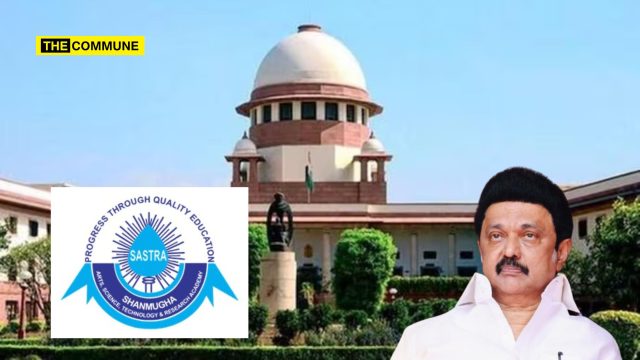
The Supreme Court on Thursday, 15 January 2026, stayed an order of the Madras High Court that had permitted the eviction of Shanmugha Arts, Science, Technology & Research Academy (SASTRA) from government land in Thanjavur, Tamil Nadu, observing that due consideration must be given to the fact that the land in question is being used for the cause of education.
A Bench comprising Justice Surya Kant, Justice Joymalya Bagchi, and Justice Vijay Bishnoi was hearing SASTRA’s challenge to the Madras High Court judgment which had dismissed the university’s plea against a government order rejecting its offer of alternate land for setting up a prison and a subsequent eviction notice issued by the Tahsildar, Thanjavur.
Senior advocates Mukul Rohatgi and C S Vaidyanathan, assisted by advocate Ronak Shankar Agarwal, appearing for SASTRA, argued that the university had made three separate offers of alternate land to the State to facilitate the proposed open-air prison project. They also submitted that the State had attempted to take possession of the land when the campus housed over 5,000 female students, raising serious safety concerns.
Appearing for the State of Tamil Nadu, senior advocate Rakesh Dwivedi contended that if SASTRA’s plea were accepted, it would set a precedent enabling every encroacher on public land to demand that the government accept alternate land instead of enforcing eviction.
Responding to this argument, the Chief Justice observed that the present case stood on a different footing. He noted that the land was being used for education and not for commercial activity. “Had it been a case of a factory or a commercial institution, we could have appreciated that you know – you have already made money out of an illegally encroached land. They (petitioners) are an (educational) institution,” the CJI remarked. He further added, “They are giving you three options; as a State, you should also promote educational institutions. How many States have been able to establish educational institutions?”
In light of these observations, the Court permitted the university to submit a fresh proposal to the State Government. Passing an interim order, the Bench directed maintenance of status quo on the subject land and recorded: “We therefore permit the petitioners to submit a fresh proposal to the State Government with respect to all three options. We expect the State of Tamil Nadu to consider the three options sympathetically and take an appropriate decision by ensuring that no … is caused to the public.”
The Court also indicated that a High-Powered Committee could be constituted to examine the proposals and clarified that, “pending such exercise, the institution shall be allowed to carry out its activities without any hindrances.”
Background of the Dispute
The controversy relates to 31.37 acres of government land in Thirumalaisamuthiram Village, Thanjavur district, which SASTRA is alleged to have encroached upon in 1985. The land had been allotted to the Prison Department for establishing an open-air jail, but the project could not be executed due to the university’s occupation.
Eviction proceedings were initiated under the Tamil Nadu Land Encroachment Act, 1905. A final notice was issued, and the university was given an opportunity to voluntarily remove the superstructures. SASTRA challenged the proceedings through multiple rounds of litigation, including writ petitions, statutory appeals before the Revenue Divisional Officer, review proceedings before the District Revenue Officer, and further appeals before the Special Commissioner and Commissioner of Land Administration, all of which ultimately went against the university.
In earlier writ proceedings, a direction was issued to assign the encroached land to the university, but the State succeeded in appeal, with the Revenue Department being directed to evict SASTRA. The university’s request to offer alternate land in lieu of the encroached area was rejected, and a special leave petition filed before the Supreme Court was dismissed with liberty to seek an appropriate remedy before the competent forum.
Acting on this liberty, SASTRA again approached the State with a representation for alternate land, which was rejected, leading to the issuance of the eviction notice challenged before the Madras High Court. A Division Bench of the High Court, comprising Justices SM Subramaniam and C Kumarappan, upheld the eviction, observing that the issue had been repeatedly litigated and that courts could not interfere with a policy decision of the government by reopening claims of encroachers.
The Supreme Court’s interim stay has now put the eviction on hold, pending reconsideration of SASTRA’s fresh proposals by the State Government.
Source: LiveLaw
Subscribe to our channels on Telegram, WhatsApp, and Instagram and get the best stories of the day delivered to you personally.