


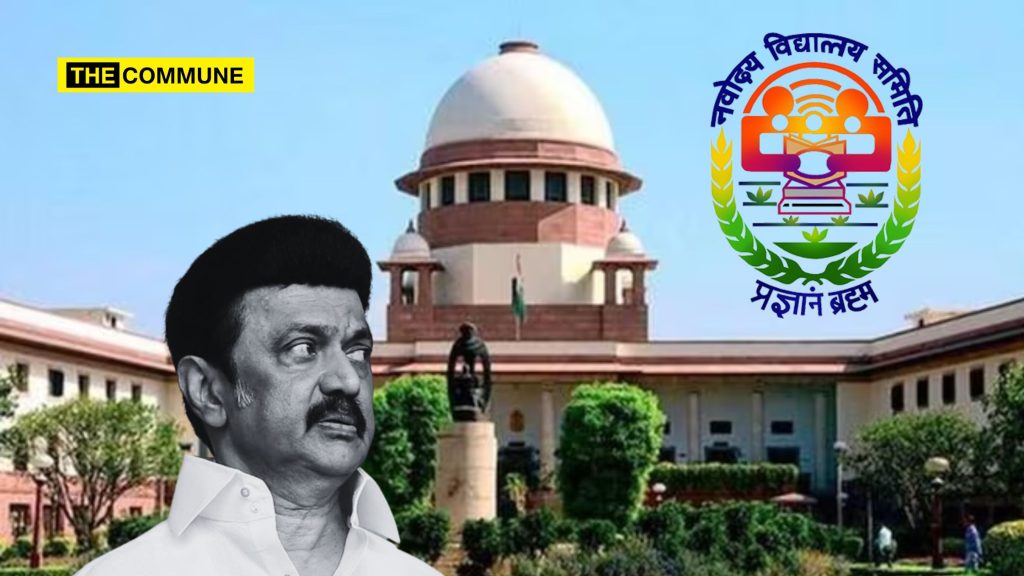
The Supreme Court on Monday, 15 December 2025, questioned the DMK government in Tamil Nadu on its continued opposition to the establishment of Jawahar Navodaya Vidyalayas (JNVs) in every district, observing that such resistance to a Central education scheme was “not in the spirit of federal cooperation” [The State of Tamil Nadu vs. Kumari Maha Sabha].
A Bench of Justices BV Nagarathna and R Mahadevan was hearing the DMK government’s appeal challenging a Madras High Court judgment that had directed the State to set up Navodaya Vidyalayas in every district.
During the hearing, the Court took exception to the State’s position when it was informed that one of the grounds for opposing the scheme was the alleged imposition of Hindi. The Bench asked the State to refrain from turning the issue into a political or linguistic dispute and instead focus on student welfare.
“We are federal society. Don’t convert this into a language matter. Don’t suppress an opportunity for rural students,” the Court told the State.
When the State’s counsel complained of Central “imposition” of schemes, Justice BV Nagarathna reminded Tamil Nadu of its constitutional position within the Union.
“Are you not part of our Republic?” she asked.
The Bench observed that education falls under the Concurrent List and that the Central government’s scheme was aimed at improving educational access and standards.
“There is nothing wrong in the Central government wanting to invest in education. Only meritorious students are admitted there. Why do you resist schools? Education is in the concurrent list. This is enhancing standards,” Justice Nagarathna said.
Senior Advocate P Wilson, appearing for Tamil Nadu, argued that the State had serious objections to the Navodaya Vidyalaya scheme. He submitted that the Navodaya model required the State to provide 30 acres of land in every district and to maintain the schools for three years.
The Bench questioned the basis of the resistance and asked why Tamil Nadu was opposing a scheme meant to expand educational opportunities.
Wilson responded that Tamil Nadu already possessed a strong public education infrastructure and followed a two-language policy under a State law. He said the Navodaya Vidyalaya scheme envisaged a three-language formula, which conflicted with the Tamil Nadu Tamil Learning Act, 2006.
The Court cautioned against politicising the issue.
“Don’t bring in politics into this. You are coming in the way of providing education to meritorious students. What is wrong in having more schools?” Justice Nagarathna demanded.
Wilson maintained that the scheme gave States the option to accept or reject participation and asserted that Tamil Nadu’s educational standards were higher than those of Navodaya Vidyalayas.
The Bench, however, appeared unconvinced.
When Wilson reiterated that Tamil Nadu’s refusal was rooted in its language policy, Justice Nagarathna said the matter could not be reduced to language politics.
“Why this mental block? If economically backward students are given the opportunity, why are you preventing that?” she asked.
Wilson argued that the State could not be compelled to provide land or financial support for a scheme that conflicted with its policies.
“They want to impose Hindi on us,” he said.
Justice Nagarathna responded that while the State’s language law would be respected, it could not be used to deny children educational opportunities.
“If you have a language policy, you say so, we will modify the scheme accordingly. But don’t suppress an opportunity for rural students,” she said.
The Court noted that the Union government had already sanctioned 650 Navodaya Vidyalayas across the country, with Tamil Nadu being the only State that had not cooperated.
Accordingly, the Bench directed Tamil Nadu to identify land required for establishing Navodaya Vidyalayas in each district within six weeks.
“We modify the interim order of stay granted by this Court on 11 December 2017 by directing the petitioner-State to identify the requisite extent of land necessary for establishing a Navodaya Vidyalaya in each district. The said exercise shall be carried out within a period of six weeks and a status report shall be placed before this Court,” the order said.
The Court clarified that its directions were limited to initiating the process and did not amount to enforcing the entire scheme.
“We are just asking for an exercise. We are not laying any foundation stone today,” Justice Nagarathna said.
Wilson insisted that the State could not be compelled to provide resources for a Central scheme, adding that the Union government still owed Tamil Nadu ₹3,548 crore under another education programme, the Samagra Shiksha Abhiyan.
Justice Nagarathna said such disputes should be resolved through dialogue rather than confrontation.
“We are a federal society. You discuss all this with them. Don’t convert this into a language matter. If you come one step forward, they will also come one step forward,” she said.
Wilson reiterated that the Navodaya system amounted to thrusting the Hindi language on Tamil Nadu.
Justice Nagarathna clarified that the Court was not adjudicating on the language issue.
“We have said nothing on the language. There can’t be such an adversarial attitude. This is in the interest of the students,” she said.
The Court then directed representatives of the Tamil Nadu government and the Union Ministry of Education to hold consultations on implementing the scheme and posted the matter for further hearing after six weeks.
In its earlier judgment, the Madras High Court had held that Navodaya Vidyalayas did not violate the Tamil Nadu Tamil Learning Act and that the State’s blanket refusal curtailed students’ right to choose educational institutions. It had directed the State to provide temporary accommodation for 240 students in each district within two months.
Tamil Nadu subsequently approached the Supreme Court, asserting that education policy fell within its exclusive domain and that its two-language policy was incompatible with the Navodaya model.
Justice Nagarathna concluded the hearing with a call for cooperation rather than confrontation.
“You can’t say ‘my State, my State’. This is a federal country. Don’t lose this opportunity. It’s an opportunity for your students,” she said.
Source: Bar and Bench
Subscribe to our channels on WhatsApp, Telegram, Instagram and YouTube to get the best stories of the day delivered to you personally.