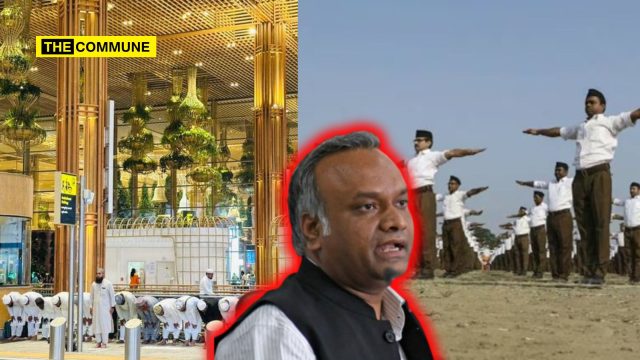
A video of a group of men offering namaz just outside the entrance gate to Terminal 2 at Kempegowda International Airport (KIA) has sparked a debate, putting a spotlight on the Karnataka government’s own guidelines for religious activities in public spaces.
The incident, which occurred near Gate 3 in the terminal’s drop-off area, shows the prayer proceeding with Central Industrial Security Force (CISF) personnel stationed nearby. The visual quickly went viral on social media, drawing public attention to the use of a high-security airport zone for a religious gathering.
How is this even allowed inside the T2 Terminal of Bengaluru International Airport?
Hon’ble Chief Minister @siddaramaiah and Minister @PriyankKharge do you approve of this?Did these individuals obtain prior permission to offer Namaz in a high-security airport zone?
Why is it… pic.twitter.com/iwWK2rYWZa— Vijay Prasad (@vijayrpbjp) November 9, 2025
Sources at Bangalore International Airport Limited (BIAL) confirmed the authenticity of the video but clarified that the prayers were offered outside the main terminal gate, in a public access area. They also pointed out that the airport already has a multi-faith prayer room inside the terminal, accessible to passengers of all religions. BIAL has so far declined to issue an official comment.
An officer from the KIA Police Station stated that no formal complaint had been received regarding the incident and added that the location technically does not fall under their direct jurisdiction.
A Question of Rules and Consistency
Priyank Kharge had formally urged Chief Minister Siddaramaiah to impose a ban on all activities conducted by the Rashtriya Swayamsevak Sangh (RSS) in government institutions and public premises across the state. In a letter dated 4 October 2025, Kharge contended that such activities go against India’s unity and the constitutional spirit.
Calling for firm government action, Kharge urged that a ban be imposed on all RSS activities, whether under the name of ‘shakha’, ‘sanghik’, or ‘baithak’. He specified that the ban should cover government schools, government-aided schools, public playgrounds, parks, temples under the Muzrai Department, sites under the Archaeology Department, and all other government premises.
The namaz incident has reignited discussion on the state’s own rules for public gatherings – rules which Minister Priyank Kharge himself had recently cited in a separate context. Kharge had emphasized that government guidelines require prior permission for any religious activity or gathering held on public or government property.
However, applying that same logic to the current incident raises several questions:
How did a group of people manage to perform prayers in a restricted airport security zone? Did they have clearance from authorities?
Why were security personnel, tasked with maintaining protocol, merely bystanders during the act?
If the rule of prior permission applies universally, does it extend equally to all religious practices in public or sensitive spaces?
Minister Kharge had earlier said, “Airports already have prayer rooms for all religions. If someone wants to pray, they can do it there.” His own statement exposes the irony of the current situation: when designated spaces already exist, what justifies performing prayers in active public areas, especially under the watch of central security forces?
(Source: Indian Express)
Subscribe to our channels on WhatsApp, Telegram, Instagram and YouTube to get the best stories of the day delivered to you personally.