


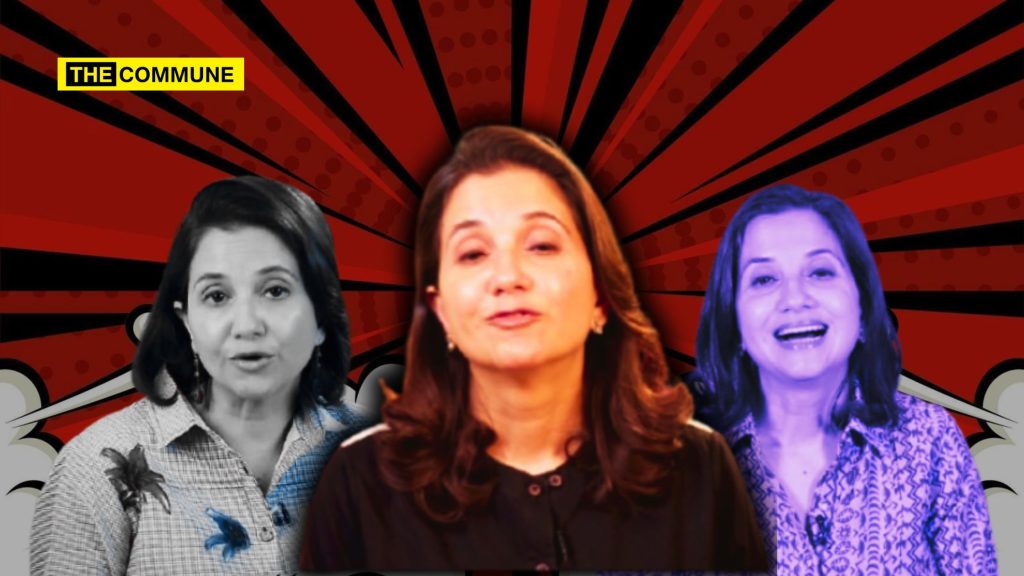
Film critic Anupama Chopra, long seen as part of the rarefied Lutyens-Bollywood cultural circuit, has once again become the centre of a national debate after abruptly taking down her Dhurandhar review following intense backlash. But this incident is not an outlier. Rather, it is part of a consistent ideological pattern in Chopra’s criticism over the past decade: an elitist, selectively moralising viewpoint that rewards films aligned with her worldview while punishing those that portray Indian nationalism, Hindu identity, or grounded geopolitical realities.
Her treatment of Dhurandhar exposed this pattern more starkly than ever.
The Dhurandhar Backlash: A Critic Who Couldn’t Take Criticism
Chopra’s now-removed review called Dhurandhar, “exhausting, relentless, frenzied”, filled with “too much testosterone”, steeped in “shrill nationalism”, containing an “inflammatory anti-Pakistan narrative”.
Anupama Chopra was trying to criticize Dhurandhar.
Instead she ended up giving one of the best review of Dhurandhar:
– Relentless espionage thriller
– Too much testosterone
– Shrill nationalism
– Inflammatory Anti Pakistan narrative pic.twitter.com/MF6WXcM755— Incognito (@Incognito_qfs) December 6, 2025
When viewers pushed back, pointing out that a spy thriller is not expected to resemble a perfume commercial or a tourist music video, Chopra restricted/removed the review entirely.
For a critic who lectures the industry about “robust artistic discourse,” deleting a review after public disagreement reveals the fragile foundation beneath her “bold criticism.”
She then went on to hide behind her Film Critics Guild criticizing those who are criticizing her review of the film.
The Ideological Divide In Her Ratings: A Pattern Too Clear To Ignore
A quick glance at her ratings paints a revealing picture.
Films with patriotic themes or realistic depictions of Pakistan/Islamist-based terrorism such as The Kashmir Files, Shershaah, were classified as bad films; Uri: The Surgical Strike was labelled “emotionally manipulative,” “desh-bhakti button pushing”, Dhurandhar – testosterone filled shrill nationalism with anti-Pakistan narrative – before she removed it.
Films with Pakistan-positive tones, anti-establishment heroes, or “apolitical” violence were praised. For example, Pathaan where Pakistan is shown as cooperative, a rogue Indian agent as villain and Chopra calls SRK’s return “a thing of beauty”, says “the emperor gets his groove back”, praises his “electrifying introduction”. Across the same review, she highlights Deepika Padukone as a bona fide action star and lauds the film’s scale and stardom, effectively giving it a broadly positive, celebratory notice rather than treating it as shallow mass cinema.
Veere Di Wedding – a forgettable film was praised and celebrated for “female agency” despite messy writing.
Kalank – again another forgettable film that was panned by audiences, was worshipped in her review.
When Janhvi Kapoor underperformed in Dhadak, Anupama Chopra gushed that the actress was “endearing, assured, the nepotism debate be damned.” Yet in her review of Raabta, she dismissed Sushant Singh Rajput as “not natural.”
And in her review of Param Sundari, she summed it up with: “pretty leads, limp writing.”
In three lines across three films, she perfectly captures what ails Bollywood today, nepotism defended, genuine talent dismissed, and beauty used as a substitute for substance.
The only major differentiating factor between the low-rated films and high-rated films is not cinematography, not screenplay, not acting, not scale but ideological comfort.
In her review of Chhaava, Anupama Chopra calls Laxman Utekar’s film ambitious and singles out the final act as its strongest stretch. But Chopra notes that the first half feels flat and sluggish, weighed down by dialogue that often reads like speeches. The characters, she argues, are underwritten and the film tends to slip into reverence rather than dramatic vitality. Even great true stories, she says, require nuance and sharper writing to land with full emotional force.
Film Companion’s Reviews
Anupama Chopra’s flagship Film Companion also published film reviews by other “reviewers. Let us take a look at how the team reviewed the films from the ‘non-left’ part of the spectrum.
#1 The Kerala Story = WhatsApp Forward
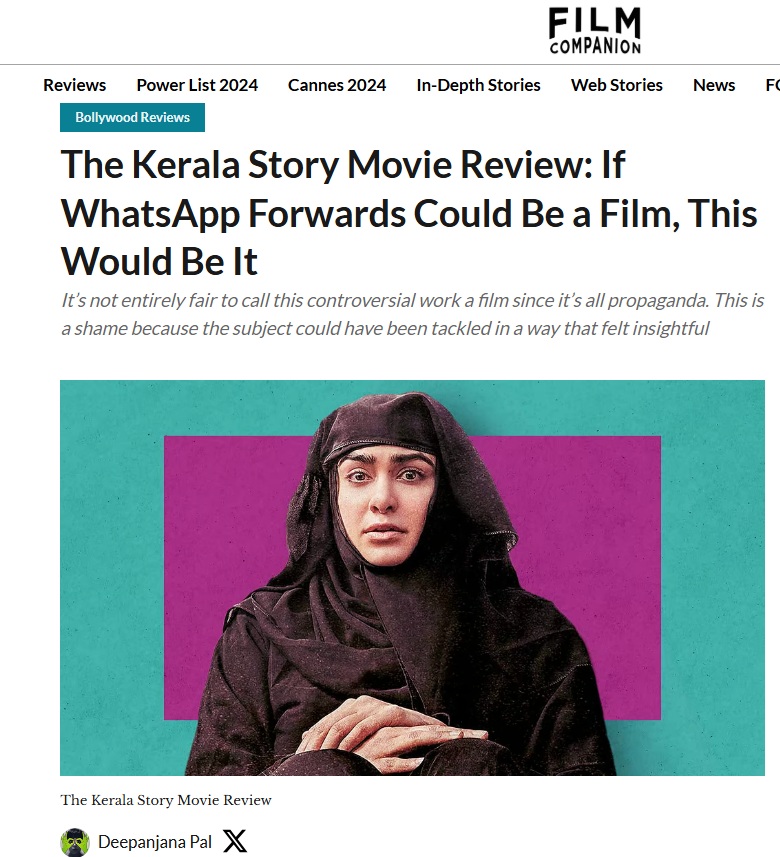

The review of this film bends over backwards to pretend The Kerala Story, the film which allegedly is based on ‘WhatsApp forwards’, is the problem, and not the extremist networks it portrays. The reviewer fixates on prop placement, background music and Communist wall art, while treating actual cases of grooming, conversions and trafficking as inconvenient “Whatsapp forwards.” The film is accused of “demonising Muslims,” but the review has no issue demonising the filmmakers for showing documented patterns. Nuance is demanded only when jihadist recruitment is depicted; outrage is effortless when a film doesn’t fit the reviewer’s politics. In the end, the review exposes more ideological panic than cinematic analysis.
#2 The Kashmir Files = Fantasy


This review spends more time diagnosing Vivek Agnihotri’s motives than discussing the genocide that actually happened. The critic dismisses documented horrors as “torture porn” but melts into lyrical admiration when the same violence appears in Hollywood war films. Apparently, showing Hindu victims is “propaganda,” but showing Hindu perpetrators is “brave cinema.” The reviewer’s real problem isn’t the craft, it’s that The Kashmir Files refuses to sanitise Islamist terror or flatter the reviewer’s ideological comfort zone. Calling a film “dishonest” while trivialising the ethnic cleansing of Kashmiri Pandits is peak Film Companion: moral outrage outsourced, historical memory optional.
#3 Uri – The Surgical Strike = Hypernationalism, Jingoism

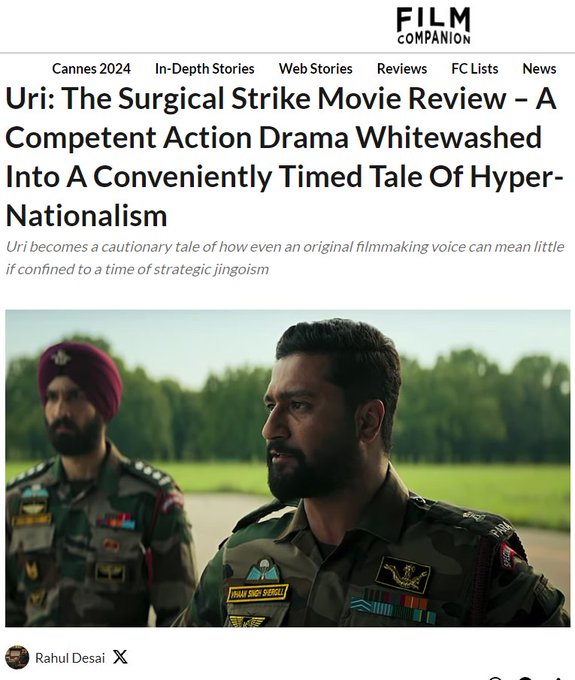
Film Companion dismissed the film as an action drama conveniently repackaged into a burst of hyper-nationalism and strategic jingoism, framing it as technically polished but ideologically loud – full of chest-thumping patriotism, “shrill” nationalism, and an unapologetically anti-Pakistan stance. To them, its high-octane, hyper-masculine energy and use of real terror attacks amounted not to legitimate wartime storytelling but to jingoism. Unsurprisingly, Anupama Chopra and Film Companion delivered a lukewarm, low-star review, entirely consistent with their long-standing discomfort toward any cinema that presents unapologetic Indian resolve.
The review is now deleted.
#4 Samrat Prithviraj = Nadir Of Saffronisation Of Hindi Cinema
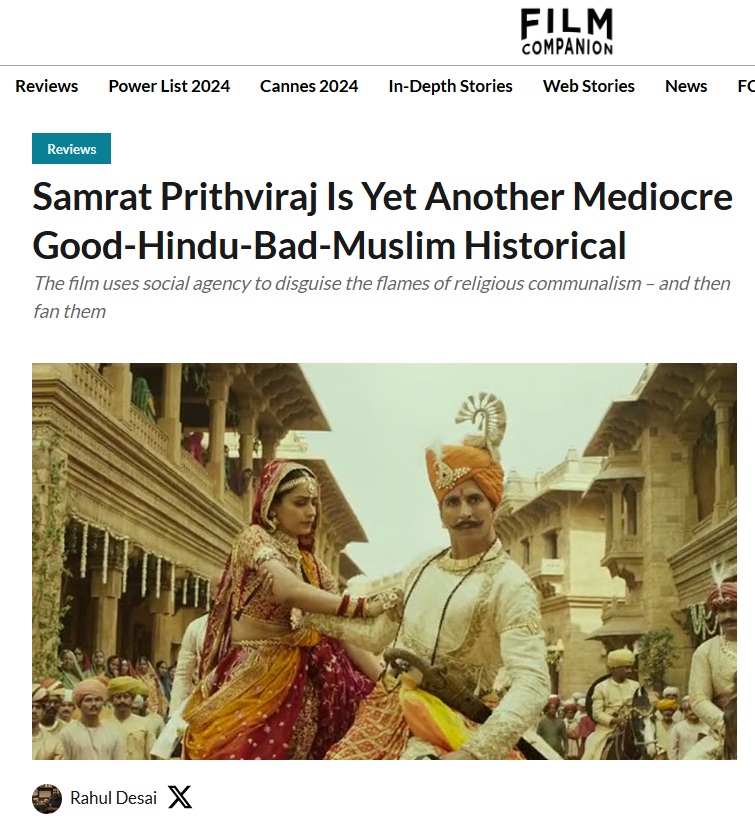

Film Companion’s review of Samrat Prithviraj reads less like film criticism and more like a triggered manifesto against anything remotely Hindu. The reviewer’s biggest gripe isn’t the craft — it’s that the film refuses to portray 12th-century Islamic invaders as misunderstood, poetry-loving soft boys. Apparently, acknowledging well-documented invasions is “Islamophobic,” but endlessly romanticising Mughals is “nuance.” The review rants more about “saffronisation” than the actual movie, revealing its real discomfort: a Hindu king portrayed without apology. FC wants historical epics to tiptoe around facts, so their ideology stays undisturbed. Sorry, but not every film is required to flatter your politics.
Tamil Films Reviewed By Film Companion
Yes, Film Companion has reviewed Tamil films too. But you know the routine – if it is by a director who is ‘right’ leaning, it is boring and if it is from the other end, it is praiseworthy.
#1 Bakasuran = Regressive Lecture
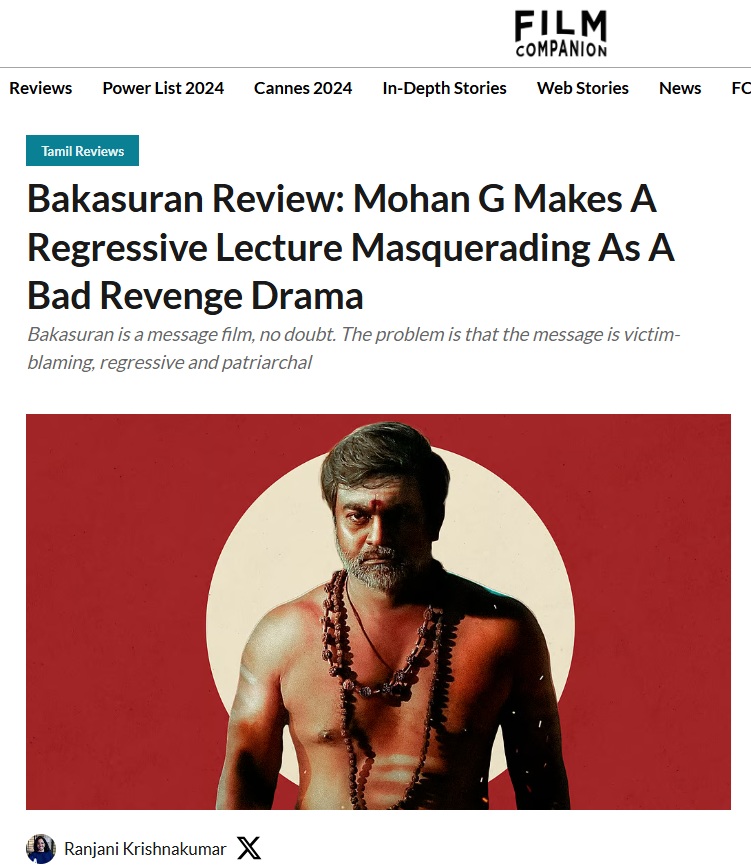

For the Film Companion, Bakasuran is yet another parade of predictable outrage disguised as critique. The reviewer is offended that Mohan G doesn’t turn a sexual-exploitation racket into a TED Talk on “lived experiences” and instead chooses, gasp, male protagonists who actually fight the criminals. The review mourns the lack of “agency” for women but is strangely unbothered by the predators they fall victim to. And of course, the reviewer’s favourite bogeyman appears: saffron, rudraksha, and any Hindu symbolism automatically equals “regressive.” FC complains about “message padams,” yet this review reads like a sermon scolding the film for not matching their politics.
#2 Blue Star = Love Letter To Pa Ranjith
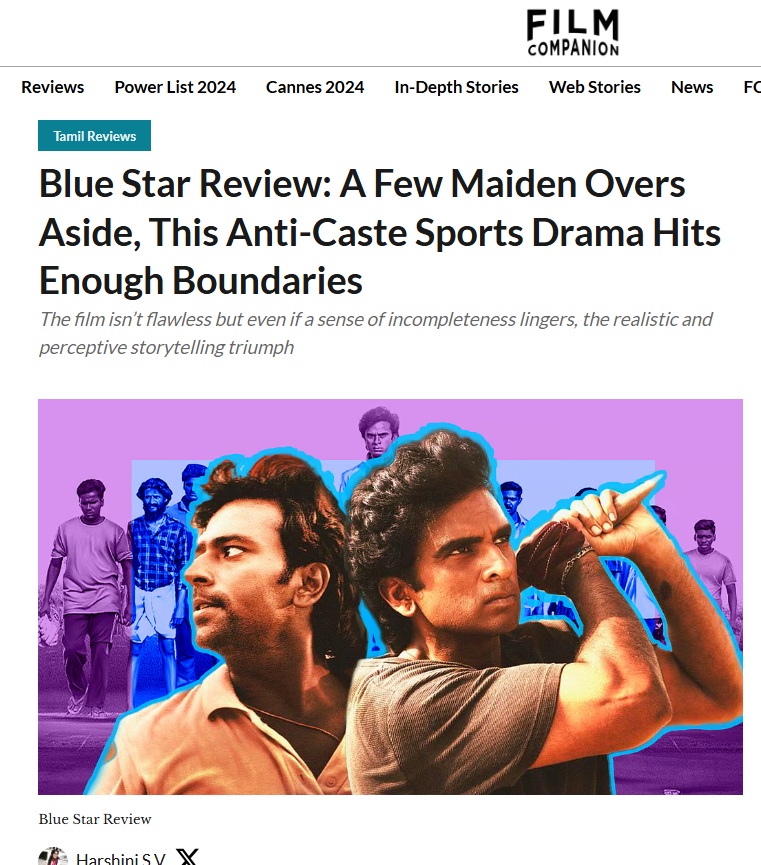

A mediocre film like Blue Star is hailed by Film Companion. Their review of Blue Star reads like a love letter to Pa. Ranjith-style caste discourse first and a film review a distant second. Every frame is analysed not for craft or storytelling but for how loudly it screams “anti-caste politics.” The reviewer treats ordinary cricket scenes as profound social uprisings and neighbourhood dynamics as revolutionary manifestos. Any flaw in the film is forgiven because the ideology aligns perfectly with FC’s worldview. The piece gushes over Ambedkar posters and “perspective storytelling” while brushing past basic narrative gaps. It’s less a critique and more an ideological certificate of approval.
#3 Natchathiram Nagargiradhu = Spiritual Bliss
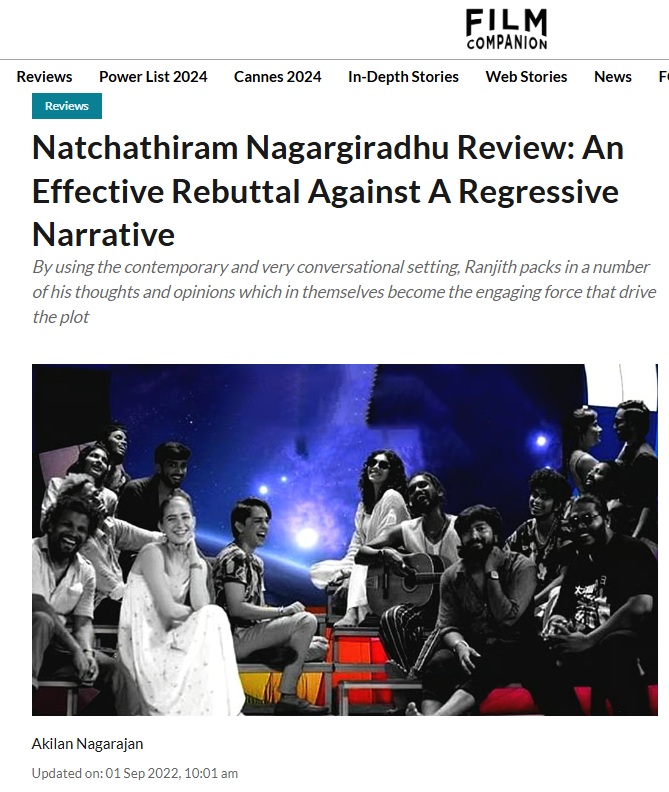

This Natchathiram Nagargiradhu review reads less like film criticism and more like a spiritual sermon for the Church of Pa. Ranjith, where every frame must be decoded for caste allegory and every character exists to educate the “regressive masses.” The reviewer gushes over microaggressions, “collectives,” and Buddha-door symbolism with the zeal of someone discovering oppression for the first time on Twitter. Cinema, performances, pacing, coherence? Mere distractions from the real task – applauding Ranjith’s ideological TED Talk. By the end, you’re left wondering whether they watched a film or attended a compulsory political workshop disguised as a love story.
Pa Ranjith – FC Loves You
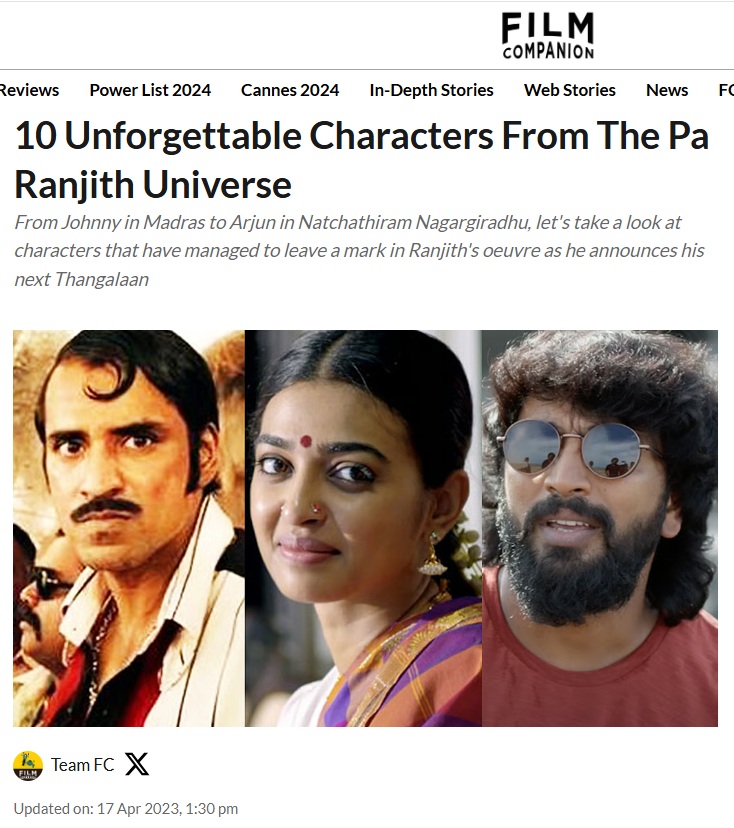

Film Companion’s “10 Unforgettable Characters From the Pa Ranjith Universe” reads less like a feature and more like a required reading list for an Intro to Identity Politics class. Every character is described not for writing, craft, or performance, but for how effectively they serve The Message™. Caste angle? Check. Oppression checklist? Check. Buddha statue symbolism? Of course. Even minor characters are elevated to mythic status as long as they align with the ideological syllabus. It’s less a celebration of cinema and more a devotional essay to Ranjith’s politics — film criticism replaced by activist fan service dressed up as analysis.
Thinks Actors Should Not Work In Films With ‘Bad Politics’
Anupama Chopra solemnly nodding along with Kabir Khan’s philosophy that “bad acting is fine, bad scripts are fine, but bad politics is unforgivable” – is already comedy gold, but the real show begins when she gently scolds Saif Ali Khan for starring in the “saffron” Tanhaji. Saif, ever the historian of WhatsApp University, responds with the iconic revelation that “There was no concept of India till the British gave it one,” a claim so intellectually barren yet so beloved in left wing kitty party circles that it practically earns him a standing ovation. And then, with breathtaking seriousness, the two lament how “tough” India is for them.
Anupama Chopra agrees with Kabir Khan who can forgive bad acting and sloppy scripts, but can’t forgive “bad politics”.
She then proceeds to ask Saif who acted in the historical film Tanhaji that had “questionable politics” – basically she wants to know why Saif is acting in… pic.twitter.com/arum0MwN0k
— Tamil Labs 2.0 (@labstamil) June 21, 2024
Selective Outrage: Why Some Violence Disturbs Her And Some Doesn’t
Chopra’s critique often focuses on “toxic masculinity,” “hyper-masculine rage,” and “patriotic bravado” but only when the protagonist is an Indian soldier or spy. But when the male lead is a Bollywood superstar who beats up 50 men in designer wear? She gushes.
In War 2, she swoons over “towering star power” and “glossy spectacle.”
In Tiger Zinda Hai, she writes, “stardom trumps storytelling,” and means that as a compliment.
But when an Indian agent infiltrates a Pakistani mafia and they fight among themselves, suddenly the testosterone is “too much.”
This asymmetry is ideological, not artistic.
A Track Record Of Condescension Toward “Middle-Class” Actors
Chopra’s elitism becomes most visible when she writes about actors outside the “Bollywood royal club.”
The Yami Gautam Episode
In her Dasvi review, Film Companion (Chopra’s platform) dismissed Yami Gautam with a line suggesting her expressions were becoming “repetitive.” Yami publicly slammed the review as “extremely disrespectful”, “mocking” her efforts.
Under Anupama’ s Film Companion, they brutally tr0lled a self made actress like Yami Gautam Dhar, who openly called out their biased and disrespectful takes.
And now these snowflakes who can’t take any criticism are weeping with victim cards. Get off your high horse cl0wns. pic.twitter.com/Il8KnuDK9b
— Tamil Labs 2.0 (@labstamil) December 10, 2025
Yami Gautam’s film Dasvi’s review described her as “no longer the dead girlfriend in Hindi films, but the combative smile is starting to get repetitive”, which is exactly the phrasing Yami publicly objected to on social media.
Fans contrasted this with Chopra’s glowing, almost worshipful interviews of the same actors when promoting films. The perception of two-faced elitist criticism gained traction.
The “Elite Insider” Question
Like Twinkle Khanna, Anupama Chopra’s career has long benefitted from proximity to industry dynasties, access to exclusive circles, leadership of Film Companion, a platform often accused of favouring certain producers, banners, and PR ecosystems.
Her patterns reinforce criticism that many mainstream critics review movies not purely on merit, but on how well they fit into the ideological and aesthetic preferences of a cultural elite centered in Mumbai and Delhi.
The Kashmir Files, The Tashkent Files, And The Selective Silence
Vivek Agnihotri has repeatedly accused Chopra and Film Companion of ignoring his trailers, delaying or burying reviews, launching negative “campaign-style” criticism.
Whether or not one agrees with Agnihotri’s films, the inconsistency is hard to miss:
The Kashmir Files received universal public acclaim → Film Companion called it “distasteful.”
Pathaan, a film Chopra herself admits is messy → “5 stars, a thing of beauty.”
This is not film analysis. This is ideological curation masquerading as criticism.
Her Dhurandhar Meltdown Seals The Pattern
Chopra’s problems with Dhurandhar mirror her long-running biases. She has a discomfort with grounded depictions of cross-border terrorism, she has a reflexive suspicion of Indian intelligence narratives, an instinctive recoil from nationalism unless wrapped in glamour, has a soft spot for films that sanitise Pakistan, a deep admiration for star vehicles starring Bollywood’s elite, and a tendency to frame strong male-led action as a moral problem, but only in certain contexts.
When this worldview clashed directly with a film embraced by audiences, Chopra did not debate, defend, or clarify. She removed the review.
The audience had pierced the bubble. And she chose the bubble.
The Divide Between Critics And Viewers Has Never Been Sharper
Anupama Chopra represents a class of critics who see patriotism as propaganda, realism as problematic, glamour as quality, “electrifying” star power where viewers see hollow spectacle, “shrill nationalism” where audiences see justified emotion, and see themselves as cultural guardians correcting the audience rather than reflecting them.
Her Dhurandhar takedown isn’t just a review gone wrong.
It exposes a deeper truth – Bollywood criticism today is less about cinema and more about ideology. And increasingly, audiences are refusing to play along.
Subscribe to our channels on WhatsApp, Telegram, Instagram and YouTube to get the best stories of the day delivered to you personally.