


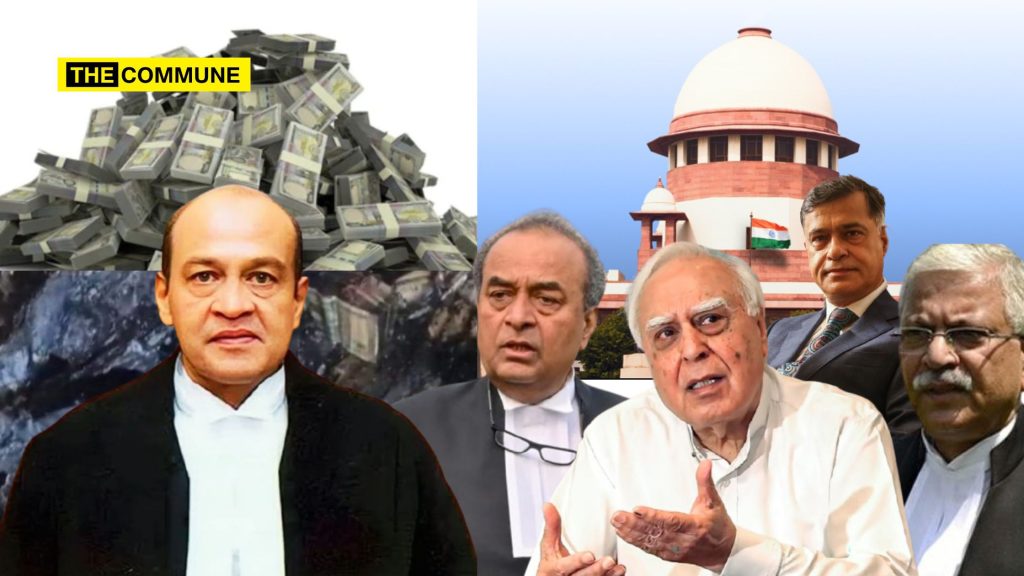
On 30 July 2025, the Supreme Court witnessed an exceptional assembly of senior lawyers in the high-profile case ‘XXX vs Union of India and Others’. Note: Varma hid his identity as XXX.
The case centers on Justice Yashwant Varma, a former Delhi High Court judge, who is challenging an in-house committee’s report that led to the recommendation for his removal after a large quantity of cash was allegedly found at his official residence in New Delhi earlier this year.
Prominent senior advocates, including Kapil Sibal, Mukul Rohatgi, Rakesh Dwivedi, Siddharth Luthra, Siddharth Aggarwal, and Jayant Mehta, appeared in support of the petitioner, whose identity remains undisclosed in official filings. The case is seen as a significant test of judicial accountability and the integrity of internal mechanisms designed to discipline sitting judges.
If I ever get caught with ₹15 crores, I just hope I also get this level of “support”, A whole army of Sr. Advocates ready to fight for me.
Mera Bharat Mahan. pic.twitter.com/jLzYSFueJq
— Venkatesh Alla (@venkat_fin9) July 30, 2025
The Supreme Court bench comprising Justices Dipankar Datta and Augustine George Masih emphasized that while the Chief Justice of India (CJI) has the authority to recommend initiating removal proceedings when there is credible evidence of serious misconduct, the final decision lies with Parliament. “The Chief Justice cannot be reduced to a mere messenger. As the guardian of the judiciary, he holds responsibilities not just to the institution but to the nation,” the bench remarked. They added that while they could have issued a ruling without further comment, silence would have been a disservice to justice.
The court has now reserved its verdict on the writ petition filed by Justice Varma, who disputes the legality of the recommendation to remove him based on the in-house panel’s findings. He argued that the internal probe lacked transparency and due process, especially because he was not allowed to cross-examine witnesses or formally respond to allegations.
Justice Varma’s transfer from the Delhi High Court to the Allahabad High Court followed the discovery of unaccounted cash at his government residence in March 2025. He claims that the inquiry was launched without a formal complaint, based instead on a report from the Chief Justice of the Delhi High Court. The in-house procedure, according to him, violated his right to a fair hearing under the Constitution.
Advocate Kapil Sibal, arguing for Justice Varma, questioned whether an in-house process without evidentiary safeguards, could validly initiate impeachment proceedings. He maintained that Article 124 of the Constitution envisions a more robust process before a judge can be removed, including opportunities for cross-examination and full defense.
However, the bench clarified that in-house inquiries are preliminary in nature and not punitive. “Cross-examination is not a requirement in such proceedings. These are fact-finding efforts to determine if further action is necessary,” the judges explained. They added that the findings are not binding on Parliament, which retains full discretion in deciding whether to act on the recommendations.
The bench also expressed concern that Justice Varma participated in the in-house inquiry and only challenged its validity after unfavorable conclusions were drawn. “Why now? If you believed the process was flawed, you should have raised these objections earlier,” the court observed. It suggested that Justice Varma may have been hoping for a favorable outcome and only raised procedural objections after the inquiry turned against him.
Regarding the media coverage and public commentary triggered by a Supreme Court press release on 22 March 2025, which disclosed allegations against Justice Varma, the court acknowledged the resulting reputational damage but emphasized that legal avenues remain open for redress. “You had an opportunity before the committee, and you’ll have another before Parliament,” the bench stated, dismissing concerns that public statements by ministers prejudged the case. “Statements by politicians carry little legal weight,” the judges noted.
The court also addressed the leak of a purported tape, acknowledging it was inappropriate but irrelevant to the legal process underway. “While such disclosures are regrettable, Parliament is not bound by them,” the bench asserted.
Justice Varma further argued that the in-house committee did not determine ownership of the cash allegedly recovered, nor did it provide him an opportunity to contest the facts. The judges reminded counsel that the in-house panel’s role is limited and does not extend to full criminal or evidentiary analysis.
Senior advocates Rohatgi, Dwivedi, and Luthra also supported Justice Varma’s plea, arguing that the internal mechanism lacked constitutional safeguards. Advocate Mathews J. Nedumpara, who intervened to seek registration of an FIR, was questioned by the bench about whether any formal complaint had been filed.
Ultimately, the court emphasized that the in-house procedure, though not equivalent to a trial, is constitutionally valid under precedents and serves a necessary function in maintaining judicial standards. It reaffirmed that Justice Varma’s conduct and timing in raising objections were relevant factors in assessing his petition under Article 32.
With judgment now reserved, the outcome of this case could have far-reaching implications for judicial accountability and the scope of internal disciplinary procedures in India’s higher judiciary.
(With inputs from Deccan Herald)
Subscribe to our channels on Telegram, WhatsApp, and Instagram and get the best stories of the day delivered to you personally.