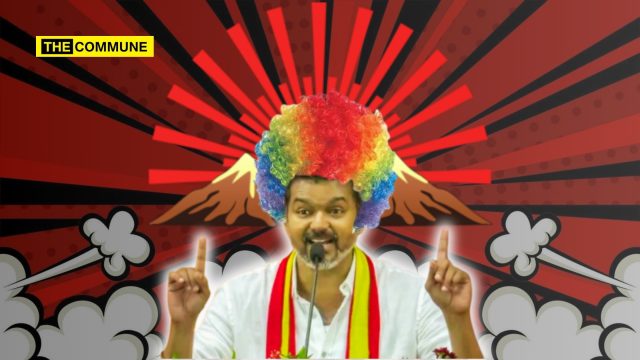
When an NDTV crew recently met actor-turned-politician Vijay, the interaction was presented as a flattering portrait of a thoughtful, grounded leader in waiting. The reportage leaned heavily on praise — of his sincerity, his clarity, his appeal — projecting Tamilaga Vettri Kazhagam as a well-oiled alternative ready for 2026. But beyond the curated optics of a friendly media interaction lies a far less flattering reality. On the ground, TVK continues to struggle with basic organisational execution, missed schedules, and prolonged silences at critical moments, raising serious questions about whether the image being sold matches the party’s actual capacity to deliver.
Ever since the buzz about the launch of his political party, Vijay and Tamilaga Vettri Kazhagam have been just big on optics and low on substance.
After claiming to launch the party around Ambedkar Jayanti, Vijay formally founded the party on 2 February 2024, which many claim was astrologically aligned.
TVK has attempted to position itself as a disruptive alternate force in Tamil Nadu politics. Through speeches, television visuals and social media messaging, actor-turned-politician Vijay projects confidence, moral clarity and a roadmap to power in 2026. Yet, beneath the spectacle, a persistent problem shadows the party: an inability to execute even its own basic schedules.
The contradiction is becoming harder to ignore – grand promises at the top, administrative drift at the bottom.
Schedules That Never Happen
Multiple internal plans prepared by TVK’s strategy team remain unfulfilled. These include booth committee meetings, a three-district tour, a two-district tour, and even the election campaign committee’s public meeting that was supposed to begin earlier. None of these have been fully carried out.
In Tamil Nadu, where elections are won through disciplined booth-level machinery, this failure is not cosmetic. It suggests an organisation struggling with routine political work – planning, coordination and follow-through. For cadres, this has translated into confusion and frustration. For observers, it raises doubts about whether TVK can scale from rhetoric to governance.
இதுவரை strategy team தயாரித்து கொடுத்த ஒரு schedule plan கூட முழுசா முடிச்சதில்ல…
உதாரணத்துக்கு
பூத் கமிட்டி மீட்டிங்ஸ்,
3 மாவட்ட சுற்றுப்பயணம் schedule,
2 மாவட்ட சுற்றுப்பயணம் schedule,
முந்தா நாள் தொடங்க வேண்டிய தேர்தல் பிரச்சார குழு பொதுக்கூட்டம் scheduleஇருக்குற ரெண்டு… pic.twitter.com/95BIotWu1V
— Sonia Arunkumar (@rajakumaari) January 28, 2026
Karur: When Optics Turned Costly
The limits of TVK’s organisational capacity were most tragically exposed on 27 September 2025, at Velusamypuram in Karur district, when a massive crowd crush at a TVK rally killed at least 41 people and injured around 100.
The rally showed Vijay’s undeniable crowd-pull but also the absence of crowd control. Investigations pointed to poor planning, lack of buffer zones, inadequate volunteer deployment and weak command structures. Tamil Nadu’s affidavit before the Supreme Court explicitly cited “reckless, negligent and uncoordinated actions” by TVK organisers, along with Vijay’s delayed response.
Vijay’s first public video message addressing the tragedy came only on 30 September 2025, two to three days after the incident. More striking was what followed: a prolonged absence from live public engagement. His cadre also seemed like headless chicken, unable to decide what to do, how to react, and what to defend.
His first appearance before a live audience after Karur was an indoor “public outreach” meeting near Kancheepuram on 22 November 2025, nearly eight weeks later. His next large open-air public meeting came only on 9 December 2025, in Puducherry.
During this period, district units reportedly drifted without direction. Routine activities stalled, membership drives did not restart, and local leaders hesitated to organise programmes or spend funds without signals from the top. In Karur itself, the district office reportedly remained shut, with no senior TVK leader visiting victims’ families.
For a party promising decisive, accountable governance, the contrast was stark.
Big Promises, Broad Brushstrokes
Even as organisational cracks showed, TVK’s political promises expanded. While the party has not yet released a full manifesto, Vijay’s speeches and statements outline a sweeping vision:
- A corruption-free, transparent government, described as “as clean as Siruvani water,” with zero compromise on welfare.
- Framing DMK and AIADMK as “corrupt” forces, while pledging that TVK leaders “will never do corruption.”
From his 22 November 2025 speech onward, Vijay has signalled welfare and economic promises likely to feature in the 2026 manifesto:
- Permanent housing for all families in Tamil Nadu.
- A two-wheeler for every household, with eventual upward mobility towards car ownership.
- At least one stable income source per family and education reforms to improve youth employment.
- A goal that everyone completes at least an undergraduate degree, with better government schools and colleges.
- Upgraded government hospitals usable “without fear.”
- Strong flood-mitigation and disaster-resilience systems, especially for Chennai.
- Stricter law-and-order enforcement and enhanced safety for women.
On social justice and federal issues, TVK positions itself as strongly pro-Tamil and anti-centralisation:
- Opposition to the Citizenship Amendment Act (CAA) and the Hindi push linked to the National Education Policy.
- Demand for retrieval of Katchatheevu to protect Tamil fishermen.
- Emphasis that “all are equal at birth,” rejection of “landlord politics,” and promises of non-elite, younger leadership.
Women, youth, farmers, labourers, fisherfolk, weavers, the elderly, persons with disabilities and trans persons are repeatedly cited as priority beneficiaries.
Yet, as of January 2026, these remain directional pledges, not a detailed, costed manifesto. TVK has only constituted a manifesto committee and begun consultations. The final document for the Assembly elections is still awaited, but will it arrive on time?
This deepens the central tension: the larger and more ambitious the promises become, the more glaring the party’s execution deficit appears.
Leadership Circle And The Guidance Gap
Another factor contributing to TVK’s execution deficit is the apparent lack of coherent political guidance around Vijay. Key figures in his core team, including Aadhav Arjuna and John Arokiyasamy, have so far failed to translate ambition into operational clarity. While they may be active in messaging and coordination, there is little evidence of structured political mentoring, crisis management planning, or ground-level organisational discipline being imposed from the top.
The repeated failure to complete schedules, the confused response after Karur, and the prolonged silence at critical moments suggest a leadership ecosystem more comfortable with optics and announcements than with the hard, unglamorous work of building a party. For a first-time political entrant like Vijay, the absence of firm, experienced guidance has left the organisation drifting – big on intent, weak on execution.
Lazy Politics Or Growing Pains?
TVK’s approach is seen as lazy politics – heavy on announcements, light on follow-through. Supporters argue the party is young and still finding its feet. But in an election cycle, time is unforgiving.
Tamil Nadu has seen charismatic leaders before. What has decided power, repeatedly, is organisation – booth committees, disciplined cadres, crisis response, and second-rung leadership.
For now, TVK’s reality remains this: a party that struggles to complete a schedule, delayed in responding to tragedy, yet promising to run a state with sweeping reforms. Until execution begins to match ambition, the charge will persist – from within and outside, that TVK is selling a vision far larger than its capacity to deliver.
As 2026 approaches, the question is no longer whether Vijay can inspire crowds. It is whether TVK can prove it knows how to do the unglamorous work of politics – on time, on the ground, and without excuses.