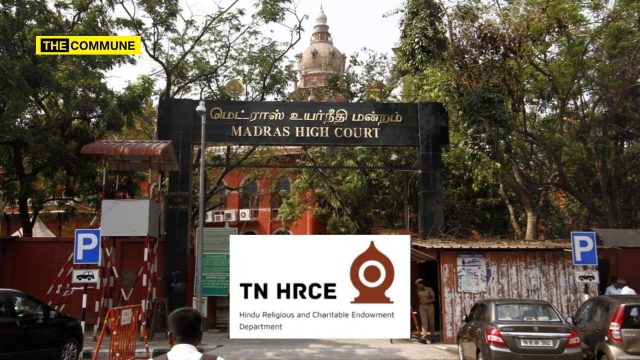
The Madras High Court has observed that the demolition of an ancient mandapam at the Subramaniya Swamy Temple in Kanchipuram on the ground that it was not constructed as per Vastu principles was “against conscience.”
The temple is located on Krishnan Street in Pillaiyarpalayam, Kanchipuram district, where renovation works are currently under way. Residents of the same locality, Vasantha and Shanmugavel, approached the Madras High Court alleging that the renovation activities had blocked access to their residence. In their petition, they sought an injunction restraining the Hindu Religious and Charitable Endowments (HR&CE) Department from constructing the temple’s compound wall close to their property.
The matter came up for hearing before Justice D Bharatha Chakravarthy.
During the hearing, the HR&CE Department submitted that the petitioners had encroached upon the road. It further informed the court that the mandapam within the temple premises was structurally improper and not in accordance with Vastu norms, and that demolition and reconstruction were being undertaken as part of renovation works.
Temple authorities also placed original photographs of the structure before the court and submitted that permission for demolition had been secured from the heritage committee after filing a report stating that the mandapam was irregular and not compliant with Vastu principles, and that reconstruction would be undertaken using the same structural stone.
After examining photographs of the temple taken prior to demolition, the court observed that the mandapam appeared ancient and structurally proper. Justice Chakravarthy remarked, “On perusal of the photographs produced by the temple authorities, the demolition simply seems to be unconscionable and, to the naked eye, the mandapam seems perfect.”
Referring to the original construction, the judge further noted, “On perusal of the original photograph of the temple, it can be seen that it is an ancient stone-built mandapam which was there on the front side of the temple. It will be extremely difficult to find even workmanship to recreate the mandapam in the same manner.”
The court said that terming the long-standing structure as non-compliant with Vastu Shastra and irregular, and proceeding with demolition on that basis, was against conscience. It also observed that once demolished, it would not be possible to recreate the ancient mandapam in its original form.
The judge directed the HR&CE Department to file a detailed report on the renovation works, including an explanation of the basis on which it concluded that the mandapam was not constructed as per Vastu principles. The department was also directed to submit information on when the temple was originally constructed.
Until such reports are filed, the court ordered that no further renovation or reconstruction work should be carried out at the temple.
The case has been adjourned to the 13 February 2026 for further hearing.
Source: Dinamalar
Subscribe to our channels on Telegram, WhatsApp, and Instagram and get the best stories of the day delivered to you personally.