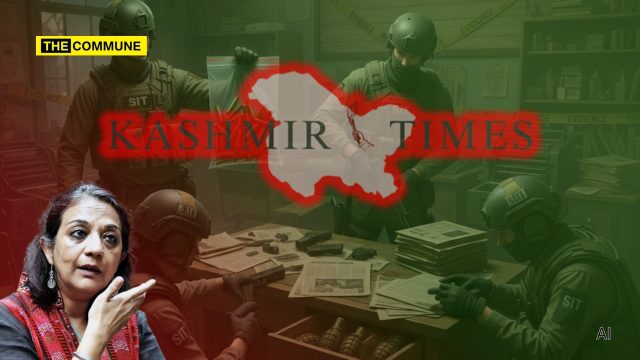
On 20 November 2025, the Jammu and Kashmir Police’s State Investigation Agency (SIA) conducted extensive raids on the offices of the historic Kashmir Times newspaper in Jammu.
#BREAKING: J&K Police SIA raids Kashmir Times newspaper office in Jammu for indulging in anti national activities and spreading disaffection against the country and threatening sovereignty. SIA FIR names Anuradha Bhasin, Editor of Kashmir Times who is likely to be quizzed for her… pic.twitter.com/4AIFSFrvKQ
— Aditya Raj Kaul (@AdityaRajKaul) November 20, 2025
The operation, based on specific intelligence, has unearthed a cache of alarming materials and opened a new front in the Union Territory’s ongoing security operations, targeting what officials describe as a “parallel power structure built on grievance and curated narratives.”
The SIA has registered an FIR naming Anuradha Bhasin, the Executive Editor of the publication, for allegedly “indulging in anti-national activities and spreading disaffection against the country.” Bhasin is expected to be questioned extensively about her links and activities.
The Raid: More Than Just an Office Search
While the raid itself was prompted by suspicions of disaffection and threats to sovereignty, the physical findings have added a grave, tangible dimension to the case. According to news reports, the search of the Kashmir Times premises yielded:
- Live AK-47 cartridges
- Pistol rounds
- Grenade levers
These discoveries in a media office have raised profound and disturbing questions. Bhasin has previously claimed the associated Srinagar office was “shut for years” after being sealed by authorities in 2020 for illegal occupation of government premises. The recovery of weaponry in Jammu now casts a long shadow over these claims, forcing a stark dichotomy: either the office was not as disused as claimed, or a deeper, more dangerous nexus has been operating under the guise of journalism, one that India’s agencies may have ignored for too long.
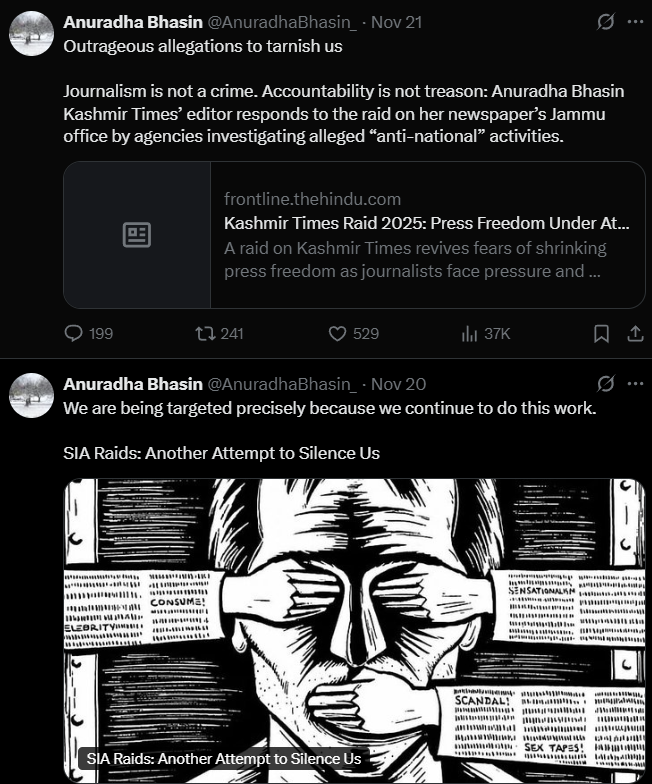
She’s now crying foul for the action taken by the SIT.
The Bhasin Dossier: A Record of Narrative Confrontation
The current action against Anuradha Bhasin and the Kashmir Times is not an isolated event but the culmination of a long-documented record that, according to security analysts, aligns more with a strategic information campaign against the Indian state than with conventional journalistic dissent.
A review of her public interventions reveals a consistent pattern:
2019: Bhasin moved the Supreme Court, petitioning against the security and communication clampdown following the abrogation of Article 370. Her petition framed the situation exclusively as a “state blackout,” conspicuously omitting the context of Pakistan-backed terror threats that necessitated the security restrictions.
2023: She authored an op-ed for The New York Times that portrayed India as an authoritarian state, a piece that was instantly weaponized by anti-India lobbies abroad. In it, she accused the government of systematic press repression and ominously warned that the rest of India may soon resemble Kashmir.
2022-25: Her book, A Dismantled State, was later listed among banned secessionist literature for its portrayal of India as an “occupier state.”
2020: The sealing of the Kashmir Times’s Srinagar office for illegal occupation of government premises was systematically packaged and amplified globally as a clear case of “press persecution.”
This pattern, experts argue, is not mere dissent but a form of “strategic narrative intervention” designed to shape a very specific, grievance-centric view of Kashmir on the global stage.
The Political Echo Chamber: Instant Amplification
The SIA’s action was met with immediate and predictable condemnation from certain political quarters, underscoring the symbiotic relationship between this media narrative and a particular brand of Kashmiri politics.
Almost in lockstep with the news of the raid, Iltija Mufti, daughter of former Chief Minister Mehbooba Mufti, took to social media, decrying the act. She wrote, “Kashmir Times is one of those rare newspapers in Kashmir that not only spoke truth to power but refused to bend or buckle under pressure & intimidation. Raiding their offices under the guise of carrying out anti national activities is preposterous & reeks of high handedness. In Kashmir every outlet of truth is being choked by invoking the anti national slur. Are we all anti nationals?”
Kashmir Times is one of those rare newspapers in Kashmir that not only spoke truth to power but refused to bend or buckle under pressure & intimidation. Raiding their offices under the guise of carrying out anti national activities is preposterous & reeks of high handedness. In…
— Iltija Mufti (@IltijaMufti_) November 20, 2025
This amplification follows a well-established playbook championed by Mehbooba Mufti herself, a leader who has repeatedly made statements that run counter to the national security narrative, including warning that “bodies will burn” if Article 35A was touched, refusing to hold the Indian Tricolour until the J&K flag was restored. Following the Delhi Red Fort metro station suicide bombing, she shifted the blame to Delhi instead of the radical modules behind the attack.
Critics note that this political chorus never has a word of condemnation for groups like The Resistance Front (TRF), Lashkar-e-Taiba (LeT), their ISI handlers, or the hawala pipelines that fund terror.
The Bigger Picture: Information Warfare in a Stabilizing Kashmir
The crackdown occurs at a time when the ground situation in Kashmir is showing significant signs of stabilization. Tourism is at a post-370 high, stone-pelting incidents have dramatically declined, and the terror infrastructure is under unprecedented pressure as normal politics slowly returns.
For the old ecosystem, a network of political elites, activist-journalists, and their international amplifiers, this stability is a direct threat. Their influence and relevance were predicated on a perpetual cycle of grievance manufacturing.
The predictable cycle has been:
- A terror strike occurs.
- Pakistan and its proxies gain.
- Indian security agencies respond.
- Outlets like Kashmir Times publish “democracy is dying” editorials.
- Political figures like Mehbooba Mufti amplify them.
- Western media republishes the narrative.
- Radical networks receive the narrative oxygen to sustain themselves.
- The cycle restarts.
This is not seen as coincidence by security planners. It is viewed as a form of information warfare, running parallel to the physical conflict.
The discovery of weapons in a media office marks a potential escalation. It blurs the line between narrative and physical militancy, forcing a fundamental question: Is the Kashmir Times case about a “free press,” or is it about unmasking the intellectual wing of a failed separatist project, now fighting for survival through any means necessary?
The message from the security establishment is clear: New India will not bleed to protect the careers of old elites. In this view, the age of narrative impunity is over, and accountability is not censorship; it is an assertion of sovereignty.
(This article is based on an X Thread by Zeba Zoariah)
Subscribe to our channels on WhatsApp, Telegram, Instagram and YouTube to get the best stories of the day delivered to you personally.