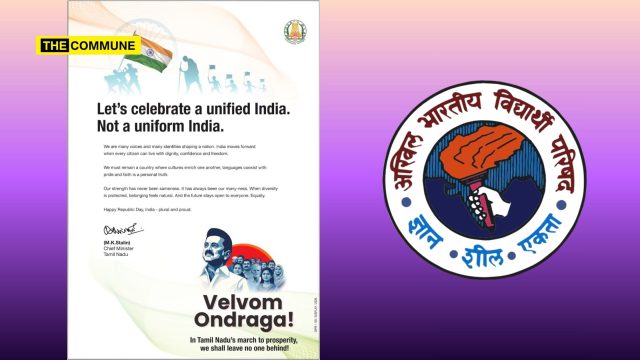
The North Tamil Nadu unit of the Akhil Bharatiya Vidyarthi Parishad (ABVP) issued a press statement criticising the ruling Dravida Munnetra Kazhagam (DMK) over its “Unified India, Not a Uniform India” campaign, accusing the party of misinterpreting constitutional principles and engaging in what it termed “fake politics of unity”.
In a statement released by the ABVP North Tamil Nadu State Secretary, the student organisation said the Constitution’s Preamble explicitly refers to the “unity and integrity of the nation” and argued that administrative uniformity should not be portrayed as divisive. The ABVP maintained that measures such as “One Nation, One Election” or the Goods and Services Tax were administrative in nature and should not be equated with threats to India’s diversity.
The ABVP also criticised the DMK for what it described as selective opposition to uniformity, alleging that the government had no hesitation in implementing uniform increases in taxes such as property tax and electricity tariff, while opposing uniform legal frameworks at the national level.
Responding to remarks made by the DMK Students’ Wing against the organisation, the ABVP said attempts to mock or delegitimise a student body reflected an inability to engage with dissenting views. It asserted that patriotism and national unity were central to its ideology and accused the ruling party of promoting family-centric politics.
The statement further raised concerns about higher education governance in Tamil Nadu, pointing out that vice-chancellor posts in several major universities had remained vacant for years. According to the ABVP, the failure to fill these positions had adversely affected the education system, and it questioned the government’s authority to lecture on national unity while administrative issues persisted within the State.
Citing Article 44 of the Constitution, which refers to the State’s endeavour to implement a Uniform Civil Code, the ABVP argued that opposing the idea of uniformity was inconsistent with the Constitution’s directive principles. The organisation alleged that the DMK’s campaign undermined the constitutional oath taken by those in power.
The ABVP also accused the DMK government of failing to uphold the rule of law, referring to incidents such as illicit liquor deaths and alleged atrocities against Scheduled Castes. It questioned whether the government’s emphasis on unity extended beyond political rhetoric to address governance failures affecting the public.
The ABVP said it was prepared to challenge the DMK’s political positions both legally and in the public domain, asserting that divisive politics driven by electoral considerations would not succeed.