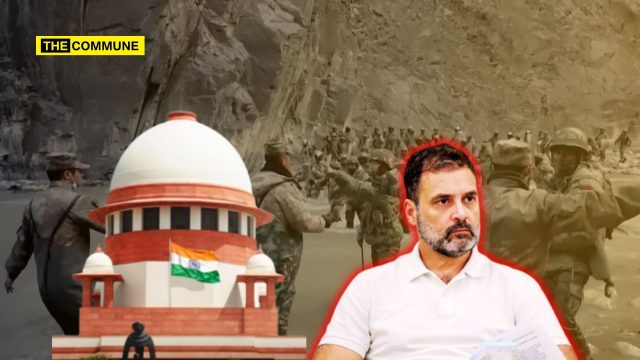
The Supreme Court on Monday, 4 August 2025, stayed the criminal defamation proceedings against Congress leader and Leader of Opposition Rahul Gandhi over his alleged derogatory remarks about the Indian Army, made in the context of the 2020 Galwan Valley clash with China. The Court, while granting interim relief, also expressed strong disapproval of Gandhi’s comments during the hearing.
The bench, comprising Justice Dipankar Datta and Justice A.G. Masih, passed the stay order while hearing Gandhi’s Special Leave Petition (SLP) challenging the Allahabad High Court’s refusal to quash the defamation case.
Senior Advocate Dr. Abhishek Manu Singhvi, appearing for Rahul Gandhi, submitted at the outset, “If he can’t say these things which are published in the Press, he can’t be a leader of opposition,” arguing that the remarks were part of his duty as a political leader to raise concerns. However, the bench did not appear entirely convinced.
“Whatever you have to say, why don’t you say in the Parliament? Why do you have to say this in the social media posts?” Justice Datta asked.
Expressing further disapproval, Justice Datta questioned the basis of Gandhi’s claim that Indian territory had been occupied. “Tell Dr. Singhvi, how do you get to know that 2000 square kilometres of Indian territory were occupied by the Chinese? Were you there? Do you have any credible material? Why do you make these statements without any…If you were a true Indian, you would not say all this.”
Responding to this, Singhvi said, “It is also possible that a true Indian will say that our 20 Indian soldiers were beaten up and killed and that it is a matter of concern.”
Justice Datta replied, “When there is a conflict across the border, is it unusual to have casualties on both sides?”
Singhvi submitted that Gandhi was only pointing to a lack of proper disclosure and attempting to raise concerns over suppressed information. While conceding that the petitioner could have “worded the comments in a better manner,” Singhvi argued that the complaint was merely an attempt to harass Gandhi for fulfilling his role as an opposition leader.
He further pointed out that under Section 223 of the Bharatiya Nagarik Suraksha Sanhita (BNSS), a prior hearing of the accused is mandatory before a court can take cognisance of a criminal complaint, a requirement allegedly not followed in the present case.
Justice Datta, however, noted that the Section 223 argument had not been raised before the High Court. Singhvi admitted to this lapse, stating that the earlier challenge was primarily based on the issue of locus standi of the complainant.
The bench agreed to examine this point and issued notice on the SLP. An interim stay on the defamation proceedings was granted for three weeks.
Senior Advocate Gaurav Bhatia appeared on caveat for the complainant, Uday Shankar Srivastava, a former Director of the Border Roads Organisation (BRO).
The defamation complaint, pending before an MP-MLA court in Lucknow, stems from statements allegedly made by Gandhi on December 16, 2022, during the Bharat Jodo Yatra. According to the complaint, Gandhi repeatedly claimed that the Chinese army was “thrashing” Indian soldiers in Arunachal Pradesh and accused the Indian press of silence on the issue. The complainant argued that such remarks were defamatory and demoralising to members of the armed forces and their families.
The Lucknow court had earlier taken cognisance of the complaint, finding prima facie that the statements appeared capable of defaming the Indian Army. Gandhi’s challenge to that order was rejected by the Allahabad High Court on 29 May 2025. Justice Subhash Vidyarthi of the High Court ruled that freedom of speech does not include the right to defame the Army.
The Supreme Court’s interim stay offers temporary relief to Gandhi, but the Court’s oral observations signal that the broader legal and political implications of the case remain under scrutiny.
(With inputs from Live Law)
Subscribe to our channels on Telegram, WhatsApp, and Instagram and get the best stories of the day delivered to you personally.