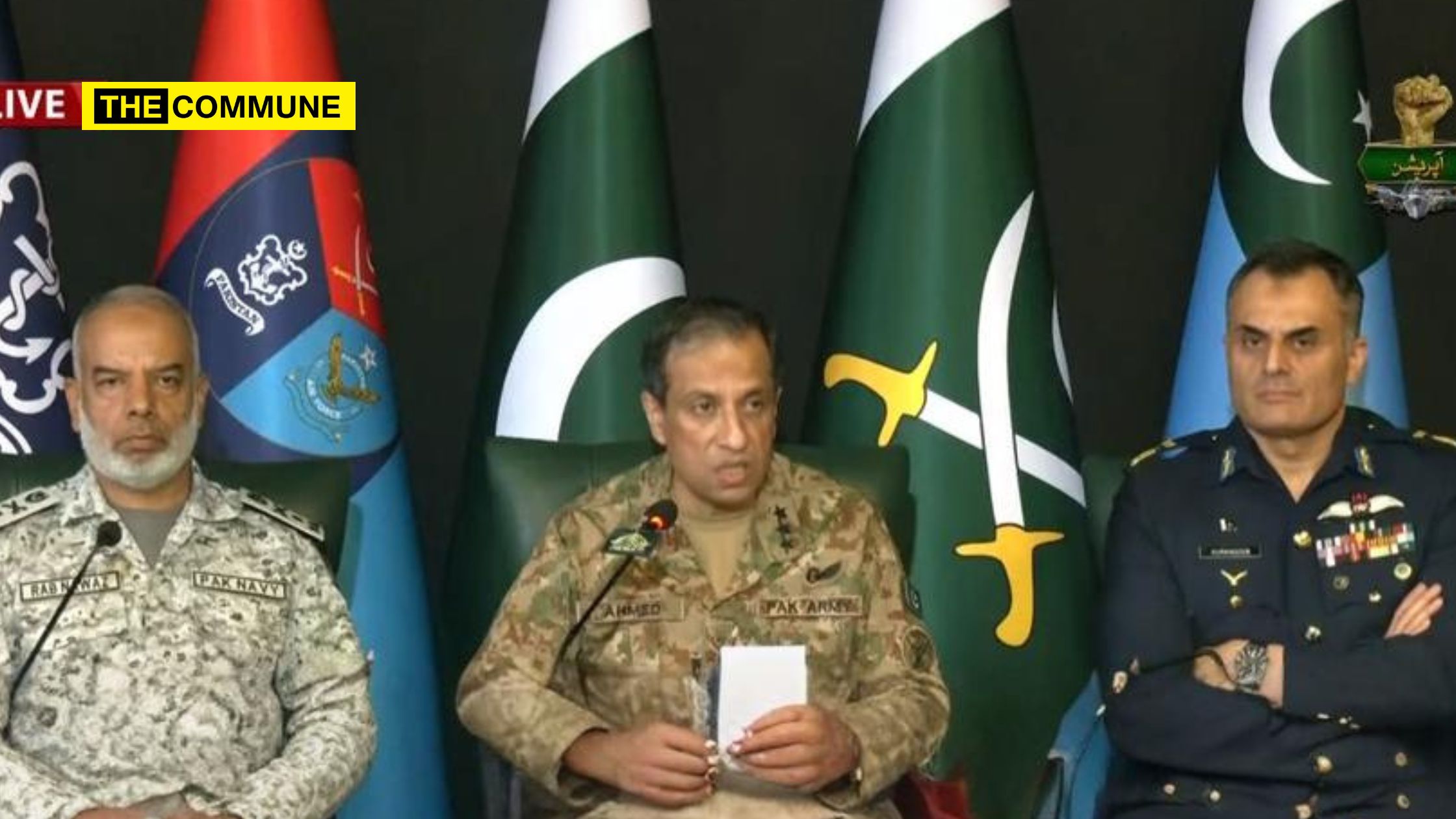
The recent press briefing by Pakistan’s military, filled with unfounded allegations against India, once again exposes their ongoing attempt to position themselves as victims of terrorism. But in an age of technological transparency, these propaganda-laden claims—often backed by doctored images and zero credible data—fail to hold up on international platforms. The global community is no longer swayed by baseless rhetoric without verifiable evidence.
Is the Pakistan Army Truly “Professional”?
Pakistan often presents its military as a professional institution, but its conduct and deep entanglement in the country’s economy tell a different story. Far from being a purely defense-oriented organization, the Pakistan Army operates what is arguably one of the world’s largest military-run business empires. Through a web of ostensibly civilian-run but military-controlled organizations, serving and retired officers oversee a vast commercial enterprise.
Key Military-Controlled Business Entities in Pakistan:
- Fauji Foundation: Established in 1954, this foundation runs over 18 companies in sectors including fertilizers, cement, food, energy, and healthcare. While profits are officially designated for veteran welfare, transparency remains questionable.
- Army Welfare Trust (AWT): Involved in industries such as real estate, banking, insurance, aviation, and manufacturing, AWT is another major arm of military-led commerce.
- Shaheen Foundation (Pakistan Air Force): Manages interests in media, education, and real estate under the guise of welfare for air force personnel.
- Bahria Foundation (Pakistan Navy): Operates in education, shipping, and property development.
- Defence Housing Authority (DHA): Arguably the most controversial, DHA oversees luxury housing projects in major cities and has been accused of land grabbing and displacing local communities.
This military-run economic empire raises several serious concerns. Foremost is the lack of transparency—these military-controlled businesses operate outside the purview of public audits and civilian accountability, making it nearly impossible to scrutinize their financial practices. Additionally, there’s a clear conflict of interest, as serving officers often reap personal benefits from these ventures, blurring the lines between military service and private profit. The army’s deep involvement in commerce also distorts the economy, crowding out private sector competition and discouraging both local entrepreneurs and foreign investors. Perhaps most troubling is the political influence that stems from this economic dominance; the military’s financial power translates into significant sway over civilian policymaking, undermining democratic institutions and weakening civilian oversight.
Renowned scholar Ayesha Siddiqa, in her landmark book “Military Inc.: Inside Pakistan’s Military Economy”, coined the term “Milbus” (military business) to describe this phenomenon. According to her, the Pakistan Army functions more like a sprawling corporate conglomerate than a conventional defense force—prioritizing profits, power, and political leverage over professionalism and national duty.
According to a report by Ayesha Siddiqa in 2007, the total estimated value of the Pakistan Army’s business empire stood at around $20 billion. However, current estimates suggest that this figure may now range between $40 billion to $100 billion (approximately ₹8,47,28,17,08,000). Experts attribute this staggering growth to the expansion of military-controlled enterprises, particularly the Defence Housing Authority (DHA), which operates lucrative real estate projects in major cities such as Karachi, Lahore, and Islamabad. DHA alone is believed to be worth several billions of dollars, reflecting the scale and economic dominance of the military’s commercial ventures.
Pakistan Army abides by commitment?
Since the 2003 ceasefire agreement between India and Pakistan, there have been numerous instances where Pakistan has been accused of violating the terms of the truce. These violations have escalated over the years, leading to increased tensions and casualties.
Notable Ceasefire Violations by Pakistan
-
2014: Pakistan committed 583 ceasefire violations, averaging one incident every 15 hours. These actions resulted in the deaths of four Indian army soldiers, one Border Security Force (BSF) jawan, and 13 civilians. Additionally, 101 civilians and 33 security personnel were injured, and 128 private structures were damaged.
-
2019: There were over 2,050 unprovoked ceasefire violations by Pakistan, leading to 21 Indian casualties. The Indian Ministry of External Affairs highlighted concerns over these violations, including cross-border terrorist infiltration and targeting of Indian civilians and border posts.
-
2021: Pakistan violated the ceasefire approximately 600 times, continuing the pattern of increased violations observed in previous years.
-
2025: In May, following a ceasefire agreement sirens wailed and explosions rang out across India’s border regions on Saturday evening, as Pakistan violated the ceasefire agreement merely hours after it was announced by sending drones into Indian airspace. Reports of loud blasts came in from Srinagar, while air raid alerts were triggered in Udhampur and several areas of the Jammu region.
Does the Pakistan Army follows the orders of Government? A Laughable Claim
When Lt. Gen. Ahmed Sharif Chaudhry claimed that the Pakistan Army “follows the orders of the government,” it was almost impossible not to laugh. The statement stands in stark contrast to decades of history, evidence, and ongoing realities. The truth is: the Pakistani military—especially the army—has long been the most dominant force in the country, far outweighing the influence of elected governments. Below are well-documented instances and facts that lay bare the extent of this control.
Military Coups and Direct Rule
Pakistan has experienced major military coups, resulting in more than 34 years of direct military rule:
-
1958 – Gen. Ayub Khan imposed martial law and suspended the constitution.
-
1977 – Gen. Zia-ul-Haq overthrew PM Zulfikar Ali Bhutto and ruled until his death in 1988.
-
1999 – Gen. Pervez Musharraf ousted PM Nawaz Sharif and held power until 2008.
Even during periods of civilian rule, the military has operated from behind the scenes, crafting what analysts call “hybrid regimes“—governments that appear democratic but are steered by the army.
Election Engineering and Political Manipulation
-
2018 Elections: Widely believed to be rigged in favor of Imran Khan, with the military using media control and judiciary pressure to sideline rivals like PML-N.
-
2022 Ouster of Imran Khan: After a rift with Gen. Qamar Javed Bajwa over ISI appointments, Khan was ousted via a no-confidence vote—allegedly orchestrated by the military.
-
Suppression of Opposition: Prior to the 2024 elections, thousands of PTI leaders and supporters were jailed, the party symbol was removed from ballots, and Khan himself faced over 180 legal cases—all widely viewed as politically motivated.
-
President Arif Alvi’s 2023 Revelation: He claimed military-backed staff bypassed his authority to pass controversial bills—underscoring just how powerless elected officials can be.
From direct coups to political engineering, from monopolizing foreign policy to running a multibillion-dollar economic empire—the Pakistan Army has repeatedly shown that it does not take orders; it gives them. Civilian governments, while elected
Pakistani Claims of Celebrating Peace?
Lt. Gen. Ahmed Sharif Chaudhry recently claimed that Pakistanis were celebrating peace following the escalation between India and Pakistan. However, the situation tells a different story. While Pakistan’s government insists on peace, disturbing images surfaced showing terrorists being mourned with Pakistani Army officers present at the funeral rites.
Following India’s precision strikes on May 7, which killed over 100 terrorists as part of Operation Sindoor, videos and photographs emerged from the funerals of these militants. The visuals showed several Pakistani Army officials and personnel attending the last rites in various border areas.
On Sunday, the Indian Armed Forces identified the Pakistani officials who were seen offering prayers at the funerals. Among those named were:
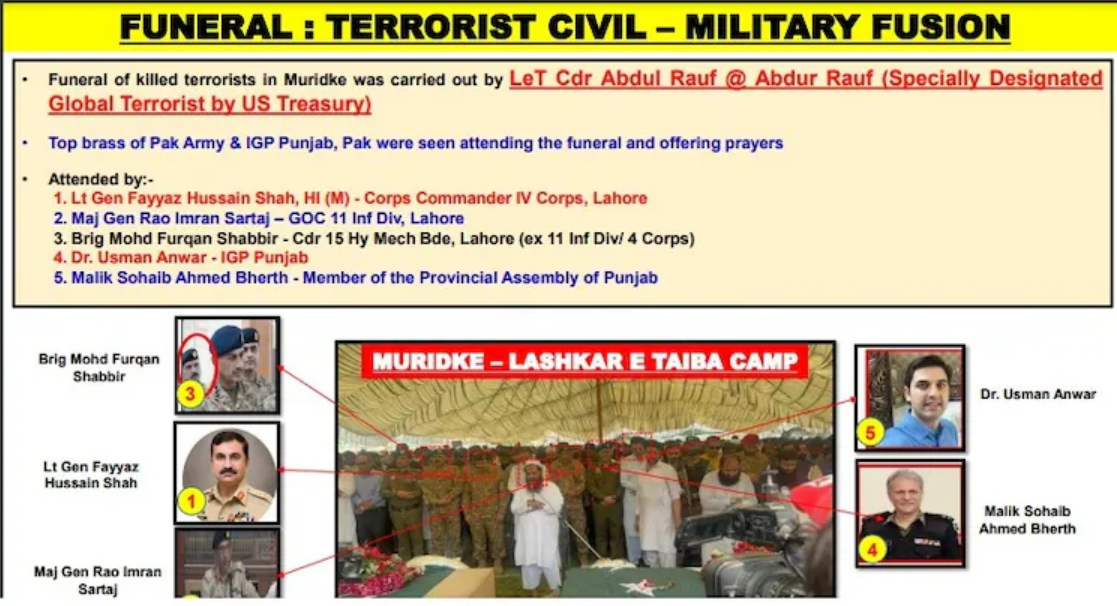
(Image Credit: India Today)
- Lieutenant General Fayyaz Hussain Shah, Commander of the IV Corps of Lahore
- Major General Rao Imran Sartaj, of the 11th Infantry Division, Lahore
- Brigadier Mohammad Furqan Shabbir
- Dr. Usman Anwar, Inspector General of Punjab Police
- Malik Sohaib Ahmed Bherth, Member of the Provincial Assembly of Punjab
Despite Pakistan’s repeated claims of not harboring or supporting terrorism, these images and videos contradict such statements.
One particularly concerning incident was the funeral of Hafiz Abdul Rauf, a prominent Lashkar-e-Taiba (LeT) terrorist, who led prayers for three militants killed in the Indian airstrike on a terror camp in Muridke, near Lahore. Notably, civil officials and members of the banned Jamaat-ud-Dawah (JuD), founded by Hafiz Saeed, were also in attendance. The individuals killed, Qari Abdul Malik, Khalid, and Mudassir, were reportedly associated with JuD, serving as prayer leaders and caretakers at a mosque destroyed during the strike.
Rauf, a globally designated terrorist by the US Treasury, was seen leading the ceremony, highlighting Pakistan’s ongoing connections with militant groups. Following the funeral, disturbing footage emerged showing Pakistan Army personnel carrying the coffins of these terrorists, draped in the Pakistani flag, further deepening suspicions of the army’s complicity in supporting terrorism. This sequence of events paints a stark contrast to the narrative of peace that Pakistani officials try to project, raising questions about the true extent of their involvement in terror activities.
Pakistan’s Military Capability: Claims vs. Reality
One of the most questionable narratives during the recent India-Pakistan conflict came from the Pakistani military’s claims about its air and naval readiness.
In a press briefing, DGPR PAF Aurangzeb Ahmed asserted that Pakistani radar systems successfully detected all Indian drones during the escalation. He even presented video footage to support this. Similarly, DG ISPR Ahmed Sharif Chaudhry claimed that Pakistan had intercepted and shot down 12 Indian drones, including Israeli-made Harop loitering munitions, allegedly in areas like Lahore, Karachi, and Rawalpindi.
However, these bold claims do not hold up to scrutiny. Various reports and open-source intelligence suggest that multiple Indian drones successfully penetrated Pakistani airspace, with some reaching deep into urban areas such as Lahore and Karachi. Even Pakistani media outlets noted explosions and unusual aerial activity in these regions. Despite claims of shooting down between 12 to 25 drones, no verifiable evidence has been provided by Pakistan’s defense establishment. If their air defense system truly detected all incoming drones, it raises a critical question—why couldn’t they intercept them effectively and prevent the resulting damage? The outcome instead revealed significant lapses in air defense, with notable losses on the Pakistani side.
The exaggeration didn’t stop there. Commodore Raja Rab Nawaz made a public statement asserting that Pakistan’s Navy was fully prepared and that submarines were on standby for any escalation at sea. However, the reality paints a far less impressive picture. Out of the five submarines that Pakistan claims to have in its arsenal, only two are currently operational. This revelation significantly undermines the navy’s stated readiness and casts doubt on the credibility of their maritime deterrence posture.
In summary, while Pakistan’s military officials made sweeping claims about their ability to detect and neutralize threats from India, the available evidence—and the results on the ground—tell a different story. These contradictions only further highlight the gap between Pakistan’s rhetoric and actual capability.
Dissecting Pakistani press briefing :
6 lies exposed in 60 seconds, with official data. #OpSindoor pic.twitter.com/EIwnr5gOLi
— Maj Manik M Jolly,SM (@Manik_M_Jolly) May 12, 2025
Subscribe to our channels on Telegram, WhatsApp, and Instagram and get the best stories of the day delivered to you personally.