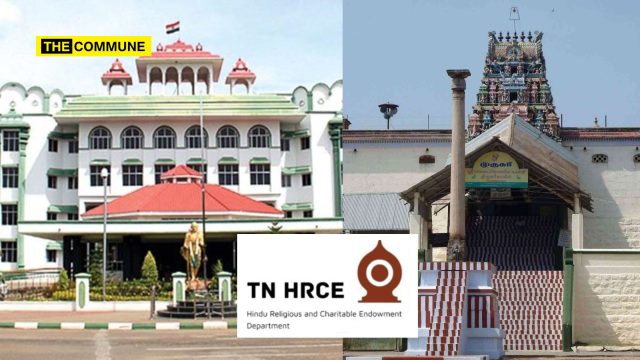
The Madras High Court has strongly criticised authorities for failing to recover 507 acres of temple land belonging to Arulmighu Balasubramaniyaswami Temple in Vennaimalai, Manmangalam Taluk, Karur District, observing that temple properties are sacred endowments and cannot be treated as commercial assets of the State.
The remarks were made while the Court was hearing a contempt petition concerning the implementation of its earlier directions ordering authorities to recover temple lands recorded in the name of the temple. The Court noted that despite the passage of several years and repeated monitoring, the directions had been only partially complied with.
The Bench comprising Justice P. Velmurugan and Justice B. Pugalendhi recorded that the total extent of temple land under encroachment is 507.88 acres, out of which only 93.64 acres have been recovered so far.
During the hearing, the Court also took note of the organised resistance faced by officials even while carrying out basic administrative actions. According to submissions placed before the Court, authorities had to deploy three Deputy Superintendents of Police, five Inspectors of Police, and 132 police personnel merely to install a flex board declaring the temple’s ownership over the land, highlighting the level of opposition from encroachers.
Observing that the matter had been under continuous judicial scrutiny for over two years, the Bench stated: “This Court has monitored this matter for over two years. Numerous orders were passed in this contempt application. Personal appearances were secured. Protection was ordered. Yet compliance remains partial. The poor deity has no voting right. On the other hand, the mighty encroachers have valuable votes. In a democratic polity, electoral arithmetic sometimes appears to influence administrative resolve. But constitutional governance is not subordinate to electoral expediency. A deity, recognised as a juristic person in law, cannot be left remediless because it does not participate in elections. The deity may not vote, but the Constitution speaks. The Court is exercising its parens patriae jurisdiction. But, when judicial orders are stalled by organised resistance, then the rule of law itself stands tested”.
The Court also examined policy notes of the Tamil Nadu Hindu Religious and Charitable Endowments (HR&CE) Department, which showed a steady decline in the extent of temple lands across the State.
According to official records cited before the Court, temple lands had reduced from 5.25 lakh acres in 1986-87 to 4.90 lakh acres in 2000-01, further declining to 4.79 lakh acres in 2002-03, and 4.78 lakh acres in 2008–09.
Expressing concern over this trend, the Bench observed, “…Temple lands are not commercial assets of the State. They are sacred endowments made by generations of devotees with a definite object to sustain religious worship and charitable services. If endowed properties diminish year after year, it is not a mere clerical anomaly, but reflects systemic erosion”.
The Court emphasised that temple lands had been dedicated by generations of devotees specifically to sustain religious worship and charitable services and therefore could not be treated as ordinary government property or as revenue-generating assets.
During the proceedings, the Court was also informed that certain organisations had mobilised protests against the implementation of the Court’s orders. Among them was a group styled as the “Inam Land Farmers Lessees and House Site Owners Protection Movement.”
The Bench observed that while any party is free to challenge judicial orders through lawful remedies, organised obstruction or extra-legal methods cannot be used to nullify court directions. It also expressed concern that some protestors involved in the agitation included legal professionals and elected representatives.
The Court further noted that among the 230 identified encroachers, 27 are government officers, 49 are industrialists, and 38 are persons wielding considerable influence. The Bench remarked that such a composition raised the disturbing possibility that the presence of powerful individuals among the encroachers may be contributing to the reluctance of authorities to enforce eviction orders.
Addressing the delays in related civil litigation, the Court stated: “Considering the manner in which the issue is being handled by the stakeholders, this Court, while is conscious that civil Courts must adjudicate upon pleadings and evidence in accordance with law, holds that such adjudicatory process cannot translate into indefinite pendency, especially in matters involving public religious endowments and longstanding encroachments. The cumulative circumstances indicate a pattern of delay that has effectively frustrated the timely enforcement of the directions issued by this Court. Therefore, this Court is constrained to reiterate and reinforce its earlier directions to ensure expeditious disposal of the pending civil suits”, as reported in Verdictum.
The Bench also recorded that 13 encroachers had filed review applications in 2023, but these petitions were not actively pursued. The review petitions were eventually dismissed on 24 January 2025, and subsequent challenges filed before the Supreme Court were dismissed through a common order dated 3 November 2025.
Despite the absence of any legal impediment following the dismissal of these challenges, the Court observed that officials of the HR&CE Department had still not implemented the earlier directions issued for the recovery of the temple lands.
The contempt proceedings arose in the case A. Radhakrishnan v. P. Madhusudhan Reddy, IAS & Others. A Radhakrishnan appeared in person for the petitioner, while NR Elango and AK Sriram, Senior Counsels, appeared for the respondents.
Subscribe to our channels on Telegram, WhatsApp, and Instagram and get the best stories of the day delivered to you personally.