


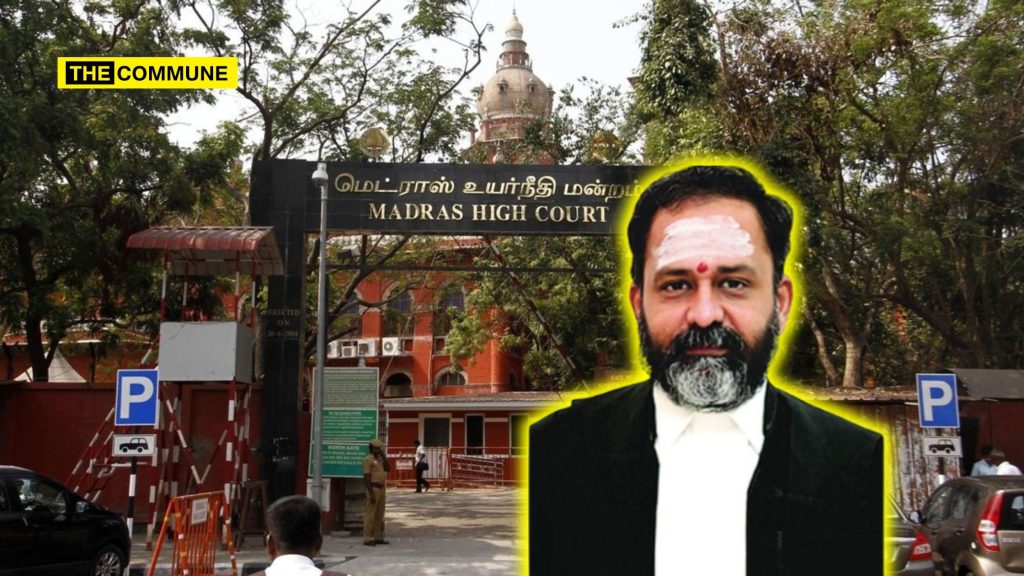
Justice GR Swaminathan of the Madras High Court has recently come under fire from Advocate Vanchinathan, who has accused the judge of caste-based bias. However, a closer look at Justice Swaminathan’s judicial record strongly contradicts these claims. Notably, he is among the few judges to publicly release his own performance record, reflecting a rare commitment to transparency. The recent accusations appear to echo a familiar pattern.
Previously, YouTuber Savukku Shankar made similar allegations, but Justice Swaminathan continued to uphold the rule of law impartially even granting bail to Shankar in a later case despite personal attacks.
Key Judgments Demonstrating Judicial Balance
Let us take a look at Justice GR Swaminathan’s history of judgements.
Interim Stay on Vice-Chancellor Amendments (May 2025)
Justice Swaminathan, along with Justice V. Lakshminarayanan, issued a temporary stay on Tamil Nadu legislative amendments that removed the Governor’s role in appointing university Vice-Chancellors. The bench asserted its jurisdiction clearly, rejecting the claim that they were revisiting a Supreme Court verdict. The court criticized the obstructionist approach of the state counsel and emphasized that the amendments were prima facie unconstitutional.
The bench argued that these changes conflicted with UGC norms and emphasized that constitutional courts remain active even during vacation to address pressing constitutional concerns.
Granting Bail to Savukku Shankar (Jan 2025)
Justice Swaminathan granted conditional bail to Savukku Shankar, who was arrested for allegedly spreading misinformation. Despite facing personal attacks from Shankar including accusations of bias in the Maridhas case the judge underscored the right to freedom of expression and questioned the necessity of arrest in such cases.
Upholding Religious Freedom in Ervadi (July 2024)
The Madurai Bench, under Justice Swaminathan, ruled in favor of a Sufi Muslim group’s right to observe Muharram in the traditional way, including processions with drums and music. Opposed by Thowheed Jamath, the court emphasized that Article 25 guarantees the right to practice religion according to one’s customs. He warned against yielding to extremist views and cautioned authorities against curbing rights under the pretext of maintaining law and order.
Caste-Based Quotas and Religious Conversion (Dec 2022)
Justice Swaminathan ruled that individuals cannot claim caste-based reservation after converting to a religion that does not recognize the caste system. In this case, a petitioner who converted to Islam could not claim Most Backward Class status under Hindu classification.
Order for Display of Dr. B.R. Ambedkar’s Portraits (2022)
In response to a student’s plea, the judge ordered all law colleges in Tamil Nadu to install portraits of Dr. B.R. Ambedkar, recognizing his contribution to Indian law and equality. The court also directed a welfare fund to support the student’s legal education.
On Religious Demographics in Kanyakumari (2022)
Justice Swaminathan noted that Hindus had become a minority in Kanyakumari district, despite the 2011 Census suggesting otherwise. He highlighted the phenomenon of ‘crypto-Christians’ Scheduled Caste individuals who convert to Christianity but continue to identify as Hindus in official records to retain reservations. The court underscored the constitutional right to religious conversion while warning against organized conversion efforts that alter demographic balances.
Defended Press Freedom, Quashed Defamation Case Against Women Journalist
Justice Swaminathan quashed a criminal defamation case filed by V.V. Minerals against journalist Sandhya Ravishankar, calling it a misuse of legal process aimed at silencing critical reporting.
He stressed that when press freedom is at risk, courts must not remain passive, “There’s no point praising a free press if courts don’t act when that freedom is threatened. Judicial power must be exercised not shelved.”
The judge noted that criminal defamation is increasingly used by corporations and politicians to intimidate journalists. In this case, the complaint targeted Ravishankar, her husband, and the editor of a newspaper where her article on illegal mining appeared. However, the company failed to pursue the editor and claimed her husband instigated the article.
Justice Swaminathan rejected this argument, “Assuming the journalist was merely influenced by her husband undermines her autonomy. She is an independent professional.” He ruled that reporting on alleged illegal mining after seeking the company’s response falls under exceptions to criminal defamation, especially when public resources are involved. The court concluded the case was frivolous and an abuse of legal process.
Transparency Through Self-Evaluation (June 2024)
Marking his seventh year on the Bench, Justice Swaminathan released a self-assessment report, detailing that he had disposed of over 64,000 cases. He argued for accountability in the judiciary and acknowledged both his achievements and areas for personal growth—such as controlling his temper.
On How Demographic Change Can Affect Constitutional Integrity
At a public event, Justice Swaminathan remarked that the Constitution’s essence could be threatened if the demographic makeup of the nation shifts drastically from what it was at the time of its creation. His comments were interpreted by some as controversial, but the judge clarified that he spoke from a cultural and constitutional lens, without undermining the secular framework.
Dharmic Inference from Hindu Epics For Legal Matters
In reference to remission laws, the judge highlighted a passage from the Valmiki Ramayana to demonstrate Indian traditions of justice and mercy. He used this example to rationalize the Supreme Court’s decision to release convicts in the Rajiv Gandhi assassination case and advocate for a homegrown legal philosophy – “Bharatiya jurisprudence.”
An Unbiased & Dharmic Judge
Justice GR Swaminathan stands out as a figure who consistently upholds the Constitution with courage and clarity. His judgments reveal a rare balance: fiercely protecting fundamental rights, while also remaining conscious of India’s civilizational ethos and legal traditions. Whether it is defending a journalist from corporate intimidation, standing up for religious freedoms, or advocating transparency in the judiciary, his record speaks louder than any allegation.
The recent accusations of bias ring hollow in light of his consistent jurisprudence. Far from demonstrating prejudice, his rulings show a deep regard for justice, pluralism, and legal accountability. If anything, the targeted criticism appears to be less about impartiality and more about discomfort with a judge who refuses to toe ideological lines. Justice Swaminathan’s example reminds us that judicial independence is not just about being free from political control, but also about having the moral clarity to decide each case on its constitutional merit, no matter the consequences.
Subscribe to our channels on Telegram, WhatsApp, and Instagram and get the best stories of the day delivered to you personally.