A recent Nikkei Asia article on West Bengal’s Special Intensive Revision (SIR) of electoral rolls follows a now-familiar template: selectively frame an Indian electoral process through a Muslim victimhood lens, rely on partisan sources, ignore inconvenient data, and publish it in prestigious foreign outlets for maximum reputational damage to India abroad.
Who is the author you ask? The piece was written by Quratulain Rehbar, a Jammu-based freelancer whose byline regularly appears in Al Jazeera, The Wire, Article 14, TRT World and VICE.
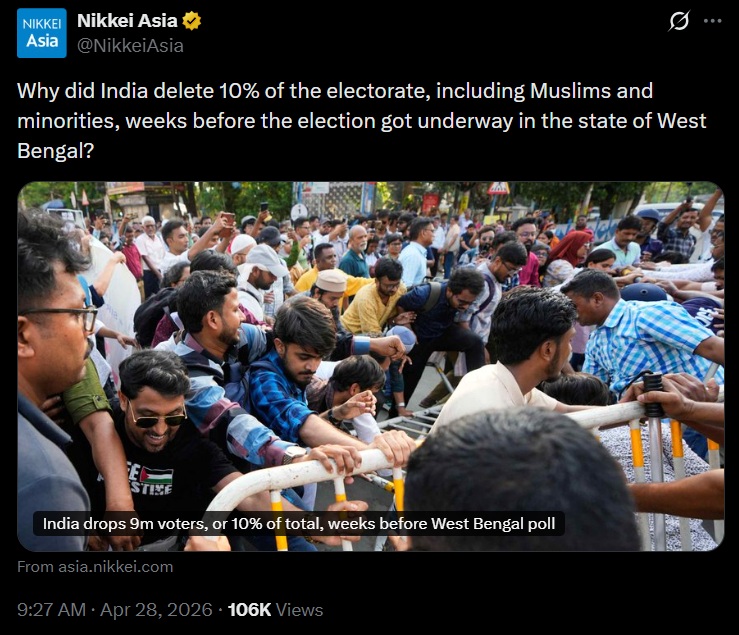
Why am I not surprised https://t.co/24NB4OYHz7 pic.twitter.com/y1OtbLl6zi
— Aadi Achint 🇮🇳 (@AadiAchint) April 28, 2026
What the Article Gets Wrong
The piece’s central claim, that the SIR disproportionately targeted Muslims, collapses under its own data. 63% of all deletions were Hindu voters, and only 34% were Muslim, per data published even by outlets sympathetic to the opposition narrative. Muslims constitute 27% of West Bengal’s population yet account for 34% of deletions – a marginal over-representation in a process that removed far more Hindus in absolute terms. The article buries this inconvenient figure while amplifying the “disproportionate” framing.
The SIR was not invented for West Bengal or for Muslims. It was first conducted in Bihar in 2025, then rolled out across 13 states and union territories. The last SIR in West Bengal was conducted in 2002, over two decades ago, meaning the existing rolls had accumulated over 20 years of deaths, duplications, and migration errors without a comprehensive clean-up. The ECI’s stated rationale is documented and publicly available. Rehbar’s article presents it as a sinister novelty without this context.
The 58 lakh deletions in Phase One were specifically categorised as deceased, duplicate, or permanently shifted voters – not arbitrary exclusions. The draft rolls were published booth-wise online with deletion reasons, and a formal claims and objections window was provided from December 2025 to January 2026. These are not the actions of an opaque process; they are standard electoral procedure. The article does not mention the objections window or online verification mechanism.
Partisan Sources Presented as Neutral Experts
The article leans entirely on Mamata Banerjee’s government narrative, TMC-aligned analysts, and a Kolkata-based political scientist, while presenting them as neutral observers. Banerjee’s claim that the SIR was “a scam done with the help of artificial intelligence” is quoted without challenge. The Supreme Court of India, after examining the controversy, allowed elections to proceed, a fact the article frames as “unusual” rather than as a judicial endorsement of the process’s legality.
Notably, even the BBC’s own coverage of the same story acknowledges that approximately 80% of those removed are Hindus, predominantly Hindi-speaking communities from North India – a figure that directly contradicts the Muslim-targeting narrative. Rehbar’s Nikkei piece does not include this.
The Author’s Track Record
Quratulain Rehbar is not a neutral elections reporter. Her biography explicitly states she covers “anti-Muslim hate” as a beat, so we are assured about the lens through which she approaches every story involving Muslims in India. Her bylines in leftist rags like The Wire, VICE etc., are outlets that have repeatedly published pieces constructing India as a Hindu nationalist state systematically persecuting minorities. This is not journalism; it is advocacy published in journalistic format.
The pattern is consistent: take a legitimate administrative process, find Muslim voices expressing fear, quote partisan political analysts as neutral experts, omit majority-community impact data, and pitch it to a foreign editor hungry for India-as-democracy-in-crisis content.
The Bigger Pattern
India’s electoral machinery, despite its scale and complexity, is routinely subjected to this treatment in Western media: processes that would be reported as routine administrative updates in any European country become evidence of democratic backsliding the moment they occur in India. The SIR was challenged legally, heard by the Supreme Court, and allowed to proceed. Elections were conducted on 23 April 2026, with record voter turnout – which itself undermines the narrative of mass disenfranchisement. Bengal has Phase 2 to go on 29 April 2026.
That a booth-level officer’s family names were temporarily missing from draft rolls, a correctable administrative error in a process involving 76 million voters, becomes the human-interest hook for an international story alleging systemic Muslim exclusion is not journalism. It is narrative construction. And Quratulain Rehbar, Nikkei Asia, and the broader ecosystem that publishes, amplifies and funds this template bear responsibility for the damage it does to India’s international standing – damage built not on facts, but on selective omission.
Subscribe to our channels on WhatsApp, Telegram, Instagram and YouTube to get the best stories of the day delivered to you personally.