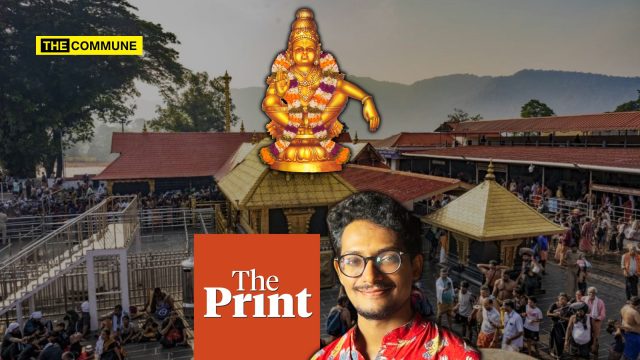
The Print has published an opinion piece titled “How Ayyappa went from a local forest deity to Kerala’s most controversial God,” authored by Anirudh Kanisetti. The headline alone frames Lord Ayyappa — revered by millions as the celibate warrior deity Dharmasastha, Hariharasuthan (son of Hari and Hara, i.e., Vishnu and Shiva), and the epitome of dharma and ascetic discipline — as inherently “controversial.”
It is a loaded Leftist framing that reduces a deeply sacred figure in the Hindu pantheon to a subject of modern political contention, made intentionally/unintentionally to delegitimize Hindu traditions.
Anirudh Kanisetti’s article in The Print misrepresents Lord Ayyappa (Dharmasastha/Hariharasuta) as evolving from a post-3rd century CE “local forest hunter deity” of Western Ghats peasants into a “controversial” celibate figure via 19th-century Brahminical legends like the Bhuta-natho-Pakhyanam, implying the restriction of menstruating-age women was a late exclusionary overlay.
The piece ties this evolution to ongoing Supreme Court debates over women’s entry, presenting Brahminical influences as having “corrupted” or overlaid a simpler local deity with exclusionary practices. The taboo, it notes, was documented by the 1820s under British records.
Puranic texts like the Srimad Bhagavatam and agamas (Amsumadbhedagama, Suprabhedagama) explicitly identify Shasta as Hariharaputra (son of Shiva and Vishnu/Mohini) centuries before the 19th century, with the celibate dharma and vratham rooted in these ancient traditions – not a recent invention. The 1820 British records merely document a long-standing custom aligned with the deity’s ascetic vow, not its origin. Kanisetti’s “Brahminical corruption” narrative ignores Hinduism’s organic syncretism seen across deities like Murugan, as evidenced by continuous temple practices under Ay, Chola, Pandya, and Travancore rulers. Far from a fragmented folk cult later Sanskritized, Ayyappa worship reflects deep continuity as a unifying symbol of dharma and discipline for millions.
While historical layering of deities is common across Hindu traditions — with regional folk elements merging into pan-Indian Puranic narratives — the article’s tone and headline choice go beyond analysis. Calling a deity “Kerala’s most controversial God” implies that the controversy stems from the god or the faith itself, rather than from activist litigation and ideological campaigns that have repeatedly targeted Hindu temple traditions.
Not The First Time By Kanisetti
This is not Kanisetti’s first foray into contentious reinterpretations of Indian history and culture. The Commune has previously responded to his work in “Setting the Record Straight on Rajendra Chola: A Response to Historical Distortions.”
In that piece, Kanisetti’s writings were critiqued for factual inaccuracies, anachronistic judgments, and unsubstantiated claims about the Chola emperor’s campaigns. These included exaggerating violence (“killed, raped, and plundered”), misdating events (attributing Rajaraja Chola’s actions to Rajendra or placing Kedah in Sumatra), downplaying Chola reverence for temples while accusing them of sacking them, and drawing false equivalences between dharmic Digvijaya expeditions and iconoclastic Islamic invasions.
Primary Chola inscriptions, such as the Thiruvalangadu copper plates, were cited to show the Ganga expedition’s purpose as sanctifying the new capital with sacred waters — akin to Bhagiratha’s efforts — with alliances and restrained warfare ethics drawn from Sangam literature, not the scorched-earth narrative pushed in the original piece.
Final Word
Media outlets like The Print, which position themselves as progressive voices, routinely apply scrutiny to Hindu practices that they seldom extend equally to others. One wonders if a similar headline — “How [deity/prophet] went from a local [tribal/regional] figure to the world’s most controversial [figure]” — would be entertained for non-Hindu traditions without accusations of bigotry. The glee in some quarters over such pieces, contrasted with outrage at any defense of tradition, reveals the asymmetry.Hindus have every right to push back against distortionist narratives that desacralize their gods and rewrite their histories to fit contemporary ideological battles. Lord Ayyappa is not “controversial”; He is a unifying symbol of dharma for crores of devotees across South India and beyond. Attempts to paint Him otherwise say more about the author’s and publisher’s priors than about the living tradition itself. As with the Rajendra Chola rebuttal, a fact-based correction grounded in inscriptions, texts, and lived practice remains the best response to such exercises in selective history. The faithful will continue their vrathams and pilgrimages undeterred, while calls for intellectual honesty in media grow louder.