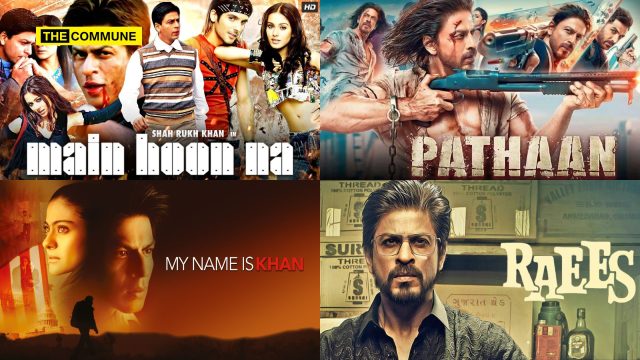
Shah Rukh Khan’s films have long been sold to us as harmless “family entertainers” or glossy, secular message – movies about love, peace and humanity. Yet, when you start revisiting some of his biggest hits with a colder eye, especially Main Hoon Na, My Name is Khan and Pathaan, a very different pattern begins to emerge.
Across two decades, these films repeatedly centre Muslim victimhood, soften or sanitise Islamist ecosystems, and redirect villainy onto Hindu nationalists, the Indian state, or a conveniently deracinated “system”. This article is not about personal hatred for an actor; it is about unpacking how carefully scripted scenes, emotional set–pieces and seemingly “progressive” plot twists work together as soft propaganda.
By zooming into specific moments, dialogues and character arcs, we will see how Bollywood’s biggest superstar has also been one of its most effective vehicles for normalising a particular politics of Islam, identity and nationalism.
Main Hoon Na (2004)
Released in 2004, Main Hoon Na was marketed as a bubbly campus comedy wrapped around a patriotic mission, arriving at a time when India was still reeling from Parliament and Kaluchak massacre. Beneath the song‑and‑dance, however, the film quietly rewires the viewer’s moral compass: a Hindu army officer becomes the face of “terror”, Pakistan is recast as a misunderstood peace partner, and the only prominent Muslim soldier is redeemed as a loyal Indian. This section unpacks how Farah Khan’s debut uses humour, nostalgia and national‑integration rhetoric to slip in some of the most brazen pro‑Islam, anti‑Hindu–nationalist messaging of its era.
Ex-Captain Khan’s “Redemption” Scene
The villain Raghavan’s second-in-command is an Ex-Captain named Khan, deliberately written as Muslim. At the film’s climax, this Khan character defects from the terrorist side, switches loyalty to India, and helps Major Ram (SRK) defeat Raghavan. The message is architecturally pro-Islam: the Muslim figure in a terrorist outfit isn’t truly a terrorist – he was “misled” and ultimately chooses right. The sin belongs to the Hindu nationalist, not the Muslim recruit.
Raghavan’s Crime – Killing “Innocent Pakistanis”
Raghavan’s entire backstory as a villain is built on the fact that he was court-martialled by the Indian Army for killing innocent Pakistanis, whom he suspected were spies. This framing is deeply ideological: the Indian Army is shown as punishing a soldier for being too anti-Pakistan. The moral framework of the film treats suspicion of Pakistani infiltrators as a criminal mindset deserving institutional punishment.
Project Milaap: The Peace-With-Pakistan Framework
The entire plot’s stated “good” objective is Project Milaap – a government initiative to facilitate peace with Pakistan by releasing Pakistani prisoners. Raghavan, the Hindu villain, opposes this peace. SRK, the Muslim-named hero, defends it. Every action scene in the film is structured around protecting an India–Pakistan peace deal, with the Hindu nationalist as the bomb trying to blow it up.
Villain Named “Raghavan” – Ram’s Own Name
Farah Khan admitted the villain was deliberately not given a Muslim name. She instead named him Raghavan, one of the many names of Bhagwan Ram from the Ramayana, meaning “descendant of Raghu.” With SRK playing Major Ram (hero) and the villain being Raghavan (anti-peace Hindu), this was a calculated inversion of Hindu symbolism – Ram’s own name is weaponised against Hindu nationalists.
My Name Is Khan (2010)
By 2010, My Name is Khan arrived as the definitive post‑9/11 Bollywood statement on Muslims and Islamophobia, with Shah Rukh Khan playing a gentle, autistic Muslim man on a mission to prove he is “not a terrorist”. The film was hailed globally as a humanist masterpiece, but its emotional power rests on a very clear ideological spine: Muslims are framed as perpetual victims, Islamic institutions are morally purified, and the burden of guilt is placed squarely on non‑Muslim societies. In this section, we track how key scenes in mosques, homes and public spaces are crafted to turn one man’s personal tragedy into a cinematic sermon about Islam and innocence.
The Mosque-Radical Confrontation Scene
Rizwan Khan enters a mosque and overhears Dr. Faisal Rahman preaching violent jihad, invoking the story of Abraham and Ishmael to justify self-sacrifice against “oppressors.” Rizwan interrupts the sermon and rejects the violent interpretation. This is the film’s central propaganda device: by having the hero confront and rebuke a radical inside a mosque, the film exonerates mainstream Islam of any link to terror placing radicalism as a fringe anomaly that “good Muslims” actively reject.
Rizwan Prays Openly at an American Bus Stop
When fellow Muslims express fear about praying openly in post-9/11 America, Rizwan refuses to hide his Islamic practice and prays publicly at a bus stop. Framed as an act of courage, this scene positions Islamic prayer and identity as something that should never be suppressed – even in a country that just suffered the worst Islamic terror attack in history. The scene systematically builds audience sympathy for public displays of Islamic identity in hostile environments.
“My Name Is Khan and I Am Not a Terrorist”
The film’s central emotional arc, Rizwan crossing America to tell the President his name and that he is not a terrorist, culminates in a mass public rally where Americans of all backgrounds take up his cause. Academically, the film was designed to demonstrate that the Muslim identity itself is under siege, and this scene is the propaganda payoff: the entire non-Muslim world (Hindus, Sikhs, journalists) unites to vindicate one Muslim man’s innocence.
Hindu/Sikh Characters as Vindictors of Muslim Innocence
In a notable narrative choice, the film shows it is Hindu journalists and a Sikh character who first notice Rizwan is innocent, amplify his story, and ultimately get him exonerated. This was likely inserted to make the film appear “secular” while the entire moral framework still centres Muslim victimhood as the cause all good people must rally around.
Sam’s Death Blamed on Islamophobia
After Rizwan’s stepson Sam is beaten to death by bullies, his mother Mandira irrationally blames Rizwan essentially blaming a Muslim for existing in a hostile environment. The film frames Sam’s murder as the direct consequence of Islamophobia, not random bullying, connecting Muslim identity to innocent death and societal guilt.
Blatant Islamic Propaganda
In one of the scenes, Rizwan who is married to Hindu single mother Mandira is shown doing namaz while she does her daily puja. Mandira feeds her son Sameer (Sam) prasad which seems to annoy Rizwan visibly. However, in contrast, when Rizwan finishes his namaz and gently blows on Sameer as part of the ritual, the child appears happy and receptive.
Mandira married Rizwan, she was a single parent to Sameer
After the puja, Mandira feeds Sameer prasad, which annoys him
But when Rizwan blows on him after namaz, Sameer is happy
But Dhurandhar is called propaganda pic.twitter.com/dlF8U2H4KI
— Tushar ॐ♫₹ (@Tushar_KN) April 1, 2026
Pathaan (2023)
Pathaan (2023) was sold as a comeback spectacle and a straight‑up patriotic spy thriller, complete with slick action, exotic locations and a hyper‑stylised Shah Rukh Khan. Look closer, though, and the film is doing far more than blowing up helicopters: it sentimentalises Afghan “Pathaans”, sanitises madrasas and maulanas, and asks Indian audiences to empathise with Pakistani operatives even as Kashmir and Article 370 sit at the story’s core. This section digs into those high‑octane set pieces to show how Pathaan dresses up a very specific re‑imagining of Islam, Pakistan and the Indian state in the costume of mass‑market entertainment.
The Madrasa Missile Diversion Scene
In Pathaan’s very first mission flashback, the US Army fires a missile at a Taliban GPS signal, but the target is actually a maulana teaching 30 children inside a madrasa. Pathaan grabs the maulana’s phone and throws it away, diverting the missile, saves the children, and is severely injured. This scene is probably the film’s most brazen propaganda insert: India’s superspy risks his life specifically to save a madrasa, children inside it, and a maulana with the US Army as the collateral villain.
The Pathaan Village “Adoption” Scene
Following the madrasa scene, Pathaan is nursed back to health by a Pathaan/Pashtun village in Afghanistan. A kind Pathaan woman ties a tabeez* (Islamic amulet/talisman) on his wrist and calls him “Our Pathaan”. He celebrates Eid with this Afghan family every year thereafter. This scene humanises and sentimentalises the very ethnic group (Pashtuns) who constitute the backbone of the Taliban at a time when Taliban-controlled Afghanistan is actively sheltering terrorists who attack India.
Pathaan’s Name = Afghan Islam
When asked about his identity, Pathaan explains his name comes from an Afghan Pashtun clan, and he was found as an orphan and raised by India. This origin story makes his Muslim identity literally Afghan-imported, ironically reinforcing the RSS claim that Islam is not indigenous to India, even while the film frames it as a celebration of Muslim identity.
Pakistan Motivated by Article 370 – Framed as Legitimate Grievance
The film opens with a Pakistani General learning of Article 370’s abrogation, calling it a “declaration of war” and arguing that Pakistan had been “pursuing diplomacy” until then. This scene effectively validates the Pakistani position on Kashmir treating the abrogation as a provocation that “explains” (even if not excuses) Pakistan’s retaliatory bioterror plot.
Rubina the “Good ISI Agent” Rescue
Indian intelligence agents are shown waterboarding Rubina, a Pakistani ISI operative. Pathaan assaults his own colleagues and rescues her, saying “Fear makes people blind”, positioning Indian anti-terror methods as morally equivalent to barbarism. This scene was designed to generate audience sympathy for a Pakistani spy, and by extension Pakistan’s intelligence apparatus, by framing Indian interrogation as the true cruelty.
Keffiyeh as Pathaan’s Signature Symbol
Throughout the film, Pathaan’s recurring visual marker is a keffiyeh – the Palestinian resistance scarf. This seems to be a deliberate choice to make a symbol of Islamic resistance acceptable to mainstream Indian audiences by attaching it to nationalism. Normalising the keffiyeh in an Indian spy thriller is itself ideological messaging, importing Palestinian Islamist symbolism into Indian popular culture under the cover of patriotism.
Raees (2017)
If Main Hoon Na, My Name Is Khan and Pathaan operate through symbolism and emotional framing, Raees makes the ideological tilt far more explicit by rooting it in crime, power and community identity. In Raees, Shah Rukh Khan plays a bootlegger who rises through Gujarat’s underworld, yet is persistently framed not as a criminal but as a Robin Hood–style protector of a marginalised Muslim community. The film repeatedly justifies Raees’ illegal empire as a response to systemic discrimination, turning law enforcement into an antagonistic force rather than a neutral institution. Nawazuddin Siddiqui’s upright cop, Majmudar, becomes the face of a rigid state, while Raees is humanised through his philanthropy, religious identity and emotional vulnerability.
The “Baniye Ka Dimaag…” Dialogue as Identity Assertion
One of the film’s most quoted lines—“Baniye ka dimaag aur Miyanbhai ki daring”—is not just a punch dialogue but a deliberate construction of identity. It merges a stereotype of Hindu business acumen with a valorised image of Muslim fearlessness, positioning the latter as the driving force behind Raees’ success. The line subtly reinforces a pride-based Muslim identity while making it central to ambition and power.
The Mohalla Protector Narrative
Multiple scenes show Raees distributing money, solving local disputes, and acting as a benefactor within a predominantly Muslim locality. These sequences are designed to override his criminality by embedding him within a morally justified ecosystem—his illegality becomes “service”. The state is distant and harsh; Raees is immediate and compassionate. This framing builds a narrative where loyalty to community supersedes loyalty to law.
Religious Symbolism and Visual Coding
Throughout the film, Raees’ identity is visually reinforced through skull caps, mosque backdrops, and Eid celebrations. These are not incidental—they are repeatedly used to associate Islamic spaces with warmth, belonging and moral legitimacy. Even as the character runs an alcohol empire (ironically prohibited in Islam), the film avoids interrogating this contradiction, choosing instead to foreground religious imagery as a shield of cultural authenticity.
The “System vs Minority” Framing Through Majmudar
Inspector Majmudar’s pursuit of Raees is framed less as a battle against crime and more as a clash between a rigid, majoritarian system and a subaltern figure. Raees’ defiance is positioned as resistance, not lawlessness. This creates a moral inversion: the state appears oppressive, while the outlaw becomes the voice of a community pushed to the margins.
The Emotional Family-Man Arc
Raees’ relationship with his mother and wife is layered with moral messaging—his mother’s early lesson that “koi dhandha chhota nahi hota” becomes a philosophical justification for his later actions. The family scenes, often intercut with religious undertones, soften the audience’s perception and frame him as a product of circumstance rather than choice.
Taken together, these scenes and narrative choices ensure that Raees is not merely a gangster drama. It is a carefully constructed story where crime is moralised, identity is politicised, and sympathy is consistently directed toward a specific community framing—continuing the broader pattern visible across Shah Rukh Khan’s filmography.
A Pattern Hiding in Plain Sight
Taken together, Main Hoon Na, My Name Is Khan and Pathaan are not random outliers but parts of a coherent narrative project. Across genres and decades, they gently but consistently invert responsibility: Islamic symbols and spaces are sanitised, Muslim characters are framed as either innocent victims or superior moral anchors, while suspicion, aggression and bigotry are disproportionately loaded onto Hindus, the Indian state or faceless Western powers. Shah Rukh Khan has used his status as a superstar in Bollywood to pander to his Islamic backers to inject propaganda in every film of his.
Subscribe to our channels on WhatsApp, Telegram, Instagram and YouTube to get the best stories of the day delivered to you personally.