The DMK government in Tamil Nadu which claims to be sole custodian of Tamil rights and pride comprises of a cabinet where a third of ministers are of Telugu origin, and they sit over some of the most resource‑heavy portfolios in the state budget.
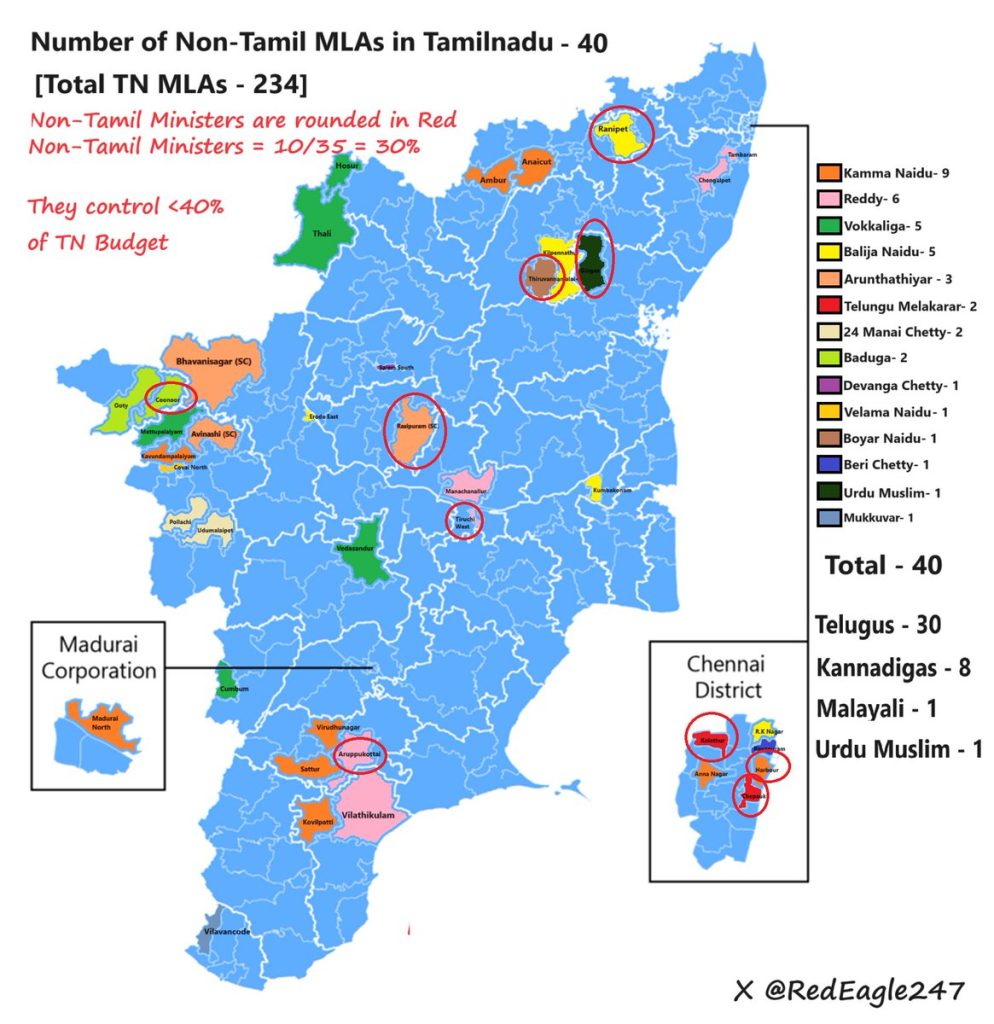
This article traces who they are, what they control, and how that squares with the claim that around 25% of ministers with non‑Tamil (specifically Telugu) roots influence significant portion of Tamil Nadu’s expenditure.
Karunanidhi–Stalin Lineage: Telugu Melakkarar Core
M. Karunanidhi, the architect of the current DMK lineage, was born to parents from the Isai Vellalar community, a caste of temple musicians and performers. The Isai Vellalar community itself is explicitly divided into Tamil and Telugu Melakkarar linguistic sects, the latter having descended from Telugu artisans who migrated into the Thanjavur region under the Nayak and Maratha courts.
Because Karunanidhi’s family is identified in his own biographies as belonging to the Isai Vellalar/Melakkarar lineage, the Stalin family including Chief Minister M.K. Stalin and Deputy Chief Minister Udhayanidhi Stalin share that Telugu‑rooted cultural ancestry even though they are politically projected as the face of Tamil nationalism. This makes the top of the so‑called Dravidian Model government itself anchored in a historically Telugu‑derived sub‑caste embedded inside Tamil society.
Mapping The Cabinet: Telugu-Origin Ministers
Using the official council of ministers list and major biographical references, we can identify ministers with clear Telugu roots.
#1 M.K. Stalin – Chief Minister
- Origin: Isai Vellalar – Telugu Melakkarar, via Karunanidhi’s family.
- Constituency: Kolathur, Chennai.
- Portfolios: Home, Police, Special Programme Implementation, general administration and all departments not allotted elsewhere.
- Budget weight: Police alone receives over ₹12,700 crore in 2025‑26; Home and related administration add several thousand crores more in establishment costs.
As CM, Stalin exerts overarching control over cabinet decision‑making, including budget prioritisation, law‑and‑order expenditure, and sanction of major schemes.
#2 Udhayanidhi Stalin – Deputy Chief Minister
- Origin: Same Isai Vellalar – Telugu Melakkarar lineage as his father.
- Constituency: Chepauk–Thiruvallikeni.
- Portfolios: Youth Welfare, Sports Development, Special Programme Implementation, Planning & Development.
- Budget weight: Planning and Development is the nodal wing steering welfare schemes and project planning; youth and sports see rising capital allocations for stadiums and infrastructure.
His presence ensures a second Telugu‑origin power centre at the core of the Dravidian Model’s planning architecture.
#3 E.V. Velu – Public Works (Buildings, Highways, Minor Ports)
- Origin: Telugu; his full name Ethirajulu Vajjaravelu is clearly of Andhra‑Telugu etymology, and he is widely identified as a Telugu leader from the northern belt. Reports note him belonging to the Telugu Gavara Balija community.
- Constituency: Tiruvannamalai
- Portfolios: Buildings, Highways, Minor Ports – essentially the roads & bridges and a large piece of the construction pipeline.
- Budget weight: The transport sector’s capital outlay on roads and bridges is pegged at ₹18,456 crore in 2025‑26, within a broader transport expenditure of about ₹27,971 crore.
Velu’s Telugu base thus commands the biggest single block of capital spending in the state budget.
#4 K.N. Nehru – Municipal Administration, Urban and Water Supply
- Origin: From the Reddiar community, an explicitly Telugu‑origin forward caste settled in Tamil Nadu.
- Constituency: Tiruchirappalli West.
- Portfolios: Municipal Administration, Urban Development, and Water Supply which cover corporations, municipalities, drinking water projects, and sewerage.
- Budget weight: Urban development and water supply see a sharp rise in capital outlay; PRS notes that urban development is among the sectors with the steepest increase, and together these heads aggregate to roughly ₹13,000–14,000 crore in 2025‑26.
Nehru therefore shapes how urban Tamil Nadu’s infrastructure is financed and expanded.
#5 K.K.S.S.R. Ramachandran – Revenue and Disaster Management
- Origin: Belongs to the Reddiyar community; biographical records and electoral affidavits use the suffix “Reddiyar”, again a Telugu‑origin caste.
- Constituency: Aruppukottai.
- Portfolios: Revenue, District Revenue Establishment, Deputy Collectors, Disaster Management.
- Budget weight: Revenue and disaster relief determine compensation payouts, land acquisition processes, and relief spending; together they handle several thousand crores annually, especially in flood‑ and cyclone‑prone years.
While much of the revenue department’s spending is classified as administrative, its control over land and relief flows gives disproportionate influence over local economies.
#6 R. Gandhi – Handlooms and Textiles
- Origin: Kamma Naidu, a Telugu agricultural‑trader community with a strong presence in Ranipet and Vellore districts; community‑specific sources list him among Kamma leaders from Tamil Nadu.
- Constituency: Ranipet, part of the northern Telugu belt.
- Portfolios: Handlooms & Textiles, Bhoodan and Gramdan.
- Budget weight: Handloom and textile policy affects subsidies, cooperative mills, and capital assistance for a sector that is a major employer; allocations here run into a few thousand crores when schemes and incentives are included.
Gandhi’s role links the Telugu business community with state support to textiles and loom cooperatives.
#7 P.K. Sekar Babu – Hindu Religious & Charitable Endowments (HR&CE)
- Origin: Identified by Kamma‑community documentation as belonging to the Telugu Kamma settler group in north Chennai.
- Constituency: Harbour, which has long‑settled Telugu and north‑Indian populations.
- Portfolios: HR&CE (which manages thousands of temples and their vast property), and chairing roles in the Chennai Metropolitan Development Authority (CMDA) through his ministerial charge.
- Budget weight: Although HR&CE’s budget head is modest compared with transport or education, the department controls significant temple lands, rental income, and endowments; CMDA decisions, meanwhile, influence large‑ticket urban land values and project approvals.
Sekar Babu thus wields strategic control over temple wealth and key planning decisions in the capital region.
#8 M. Mathiventhan – Adi Dravidar Welfare
- Origin: From the Arunthathiyar community, a Scheduled Caste whose roots are reportedly in Telugu‑speaking regions; anthropological records classify them as a Telugu‑origin group that migrated into Tamil country.
- Constituency: Rasipuram.
- Portfolios: Adi Dravidar Welfare, welfare of hill tribes and bonded labour.
- Budget weight: Targeted welfare schemes, scholarships, and housing for SC/ST communities fall under this ministry and account for several thousand crores in earmarked spending.
His position gives a Telugu‑origin SC leader control over a critical share of social‑justice expenditure.
#9 S. Masthan – Minister of Minorities Welfare & Waqf Board
How Much of the Budget Do These Telugu-Origin Ministers Oversee?
Tamil Nadu’s total expenditure (excluding debt repayment) for 2025‑26 is ₹4,39,293 crore, with capital outlay at ₹57,231 crore. Committed expenditure such as salaries, pensions, and interest eats up almost half of revenue receipts and is largely formulaic. The political leverage lies in:
Highways and buildings: ₹27,971 crore in transport sector spending, including ₹18,456 crore capital outlay on roads and bridges under E.V. Velu.
Energy sector: Capital outlay jump to ₹5,068 crore, though this portfolio is currently with a Tamil minister; still, it interacts with Stalin’s overall control of state public sector policy.
Urban development: A sector whose capital outlay is named by PRS as one of the three with the sharpest increase, overseen by K.N. Nehru.
Home & Police: Over ₹12,700 crore to Police alone, under Stalin’s direct charge.
SC/ST welfare, youth, planning and other schemes under Udhayanidhi, Mathiventhan and others collectively run into several thousand crores.
If one aggregates only the clearly Telugu‑headed big‑ticket sectors such as Highways (Velu), Urban & Water (Nehru), Home/Police (Stalin), and key welfare heads (Mathiventhan, Udhayanidhi), the associated expenditure easily crosses ₹1–1.5 lakh crore, depending on how sub‑heads are grouped. Relative to the total ₹4.39 lakh crore, this cluster approaches around 40% once broader scheme‑linked and establishment spending under these ministries are included, even before considering temple‑land and CMDA‑linked economic influence via Sekar Babu.
In other words, while precise quantification needs granular department‑wise numbers, there is strong evidence that a relatively small Telugu‑origin bloc occupies several of the most capital‑intensive and policy‑heavy posts in the DMK government.
What This Means For The “Dravidian Model”
The DMK’s Dravidian Model is marketed as a Tamil social‑justice project, but the social base of its leadership tells a more layered story.
- The Karunanidhi family itself is of Telugu Melakkarar stock, rooted in a migrant musician caste that was linguistically Telugu.
- A cluster of Telugu‑origin elites viz, Reddiars, Kamma Naidus, Melakkarars hold core portfolios in highways, urban infrastructure, revenue administration, and temple‑land management.
- These ministries collectively sit over some of the highest discretionary and capital outlay items in the budget, meaning strategic control over where money flows and where physical assets like roads, flyovers and urban layouts are created.
Taken together, the picture that emerges is not merely of “30% non‑Tamil ministers,” but of a Telugu‑origin power spine running through the top of the Tamil Nadu cabinet: the chief minister and his heir, the highway baron, the urban czar, the revenue strongman, and the temple‑infrastructure manager. This configuration allows a historically migrant, now entrenched set of communities from Andhra‑linked lineages to exercise influence over a disproportionately large slice of Tamil Nadu’s future.
Subscribe to our channels on WhatsApp, Telegram, Instagram and YouTube to get the best stories of the day delivered to you personally.