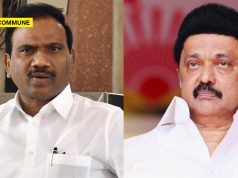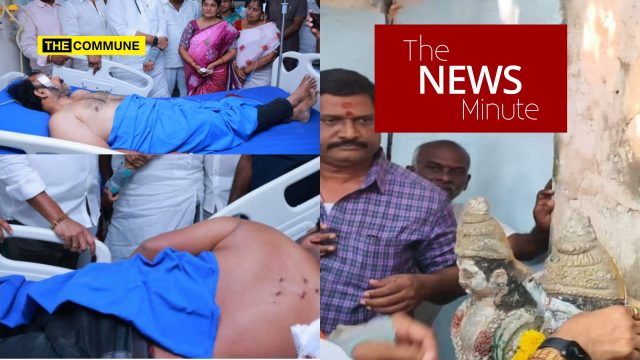
A violent mob attack on a sitting Deputy Speaker at a Hindu temple on Sri Rama Navami became, in The News Minute’s telling, a story about Dalit oppression. Here is what the outlet left out and what it deliberately buried.
What Actually Happened on March 27
As reported in Organiser, on the morning of Sri Rama Navami, 27 March 2026, Andhra Pradesh Assembly Deputy Speaker and Undi MLA K. Raghu Rama Krishna Raju visited the Ramalayam temple in Pedapeta, Akividu, West Godavari district, to offer prayers and garland the idol of Lord Rama. He had been invited by local Hindus who had been seeking the temple’s renovation for years.
After completing the darshan and as his convoy began to leave, a group armed with knives, sticks embedded with nails, and stones launched a coordinated attack on the Deputy Speaker and the Jana Sena and TDP leaders present. Three persons were grievously injured, including one who was stabbed approximately 12 times and hospitalised in critical condition in Bhimavaram. Another sustained a nail injury to the head.
శ్రీరామనవమిని పురస్కరించుకుని పశ్చిమ గోదావరి జిల్లా, ఆకివీడు మండలం, పెద్దపేట గ్రామంలోని రామాలయాన్ని దర్శించుకోవడానికి వెళ్లిన రాష్ట్ర డిప్యూటీ స్పీకర్ @KRaghuRaju గారిపై, కూటమి నాయకులు, కార్యకర్తలు, భక్తులపై దాడి జరగడం అత్యంత ఆందోళనకరం.
దేవాలయ ప్రవేశాన్ని అడ్డుకోవడం, హింసకు… pic.twitter.com/o9Ar4t7A6t
— PVN Madhav (Modi Ka Parivar) (@MadhavBJP) March 27, 2026
Police registered an FIR against 58 accused, adding serious charges including attempt to murder under Section 109(1) of the Bharatiya Nyaya Sanhita, carrying a punishment of over 10 years, and Section 308(2) related to attempt to commit culpable homicide. All 58 were produced before a court on March 28.
AP Chief Minister Nara Chandrababu Naidu, Deputy CM and Jana Sena President Pawan Kalyan condemned the attack.
ఉండి నియోజకవర్గం ఆకివీడు మున్సిపాలిటీ పరిధిలోని శ్రీరామనవమి సందర్భంగా అక్కడ ఉన్న పురాతన ఆలయానికి పూజకు వెళ్తున్న డిప్యూటీ స్పీకర్ శ్రీ కే రఘు రామకృష్ణ రాజు పై, కూటమి నాయకులపై కొందరు దాడి చేయడాన్ని ముఖ్యమంత్రి శ్రీ నారా చంద్రబాబు నాయుడు తీవ్రంగా ఖండించారు. దశాబ్దాలుగా నిరాదరణకు…
— CMO Andhra Pradesh (@AndhraPradeshCM) March 27, 2026
హిందువులు అత్యంత పవిత్రంగా జరుపుకొనే శ్రీరామ నవమి రోజున, ఆకివీడులో రామాలయానికి పూజలో పాల్గొనేందుకు వెళ్లిన గౌరవ శాసనసభ ఉప సభాపతి @KRaghuRaju గారిపై, ఆయన అనుచరులపై, జనసేన నాయకులపై కొంతమంది వ్యక్తులు ఆయుధాలతో దాడి చేయడం తీవ్రంగా ఖండిస్తున్నాను.
పండుగ రోజు, ఆలయం దగ్గర ఈ దాడి జరగడం…
— Deputy CMO, Andhra Pradesh (@APDeputyCMO) March 27, 2026
What The News Minute Reported Instead
The News Minute published its account on 31 March 2026, four days after the attack, under the headline: “Andhra Pradesh: TDP-RSS call for building Rama temple leads to tensions with Dalits.”
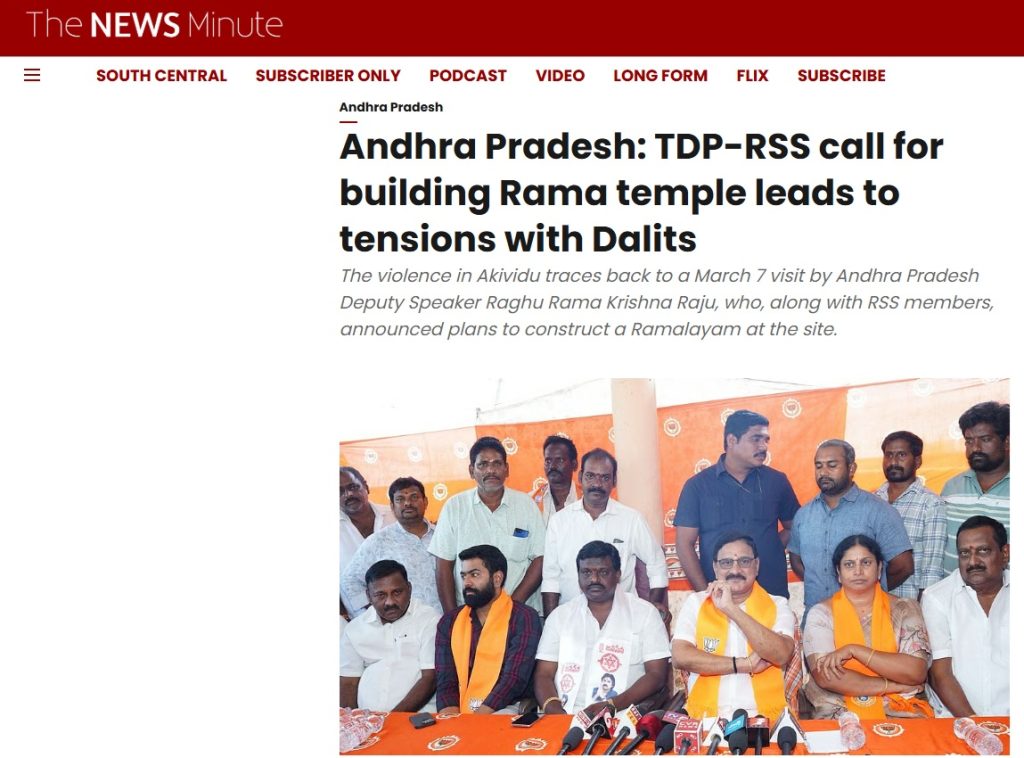
The framing only does narrative inversion. Consider what the headline does:
- The victims, Hindu devotees at a temple on a festival day, disappear entirely
- The attackers are recast as “Dalits” facing “tensions”
- The Deputy Speaker visiting a temple for prayers becomes a TDP-RSS aggressor “calling for building a Rama temple”
- A knife attack on worshippers becomes a “tension” – a word that implies mutual provocation
The article relies almost exclusively on a fact-finding report by the left-leaning Human Rights Forum (HRF), a Hyderabad-based civil liberties group, as its primary source, while treating the statements of the Deputy Speaker, the AP Chief Minister, Deputy CM Pawan Kalyan, police FIR details, and the injured victims as either secondary or unworthy of equivalent weight.
The Four Critical Facts TNM Buried
#1 The attackers were not simply “Dalits” – they were identified Christians
Deputy Speaker Raghu Rama Krishna Raju stated clearly to media: “Christians in the guise of Dalits, while I was having darshan of Bhagwan Rama, shouted loudly, and immediately after I left from there, they attacked the Rama devotees present at the temple with knives and made an attempt to murder many people.”
The Deccan Chronicle reported that among those being hunted by police was one Ismail, identified as having led the attacking group. The presence of a person named Ismail leading an assault on a Hindu festival at a Hindu temple is not a detail that fits the “Dalit vs TDP” narrative. TNM did not mention it.
#2 The temple is documented as a Rama temple in government records dating to 1923
Local Hindus and the Deputy Speaker both stated that land records confirm this is a Rama temple spread over 2.33 acres, with documentation from 1923 onwards. TNM instead relied on the HRF report characterising it as a “choultry” – a framing that conveniently erases a century of recorded history.
#3 The attack was pre-planned, not spontaneous
Raghu Rama Krishna Raju told media that on the evening before the attack (March 26), outsiders from a particular community had arrived in the village indicating advance organisation. A spontaneous communal flare-up does not involve outsiders travelling to a village the night before. TNM described it as violence arising from “repeated confrontations” stripping out all evidence of premeditation.
#4 Section 144 was imposed after the attack – not before
TNM’s framing implies a police crackdown on Dalits after communal tension. The documented sequence is the reverse: 58 members of the attacking group were arrested and charged with attempt to murder. Police imposed Section 144 to prevent retaliatory violence, not to suppress Dalit protest.
The HRF Shield
TNM’s primary armour against factual scrutiny is its near-total reliance on the Human Rights Forum (HRF), a civil liberties group that explicitly describes itself as “non-political” but whose own founding statement says its perspective was shaped by “militant leftist movements”. By presenting HRF findings as authoritative fact-finding and reducing police FIRs, CM statements, and eyewitness accounts to mere “claims,” the outlet creates an asymmetry: the left-leaning, anti-establishment narrative gets the weight of a “report,” while documented violence against Hindus gets treated as merely contested.
This is a structurally dishonest approach to journalism. A fact-finding report published by a civil society organisation three days after an incident, without access to the FIR, forensic evidence, hospital records, or police investigation is not equivalent to contemporaneous reporting, police documentation, and statements by the sitting state government. TNM presents it as though it is.
TNM Being TNM – Narrative Twist Is Its Middle Name
The Akividu coverage does not appear to be an isolated instance. It aligns with a broader pattern in how The News Minute has framed similar incidents where episodes of violence at Hindu religious sites are often presented through the lens of “tensions,” with emphasis placed on underlying social dynamics rather than the specifics of the attack.
In the case of Akividu, the incident occurred on Sri Rama Navami 2026, with reports of devotees being attacked and multiple injuries recorded, including a serious stabbing. Yet, the framing of the episode as a dispute or tension has raised questions about whether the description fully reflects the severity of the events reported elsewhere.
Subscribe to our channels on WhatsApp, Telegram, Instagram and YouTube to get the best stories of the day delivered to you personally.