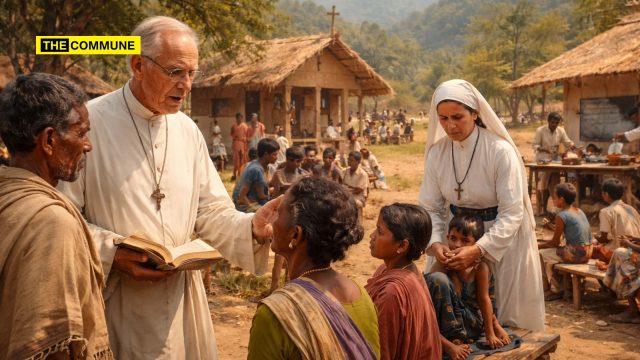
For nearly a century before Indian independence, Christian missionaries, primarily Lutheran, Roman Catholic, and various Protestant denominations, had established a near-complete dominance over education, healthcare, and social services in the tribal belts of central India. The regions of Surguja, Jashpur, Udaipur, Changbhakar and surrounding erstwhile native states in what is today Madhya Pradesh (and later Chhattisgarh) were home to large concentrations of aboriginal tribal communities – communities that had little access to modern education and healthcare, and which missionaries had systematically targeted for over a hundred years.
The arrangement was straightforward: missions provided schools, hospitals, orphanages, and leper homes. In return, they gained unparalleled access to the most vulnerable sections of Indian society – access that was routinely used to facilitate religious conversion. As the Niyogi Committee would later record after exhaustive inquiry: “there was a general complaint from the non-Christian side that the schools and hospitals were being used as means of securing converts.”
When the British left India in 1947, these native states were merged into Madhya Pradesh. With that merger came something the missionaries had never faced before – an accountable, elected Indian government that wanted to serve its own tribal citizens directly.
The Spark: MP Government’s Backward Area Welfare Scheme
Soon after Independence, the newly elected Madhya Pradesh government launched its Backward Area Welfare Scheme – a programme specifically designed to bring government-run schools and social services to tribal areas that had historically been neglected or, more precisely, left entirely to missionary organisations.
The intent was constitutional and straightforward: the Indian state had a duty to provide education to its most marginalised citizens. Scheduled Tribes and backward communities in the tribal heartland deserved schools funded and run by their own government – schools that were religiously neutral, publicly accountable, and free from the condition of conversion.
The missionary response was immediate, organised, and fierce.
The Missionary Attack on Government Schools
The Niyogi Committee Report, the most comprehensive government investigation into missionary activities ever conducted in India, documented what happened next in unambiguous terms: “The Missionaries launched a special attack on the opening of schools by Madhya Pradesh Government under the Backward Area Welfare Scheme.”
This was not passive resistance or quiet lobbying. The missionaries mounted an active agitation, mobilising tribal Christian converts against the state government’s welfare initiative. The committee documented how missionaries deliberately inflamed religious sentiment among tribal communities to turn them against the government’s schools: “They started an agitation, playing on the religious feelings of the primitive Christian converts, representing the Madhya Pradesh Government as consisting of infidels and so on.”
In other words, tribal converts were being told that the Indian government, their own government, was an enemy of their faith, and that accepting education from a government school was tantamount to accepting the rule of “infidels.”
The Missionary Press: Echoes of Pakistan
The agitation was not limited to speeches and village-level mobilisation. Missionary-controlled publications became active propaganda organs. The committee specifically cited three missionary newspapers, ‘Nishkalank’, ‘Adiwasi’ and ‘Jharkhand’ and noted with alarm: “Some of the articles published in Missionary papers, such as ‘Nishkalank’, ‘Adiwasi’ and ‘Jharkhand’ were hardly distinguishable from the writings in Muslim papers advocating Pakistan before the 15th of August 1947.”
This was a devastating comparison. The committee was drawing a direct parallel between the secessionist political demands being fanned by missionaries among tribal communities and the communal separatism that had just torn the subcontinent apart in 1947. The implication was grave: that missionaries were not merely running schools and hospitals but actively working to drive a wedge between tribal communities and the Indian nation-state.
The Adiwasisthan Demand
The schools controversy was part of a broader, more alarming political pattern that the committee documented in detail. Missionaries had been instrumental in nurturing the demand for ‘Adiwasisthan’, a separate sovereign state carved out of tribal areas, among the aboriginal communities of central India.
The committee noted that the Christian community in the Ranchi district, described as being “‘supported’ by the Missionaries,” had organised itself into a body called ‘Raiyat Warg’ – ostensibly a social work organisation but, in the committee’s assessment, a vehicle for propagating the Adiwasi separatist movement.
Crucially, the committee traced the ideological roots of this separatism directly to colonial-era missionary policy: “The separatist tendency that has gripped the mind of the aboriginals under the influence of the Lutheran and Roman Catholic Missions is entirely due to the consistent policy pursued by the British Government and the Missionaries.”
This was the deepest charge: that decades of missionary education had been deliberately designed not to integrate tribal communities into mainstream Indian society, but to create a separate, alienated, foreign-funded constituency — one that could be mobilised against the Indian state whenever necessary.
The Niyogi Committee: Scope and Findings
The Christian Missionary Activities Enquiry Committee, Madhya Pradesh was constituted in April 1954 by the state government, chaired by Dr. M. Bhawani Shankar Niyogi, retired Chief Justice of the Nagpur High Court, along with five other members including M.B. Pathak, Ghanshyam Singh Gupta, S.K. George, Ratanlal Malviya, and Bhanu Pratap Singh. It submitted its report on 18 April 1956.
The scale of the inquiry was remarkable:
- Contacted 11,360 persons across 14 districts
- Visited 77 centres including hospitals, schools, churches, leper homes, and hostels
- Interviewed people from 700 villages
- Received 375 written statements and 385 replies to a 99-question questionnaire: 55 from Christians, 330 from non-Christians
The committee’s findings documented a systematic pattern of abuse:
- Schools, hospitals, and orphanages were being used as instruments of proselytisation, not purely as charitable work – poor boys were attracted to mission schools through fee waivers and freeship, with the committee noting: “Only such people are rendered help, in whose case there are some chances of conversion”
- Missionaries had used “threats and intimidation” against tribal communities that resisted conversion
- Evangelists sang “provocative songs denouncing Hindu religion” inside tribal villages
- Roman Catholic priests were found visiting newborn babies to give blessings “in the name of Jesus”, taking sides in local litigation, and interfering in domestic quarrels as means of securing influence
- The report documented instances of “kidnapping of minor children, abduction of women” and “recruitment of labour for plantations in Assam or Andaman” as means of propagating the Christian faith among illiterate communities
- Foreign organisations were funnelling the equivalent of ₹25 crore annually into conversion projects, with 4,877 foreign missionaries operating across India
The Committee’s Recommendations
Having documented this pattern, the Niyogi Committee made recommendations that remain remarkably relevant in the context of the FCRA Amendment Bill 2026:
- Government should establish a policy that the responsibility for providing social services; education, health, medicine to Scheduled Tribes, Scheduled Castes, and other backward classes rests solely with the state government, with non-official organisations permitted to run institutions only for members of their own religious faith
- Institutions receiving government grants-in-aid should be compulsorily inspected every quarter by government officers
- Circulation of literature meant for religious propaganda should require approval of the state government
- Foreign funding for religious conversion activities should be strictly regulated
Why It Was Buried
Despite the comprehensiveness of the report, its findings were largely suppressed in the years that followed. As historian Sita Ram Goel documented, the powers that be, “the Government, the political parties, the national press and the intellectual elite”, either protected the missions or “shied away from studying and discussing the exposures publicly for fear of being accused of ‘Hindu communalism’, the ultimate swear-word in the armoury of Nehruvian Secularism.”
The Secretary of the Catholic Bishops’ Conference of India himself admitted that the report “created a sensation everywhere in India”, yet it was never acted upon in any meaningful legislative sense.
The Thread to 2026
Seventy years after the Niyogi Committee submitted its report, the FCRA Amendment Bill 2026 proposes, at its core, what the committee had recommended in 1956: that the Indian state must have the power to scrutinise, regulate, and if necessary, control the assets of foreign-funded organisations operating in the name of charity.
That Cardinal Baselios Cleemis now speaks of “anxiety” over a government seeking accountability over foreign-funded NGOs is, in the light of the Niyogi Committee’s findings, a history rhyming with uncomfortable precision.
Subscribe to our channels on WhatsApp, Telegram, Instagram and YouTube to get the best stories of the day delivered to you personally.