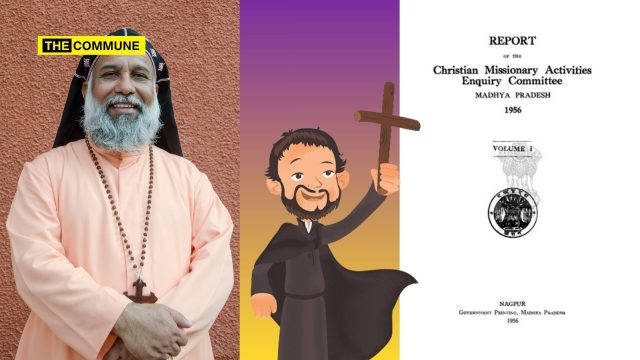
As Parliament debated the Foreign Contribution (Regulation) Amendment Bill, 2026, one of India’s most senior Catholic leaders stepped forward to voice what he called the collective unease of an entire community. Cardinal Baselios Cleemis Catholicos, President of the Kerala Catholic Bishops’ Council (KCBC), publicly stated that the bill has “caused anxiety and pressure among Christian communities,” urging the Central Government to reconsider the proposed changes before it becomes law.
The Cardinal’s statement, delivered at a press conference, has since ignited a political firestorm particularly in Kerala, where Assembly elections are scheduled for 9 April 2026 and has reopened a decades-old debate about the role of foreign-funded missionary activity in India.
Speaking to media, he said, “The context of the amendment of the new FCRA Bill 2026 presented in the Parliament which gives us certain anxieties. The Christian communities have experienced a sort of anxiety and a little pressure on us as we discharge our duties as missionaries, as well as those who have been building up this nation with our commitment and communion. The new bill with its specific amendments have brought certain anxieties, especially as it is presented in the Parliament with a designated point of reference. This is meant for those who are converting, for example. What is it all about? This is in continuation of the FCRA Bill established in 1976, later amended in 2010, and then now 2026 as a recent amendment. There is a pressure on those NGOs who have been trying to protect the interest of the vulnerables in India through different services. And more than a court, this designated authority has acquired incredible power to cancel and to take over and to take complete control over the assets which these NGOs have already created. If there is even only a small portion which you received as foreign contribution, the whole setup, the whole building, the whole property should be taken by this authority, the designated authority, as its supreme power, like. So, these concerns, these attitudes which are reflecting in a new bill naturally invite us to be reflective on the consequences. That is why all the churches, all the major political parties, of course, the opposition parties, they raise their concerns.”
“FCRA amendment bill has caused anxiety and pressure among Christian communities.”
– Cardinal Baselios Cleemis, President of the Kerala Catholic Bishops’ Council pic.twitter.com/ZIpgGN3ZX4
— News Arena India (@NewsArenaIndia) March 31, 2026
The Foreign Contribution (Regulation) Amendment Bill, 2026 was introduced in the Lok Sabha on 25 March 2026, by Minister of State for Home Affairs Nityanand Rai, on behalf of Home Minister Amit Shah. It proposes significant changes to India’s existing FCRA framework – a law that regulates how individuals and organisations receive foreign funding.
A Warning Written 70 Years Ago: The Niyogi Committee
What makes the current FCRA debate uniquely layered is the historical precedent it evokes – one that dates back to the very early years of independent India.
In April 1954, the Madhya Pradesh state government constituted the Christian Missionary Activities Enquiry Committee, popularly known as the Niyogi Committee, after its chairman M. Bhawani Shankar Niyogi, a retired Chief Justice of the Nagpur High Court. Over two years, the committee conducted one of the most thorough government investigations into missionary activities ever undertaken in India: it contacted 11,360 persons, interviewed people from 700 villages, and received 375 written statements before publishing its report in 1956.
The Schools Episode
Among the committee’s most striking findings was an incident that directly mirrors today’s tensions over the FCRA. When the post-Independence Madhya Pradesh government launched its Backward Area Welfare Scheme, an initiative to open government-run schools in tribal areas, missionaries mounted fierce opposition to it. As documented in the Niyogi Committee findings and subsequently recorded by historian Sita Ram Goel: “The Missionaries launched a special attack on the opening of schools by Madhya Pradesh Government under the Backward Area Welfare Scheme.”
The logic was straightforward and deeply revealing. Missionaries had until then enjoyed a near-monopoly over education in tribal regions, and schools were not merely centres of learning. They were the primary gateway through which tribal communities were introduced to Christianity and gradually drawn into conversion. A government school, publicly funded and religiously neutral, represented a direct threat to that pipeline.
The committee’s findings went far beyond the schools controversy. It documented a systematic pattern that it deemed incompatible with India’s constitutional framework:
- Schools, hospitals, and orphanages run by missions were being used as instruments of proselytisation, not purely as charitable or social work
- Missionaries had used “threats and intimidation” against tribal communities that resisted conversion
- Evangelists sang “provocative songs denouncing Hindu religion” inside tribal villages
- The report documented instances of “kidnapping of minor children, abduction of women” conducted under the cover of missionary activity
- Perhaps most alarmingly, the committee found that some missions had ties to the demand for ‘Adiwasisthan’, a proposal for a separate state carved out of tribal areas, a demand that had been raised in 1938 alongside the demand for Pakistan.
- Foreign organisations were funnelling the equivalent of ₹25 crore annually (an enormous sum in 1950s India) into conversion projects in the country, with 4,877 foreign missionaries then operating across India
The Thread That Connects Them
Seventy years separate the Niyogi Committee report and the FCRA Amendment Bill 2026. Yet the essential tension at the heart of both remains unchanged: the question of whether foreign-funded institutions operating under the banner of charity and education in India’s most vulnerable communities are also, simultaneously, instruments of religious and political influence and how the Indian state ought to respond.
Subscribe to our channels on WhatsApp, Telegram, Instagram and YouTube to get the best stories of the day delivered to you personally.