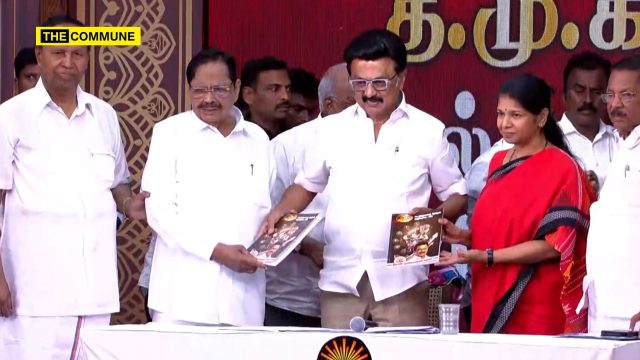
On 12 March 2021, DMK President M.K. Stalin stood before the cameras and released a 505-point manifesto. The party came to power six weeks later with a slightly larger vote percentage but bigger number of seats, compared to the opposition.
Five years on, with the state preparing to vote again on 23 April 2026, a full accounting of those 505 promises reveals a government that delivered genuinely on welfare transfers for women and a handful of direct benefit schemes but systematically failed on structural commitments, institutional reforms, economic relief, and governance pledges that would have required political will rather than treasury disbursements.
The government itself cannot agree on how many promises it kept. Chief Minister Stalin said 364 of 505 had been implemented. Finance Minister Thangam Thennarasu told a press conference that 206 had been fulfilled and 170 were being implemented, arriving at a 75% figure. By March 2026, a party MLA escalated the number to 404, and a party spokesperson claimed 490 out of 505 – a staggering 97%. Four different figures, from the same government, on the same promises, within months of each other.
When a ruling party cannot agree internally on its own record, the promises deserve independent scrutiny. Here is what that scrutiny reveals.
Fuel and Gas Relief: The Promises That Hit Every Household
No promises in the 2021 manifesto touched more households directly than the relief pledges on fuel, cooking gas, and milk. The outcomes were, at best, partial; at worst, entirely absent.
Promise No. 504 committed the DMK to reducing the price of diesel by ₹4 per litre through a cut in state taxes. As of May 2026, diesel prices have not been reduced by a single paisa under the Stalin government. The state has not touched diesel taxation in five years.
Promise No. 504 (the same clause) and broader campaign rhetoric promised to cut petrol by ₹5 per litre. In August 2021, the government reduced petrol by ₹3 per litre through a state excise cut – a ₹2 shortfall on a ₹5 promise, delivered in the first budget and never revisited. The government declared this a fulfilled promise.
Promise No. 503 guaranteed every ration cardholder a ₹100 subsidy per LPG cylinder – one of the most tangible relief pledges in the manifesto. With over 2 crore ration card families in Tamil Nadu and LPG prices regularly crossing ₹900 per cylinder, this was a promise of real daily consequence. It was never implemented. Not partially, not conditionally, simply not done.
Promise No. 505 on Aavin milk, a ₹3/litre price reduction, was the one relief promise the government delivered on, doing so within days of taking office in May 2021. That solitary delivery only throws the failure on the other three promises into sharper relief.
The Assembly That Barely Sat: Democracy’s Own Broken Promise
If a single data point encapsulates the gap between the DMK’s rhetoric and its governance, it is Promise No. 376. The 2021 manifesto specifically attacked the AIADMK for convening the Assembly too infrequently and gave a firm commitment in writing: “DMK will ensure that the Assembly is convened for at least 100 days or more.”
The 16th Tamil Nadu Legislative Assembly, presided over by Chief Minister M.K. Stalin, met for a total of 155 days across five years – an average of 32 sitting days per year. This is the lowest sitting count for any full-term Tamil Nadu Assembly since 1952, when the first general elections were held in independent India. It is lower than the 40 days averaged by the AIADMK government of 2011–16 and lower than the 34 days averaged by the AIADMK government of 2016-21, the very government the DMK cited in its manifesto as a failure on this count.
The numbers within those 155 days are equally telling. Ministerial statements in the House numbered just 32 in the entire five-year term compared to 185 in the 2011-16 term and 177 in the 2016-21 term. Calling attention motions totalled only 35, against 70 in the previous Assembly. The promise was 100 days per year. The reality was 32. The party that made legislative accountability a manifesto issue delivered the least accountable Assembly in 74 years.
Employment: The 5.5 Lakh Jobs That Did Not Come
Promise No. 179’s commitment to create 5.5 lakh jobs in government departments was arguably the most consequential economic pledge in the manifesto, targeting Tamil Nadu’s large pool of educated unemployed youth. By September 2023, two and a half years into the government’s term, opposition leader and PMK founder Dr. S. Ramadoss stated on record that the government had created only 22,781 jobs, with over 4 lakh vacancies remaining unfilled and no new positions created as promised. The government responded by promising 50,000 more jobs in the remaining two years – a tacit admission that the 5.5 lakh target was never in reach. By March 2026, the DMK’s own 2026 manifesto is again promising to create 1.5 lakh government jobs in the next term, effectively acknowledging the 2021 employment commitment remains unfulfilled.
Promise No. 196 pledged legislation reserving 75% of private sector jobs for locals – a demand with broad popular support in a state with significant migrant labour competition. Not only was this legislation not enacted, it was not even tabled. The government cited legal and administrative complexity, but no serious attempt to navigate that complexity was visible in five years.
Promise No. 179 said priority would be given to first-generation graduates in government recruitment. No structured policy, quota, or administrative order implementing this preference has been notified. The promise was made to students who were the first in their families to earn a degree and it was quietly abandoned.
Education: Committees, Not Outcomes
Promise No. 3 to formulate a separate State Education Policy for Tamil Nadu was partially addressed. The government constituted the Justice Murugesan Committee, which resulted in the Tamil Nadu School Education Policy 2025. However, the Higher Education Policy, covering colleges and universities, remains unformulated. Half a promise is not a promise kept.
Promise No. 160 pledged to get NEET abolished for medical admissions. The government passed legislation to exempt Tamil Nadu from NEET, not once but twice. Both times, the President withheld assent. The promise remains unfulfilled, though not for want of legislative effort by the state. The constitutional and political deadlock with the Centre is real, but the outcome for Tamil Nadu’s medical aspirants is unchanged: NEET continues.
Promise No. 159 to waive education loans for graduates under 30 years of age who are unable to repay within a year was never operationalised. No scheme was announced, no budget allocation made, and no beneficiaries identified under this specific commitment.
Promise No. 332 of a 2.5% reservation in medical colleges for students from government-aided schools – a promise specifically designed to give access to poor students with strong academic records was never enacted. No legislation was introduced, no administrative order was issued.
Institutions Never Built
Promises No. 53 and No. 54 committed the DMK to establishing a Horticulture University in Krishnagiri and an Agriculture University in Madurai. Tamil Nadu is a significant horticultural and agricultural state, and both institutions were intended to provide specialised research and training at the grassroots level. Five years later, neither university has been established. There is no campus, no faculty, no student intake, and no construction timeline. Both remain entirely on paper.
Promise No. 53 companion clause mentioned a Turmeric Research Institute in Erode, recognising Erode’s status as Asia’s largest turmeric trading centre. No such institute has been established or broken ground.
Anti-Corruption Courts: The Promise That Exposed the Limits of Accountability
Promise No. 21 was among the most politically explicit commitments in the entire manifesto. It read: “DMK will establish special courts to handle corruption cases against former AIADMK Ministers and expedite its function.” The DMK came to power with a specific, formal commitment to fast-track accountability for the party it replaced.
The DVAC did register cases against select former AIADMK Ministers. But the promised special courts were never constituted. The cases proceed through ordinary courts at ordinary pace. The PMK noted in its August 2025 assessment: “The government also failed to strengthen the Lokayukta and did not set up special courts to curb corruption, despite firm assurances”. Five years of DMK governance produced no structural change in how corruption cases are prosecuted in Tamil Nadu.
The Old Pension Scheme: A Conditional Future Promise, Not a Delivery
Promise No. 309 called for the restoration of the Old Pension Scheme, abolished in 2003, for government employees — a demand that government employee unions had been pressing for over two decades. The DMK made this a clear, unconditional commitment.
In January 2026 — five years after the promise, three months before the election — Chief Minister Stalin launched the Tamil Nadu Assured Pension Scheme (TAPS). TAPS is not the OPS. It guarantees 50% of the last drawn salary, whereas OPS had no such cap. Crucially, TAPS will take effect only from January 1, 2027 — and only if the DMK wins the April 2026 election. A promise made in 2021 has been converted into a pre-election announcement that will activate only if the party is re-elected, contingent on a future mandate rather than honouring a past one. JACTTO-GEO and government employee unions, who had gone on strike demanding OPS restoration, continue to hold that TAPS is not what was promised.
Monthly Electricity Bills and Kalaignar Canteens: The Routine Unfulfilled
Promise No. 221 pledged to replace Tamil Nadu’s bimonthly electricity billing system with monthly billing, estimating that the change alone would save households up to ₹6,000 annually on their power expenses. As of March 2026, TANGEDCO continues to issue bimonthly bills. A report from August 2025 noted that TANGEDCO was still conducting “exploratory discussions” on the feasibility of monthly billing – four years after the promise was made. This is a promise that required administrative will, not legislative approval or central government cooperation. It was simply never implemented.
Promise No. 331 committed to establishing 500 Kalaignar Canteens – subsidised food outlets for the poor and underprivileged in the first phase of implementation. The government did open canteens under the Kalaignar Unavagam brand in select locations. The 500-canteen target, however, has not been met.
What the Government Did Deliver
A fair accounting requires acknowledging what worked.
The Kalaignar Magalir Urimai Thittam, providing ₹1,000 per month directly to 1.31 crore women heads of families, was implemented and sustained with a special ₹5,000 lump sum credited in one tranche, just before the elections were announced, in February 2026. This was real money in real hands, and it represented a significant welfare delivery. Free bus travel for women, now expanded under the Vidiyal Payanam scheme, transformed mobility for women across urban and semi-urban Tamil Nadu. The Aavin milk price cut of ₹3/litre was delivered within days of the government taking office but the prices kept fluctuating and quality of milk started going down. The separate agriculture budget, a first for Tamil Nadu, was presented as promised.
Beyond the manifesto, the government introduced several schemes it had not announced in 2021: the Chief Minister’s Breakfast Scheme for primary school children, Pudhumai Penn (₹1,000/month for girl students in higher education), Naan Mudhalvan for career guidance, and Illam Thedi Kalvi for post-COVID learning recovery. These were genuine governance contributions. The government has repeatedly cited them to offset its manifesto failures – a rhetorical move that holds limited merit, since voters cast their vote in 2021 based on specific promises, not unannounced future schemes.
The Arithmetic of Accountability
Finance Minister Thennarasu’s official statement acknowledged that 20 promises were dropped as “not feasible,” without identifying a single one. A further 33 were classified as pending with the Union Government, a category that effectively shifts responsibility to New Delhi. Another 40 remained “under consideration” even after five years in office.
By the government’s own admission, more than a third of the 505 electoral promises fall into the categories of dropped, delayed, or unimplemented. The actual figure, based on available evidence, appears to lie somewhere else but closer to the opposition’s estimate than the government’s projection.
The broader governance record reinforces this gap. The Assembly reportedly functioned for fewer than 32 days annually, key welfare assurances such as ₹100 subsidy per LPG cylinder saw no implementation, and commitments to expand legislative oversight remained unmet. Similarly, promises to establish special courts to address corruption have not materialised.
Taken together, the data suggests a pattern: delivery on limited, low-resistance commitments, and inaction where execution required deeper structural decisions.
Subscribe to our channels on WhatsApp, Telegram, Instagram and YouTube to get the best stories of the day delivered to you personally.