In a move that signals a sharp legislation and what can be termed as a surgical strike on the ‘woke’ and ‘pronoun’ crowd, the Narendra Modi government has passed the Transgender Persons (Protection of Rights) Amendment Bill, 2026, making it a direct pushback against the rise of “pronoun politics” and Western-style woke frameworks entering Indian law.
Far from being a routine amendment, the Bill is seen as a structural reset – one that replaces subjective identity claims with legally verifiable criteria and shuts down what it sees as a rapidly expanding and unworkable identity regime.
From “Self-ID” to State-Defined Identity
The 2019 law had granted individuals the right to self-perceived gender identity – a provision that, while celebrated in activist circles, quickly ran into practical problems in governance, as reported in OpIndia.
The 2026 amendment effectively dismantles that model.
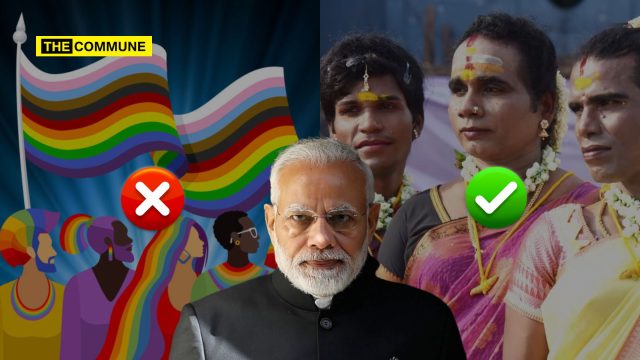
Instead of allowing open-ended self-identification, the law now defines transgender persons through biological realities and established socio-cultural categories including hijra, kinner, aravani, jogta communities, intersex variations, and cases involving coercion.
What it decisively excludes is just as important: self-declared, fluid, or purely subjective identities with no grounding in biology or recognised social categories.
In one stroke, the government has drawn a line that many Western governments have avoided.
The End of “Say It and Become It”
At the heart of the amendment lies a blunt legal principle: identity, for the purposes of law and state benefits, cannot be based purely on personal declaration.
The Bill explicitly states that recognition cannot be extended based on “personal choice” or “self-perceived identity.”
That clause effectively dismantles the legal foundation of what critics call the “pronoun ecosystem” where identity is treated as entirely self-defined and infinitely expandable.
The new framework introduces verification, documentation, and state oversight bringing gender classification in line with how the law handles every other legally significant category.
Why the Government Tightened the Law
The reasoning is laid out clearly: the earlier definition was too vague to administer.
According to the government, an open-ended identity framework made it nearly impossible to:
- Identify legitimate beneficiaries
- Implement welfare schemes
- Maintain consistency across legal systems
More critically, it risked diluting protections meant for historically marginalised communities by expanding eligibility to an ever-growing set of identity claims.
This amendment is designed to stop exactly that.
A Pre-Emptive Strike, Not a Reaction
What makes the move notable is its timing.
Countries across the West are already dealing with the fallout of self-ID based frameworks from legal contradictions to conflicts in women’s spaces and sports.
Public figures like J. K. Rowling have highlighted these tensions, particularly around laws that blur the distinction between biological sex and declared identity.
Meanwhile, bodies like World Athletics and World Aquatics have rolled back open participation policies, citing fairness and biological advantage.
The Modi government’s approach is the opposite of reactive – it is stepping in before similar conflicts fully take root in India.
Stronger Laws Where It Actually Matters
While the battle over identity has grabbed attention, the Bill also sharpens the law on real-world harms.
It introduces stringent penalties for:
- Forced gender alteration
- Coercion into identity adoption
- Trafficking and exploitation
In severe cases, especially involving minors, punishments can extend to life imprisonment.
This shifts the focus from abstract debates to concrete protections.
Impact Beyond the Law
The implications go beyond courts.
By setting a clear legal definition, the Bill effectively forces institutions including schools and public bodies to align policies with statutory reality rather than activist-driven frameworks.
This could significantly reshape how gender identity is approached in education, documentation, and public administration.
A Direct Message
The amendment is not subtle in what it signals.
It rejects the idea that law should follow endlessly shifting identity claims. It asserts that legal systems require fixed definitions, verifiable categories, and administrative clarity.
Supporters see it as a necessary correction. Yes, the pronoun gang will call it restrictive.
But the intent is unmistakable: this is the Modi government drawing a hard boundary between personal identity and legal recognition, between ideology and governance.
And in doing so, it has effectively launched what it frames as a legislative pushback against pronoun-driven politics and the spread of wokeism into Indian law.
Subscribe to our channels on WhatsApp, Telegram, Instagram and YouTube to get the best stories of the day delivered to you personally.