A few weeks ago, we reported on tensions in Thummanayakkanpatti village in Peraiyur taluk of Madurai district after opposition emerged from Muslims to the renovation of the Arulmigu Vinayagar and Karuppannasamy temples, which are around 300 years old and administered under the HR&CE Department. The Madurai Bench of the Madras High Court had permitted the renovation, dismissed objections raised by a group led by Sagul Hameed, and subsequently ordered police protection for the project.
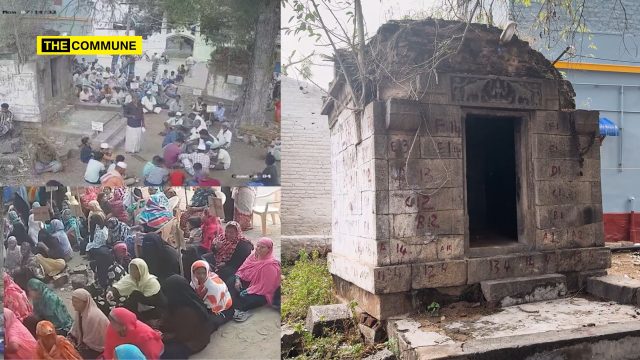
Weeks later, the situation on the ground remains tense. Despite court approval and security directions, renovation work has not commenced. Villagers have alleged that sections of the local Muslim community protested at the site, demanding relocation of the temple. Police intervened and dispersed the gathering. Recent field interactions reveal sharply differing accounts from Hindu residents and Muslim community members, indicating continued mistrust, with residents seeking government intervention to implement the court’s orders.
Hindu Residents Detail Longstanding Grievances Over Land, Access and Renovation
Field interviews with Hindu residents and temple stakeholders revealed a detailed account of long-running tensions, with several villagers stating that the temple has existed for nearly three centuries, dating back to the Zamin period, and has historically functioned as a shared place of worship across caste lines.
Residents said the temple currently stands in a severely dilapidated condition, with vegetation growing through the structure and parts of it on the verge of collapse. According to them, rituals were conducted in 2021, and the idols had been temporarily relocated as part of the process of rebuilding.
Villagers traced the roots of the dispute back several decades, citing major conflicts in 1980 and 1987, and stating that the issue has been ongoing for nearly 50 years. They alleged that the presence of a mosque adjacent to the temple site has been a central factor in the dispute.
Several residents claimed that temple land ranging from approximately 2 acres and 20 cents to nearly 2.80 acres had gradually been encroached upon over time. They alleged that houses belonging to members of the Muslim community had come up within what they consider temple land, leaving only the temple structure itself in their control.
Some residents further stated that the Muslim settlement in the area had initially begun with a small number of families, estimated at around 20 households which, over time, increased to about 60 households. They alleged that the early settlers had gradually established structures after initially seeking informal accommodation, and that this expansion eventually led to what they described as encroachment onto temple lands. According to these accounts, villagers believed that earlier generations, lacking awareness of land rights, had allowed such expansion to take place unchecked.
Some villagers further stated that access to public pathways traditionally used for temple processions, including routes for Vinayagar idol immersion, was being denied. They also alleged that they were being prevented from entering certain areas around the temple and from conducting religious activities, including carrying idols through what they described as public roads.
Residents maintained that they had obtained all required permissions for renovation, including approvals from government authorities and the courts. However, they alleged that attempts to begin reconstruction were obstructed, including instances where structures they had erected were dismantled and rebuilding efforts halted.
They also expressed concern that the dispute was linked to fears among some residents that formal recognition of temple land under government administration could lead to recovery of encroached areas. According to villagers, this fear was driving resistance to the renovation.
Some residents accused sections of the administration and police of acting in a biased manner and failing to enforce court orders effectively. They also alleged that officials had delayed action despite clear directives.
Villagers repeatedly emphasised that the temple was central to their identity and community life, stating that they were seeking only to rebuild a structure that had existed for generations and to reclaim access to associated land and facilities, including a temple well used for rituals.
Muslim Community Raises Concerns Over Land Claims, Trustee Actions And Deviation From Official Orders
Members of the local Muslim Jamaat, however, offered a sharply different account, rejecting claims that they were opposing the temple or its renovation.
Community representatives stated that the temple had indeed existed for centuries and acknowledged that their own ancestors had once worshipped there before converting to Islam generations ago. They said the temple had remained in a neglected state since that time.
According to their account, the temple is associated with approximately 8 acres to 8.70 acres of endowment land, much of which they allege had been sold off decades ago by individuals claiming ownership. They said recent efforts by the HR&CE Department under the Tamil Nadu government were aimed at reclaiming these lands.
They claimed that the present dispute intensified after a local individual, Maheswaran, was appointed as trustee and began asserting control over the temple and surrounding land. According to them, this included claims that the entire area around the temple belonged exclusively to the temple and restrictions on entry for others.
Community members alleged that such claims affected access routes used by residents, including pathways leading to nearby mosques, and that disputes arose when it was asserted that no such right of way existed.
They further stated that the State Expert Committee had recommended renovation without demolition or expansion but alleged that attempts were being made to demolish and rebuild the structure instead, which they said was contrary to official orders.
Another key issue raised by the community was the alleged removal of temple idols several years ago. They claimed that idols from the Karuppannasamy temple were taken away in a vehicle, and that there were inconsistencies in subsequent explanations regarding their status.
They also questioned the role of the current trustee, alleging that he had previously been involved in the sale of temple land and raising concerns about transparency and accountability in temple administration.
Community representatives maintained that they had no objection to the temple being renovated or religious ceremonies being conducted and stated that they had even participated in temple festivals in recent months, including attending events and offering contributions.
They further said that the recent protest was specifically against demolition and expansion, not against restoration itself, and that they had approached the courts to ensure adherence to official guidelines.
In addition, they disputed allegations that they had blocked religious processions, stating that no formal complaints had been filed to that effect and pointing to past instances of communal participation as evidence of coexistence.
They also raised concerns about access to shared resources such as a well near the temple, stating that it had previously been used by all residents but was now restricted.
At the same time, community representatives alleged that a narrative was being deliberately promoted portraying Muslims as opposing the temple’s construction, and claimed that this narrative was being amplified with the backing of the RSS.
Overall, the community maintained that the issue had been framed incorrectly and that their actions were aimed at preventing misuse of land and ensuring that legal and administrative procedures were followed.
Coexistence Amid Rising Mistrust
Despite the sharply divergent claims, the villagers maintain that both communities have historically coexisted and, in many instances, continue to engage with each other in daily life.
Residents from both sides acknowledged that there had been participation across communities in local events, and that tensions had escalated only in recent years.
However, there was a shared concern that the situation could deteriorate further due to external influences, including political intervention and competing narratives.
Subscribe to our channels on WhatsApp, Telegram, Instagram and YouTube to get the best stories of the day delivered to you personally.