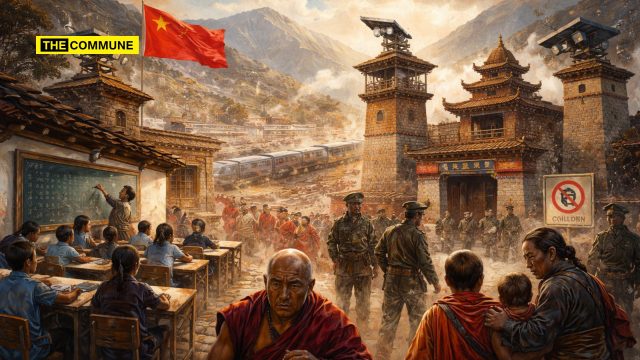
There is a pattern, systematic and increasingly visible across policy, law, and enforcement. It is not confined to isolated measures but emerges from a sequence of legal instruments shaping education, religion, language, and social systems in Tibet. On 19 March 2026, China introduced a policy promoting a unified national identity, placing pressure on Tibetans to adopt Han Chinese language, culture, and state-defined norms. Such incidents reveal a broader pattern where laws on education, religion, surveillance, and social systems collectively enforce assimilation, restrict freedoms, and strengthen centralized control, limiting the preservation of Tibetan identity.
#1 China’s New Law Mandates Assimilation of Tibetans into Han Culture – 19 March 2026
China introduced a policy framework that requires promotion of a unified national identity, pushing Tibetans to adopt Han Chinese culture, language, and social practices. The law mandates institutions, education systems, and communities to align with state-defined cultural norms, reducing space for Tibetan identity. Critics state that such measures aim at cultural assimilation and weaken linguistic, religious, and traditional autonomy of Tibetans.
#2 China Enacts Ethnic Unity Law Promoting Assimilation of Minority Groups – 17 March 2026
China passed the Law on Promoting Ethnic Unity and Progress mandating the promotion of a unified national identity across all ethnic groups, including Tibetans. The law requires the use of Mandarin in education, encourages mixed ethnic communities, and promotes adoption of Han Chinese cultural practices. It extends state control over education, housing, and social life while discouraging distinct linguistic, cultural, and religious identities.
#3 China Moves to Codify Mandarin Dominance, Restricting Minority Language Education – 4 March 2026
China proposed a legal framework to establish Mandarin as the primary language in education and public life, including in Tibetan regions. The law restricts minority languages like Tibetan to secondary or elective status and removes them as mediums for core academic instruction. It strengthens state control over language use in schools and public domains, aiming to promote a unified national identity. This move systematically reduces the functional role of Tibetan language in formal education and reinforces linguistic assimilation through policy design.
#4 China Bars Tibetan Children from Monasteries, Expands Religious Restrictions – 18 February 2026
Chinese authorities enforced new regulations prohibiting children under 18 from entering monasteries or receiving religious education from monks in Tibetan regions. Notices and school directives instruct families and institutions to prevent minors from participating in religious activities, including visits during festivals. The measures expand state oversight of monasteries, impose stricter approval and supervision systems, and restrict traditional religious learning. These rules reduce the role of monasteries in cultural and linguistic transmission and increase state control over Tibetan religious practices.
#5 Chinese Government Continues Highly Repressive Policies in Tibet, Says HRW Report – 4 February 2026
A report by Human Rights Watch stated that Chinese authorities continue to enforce strict and repressive policies in Tibet, restricting freedoms of expression, religion, and association. The report highlighted detentions of Tibetan educators, shutdown of schools promoting Tibetan language and culture, and enforcement of assimilation policies aligned with state ideology. It also pointed to intensified ideological control under the Chinese Communist Party, limiting cultural, linguistic, and religious autonomy of Tibetans through sustained policy enforcement.
#6 China Removes Tibetan Language from College Entrance Exam Core Subjects – 8 August 2025
Chinese authorities announced that Tibetan language would no longer be a core subject in the national college entrance examination system for most students in Tibet. The reform introduces unified exam subjects such as Mandarin, mathematics, and foreign languages, reducing the role of Tibetan to a limited or optional subject. This policy shifts academic priorities and further marginalizes Tibetan language within formal education, reinforcing Mandarin dominance and reducing institutional incentives for preserving linguistic identity.
#7 China’s Boarding Schools Accused of Indoctrinating Tibetan Children – 29 June 2025
Tibetan children, including some as young as four, are placed in state-run boarding schools where they are separated from families and taught primarily in Mandarin. The schooling system enforces state ideology and limits the use of Tibetan language and culture, reflecting broader policies aimed at assimilation and control over Tibetan identity. Religious practices such as prayers and wearing Buddhist symbols are restricted, and students are instructed to promote loyalty to the Chinese Communist Party within structured institutional environments.
#8 Chinese Authorities Shut Down Tibetan Schools Promoting Language and Culture – 5 February 2025
Chinese authorities closed privately run schools in eastern Tibet that promoted Tibetan language and culture, despite some having prior government approval. The closures targeted institutions that combined modern education with Tibetan cultural teaching and were accompanied by detentions of associated religious and educational figures. These actions reflect enforcement of state policies prioritizing Mandarin-language education and ideological control, limiting independent Tibetan educational initiatives and reducing space for cultural and linguistic preservation.
#9 China Accelerates Forced Relocation of Tibetan Villagers Under State Policies – 21 May 2024
Chinese authorities accelerated relocation of Tibetan villagers and herders from rural areas to urban settlements under state-directed programs. While officially presented as voluntary and aimed at development, evidence indicates coercion, pressure from officials, and lack of genuine consent. Entire villages are being moved, disrupting traditional livelihoods such as herding and farming. The policy enforces state control over land use and settlement patterns, weakening Tibetan cultural and social structures and aligning communities with centralized governance and assimilation objectives.
#10 China Imposes New Cybersecurity Rules Tightening Control in Tibet – 1 February 2023
Chinese authorities implemented new cybersecurity rules in Tibet imposing stricter monitoring and harsher punishments for online activities linked to “separatism” or “public disorder.” The regulations expand surveillance over digital communication and restrict how Tibetans use online platforms. These measures limit the ability to communicate freely and enable authorities to monitor, control, and penalize dissenting views, strengthening state control over information and expression across digital spaces.
#11 Tibetans Face Discrimination and Denial of Rights After Returning to Tibet – 2023
Chinese authorities denied or delayed household registration, known as hukou, for Tibetans returning from abroad, sometimes for several years. Without hukou and identity documentation, individuals face restrictions in accessing jobs, travel, and basic social services. Reports indicate that many returnees are blacklisted or deregistered, particularly those who traveled for religious or educational purposes. The policy restricts reintegration and limits civil and economic rights, reinforcing administrative control over movement and access to opportunities.
#12 Chinese Authorities Strengthen Control Over Tibetan Buddhist Reincarnations – 15 December 2021
Chinese authorities intensified enforcement of regulations requiring state approval for recognizing reincarnate Tibetan Buddhist leaders. The law mandates that reincarnations must be approved by government authorities, occur within China, and follow prescribed procedures such as the Golden Urn system. Officials are also pressuring monks and local authorities to endorse these rules and demonstrate political loyalty. These measures expand state control over religious leadership selection and limit traditional Tibetan religious practices.
#13 China Imposes Political Loyalty Requirements on Tibetan Monks and Nuns – 30 October 2018
Chinese authorities introduced political requirements for Tibetan monks and nuns under policies aimed at “Sinicizing” religion. Religious figures are required to demonstrate loyalty to the Communist Party, undergo ideological training, and actively promote state policies within monasteries. Under the “Four Standards” framework, monastics must align with government ideology and discourage dissent. These measures expand state control over religious institutions and reshape Tibetan Buddhist practices to fit official political objectives.
Subscribe to our channels on WhatsApp, Telegram, Instagram and YouTube to get the best stories of the day delivered to you personally.