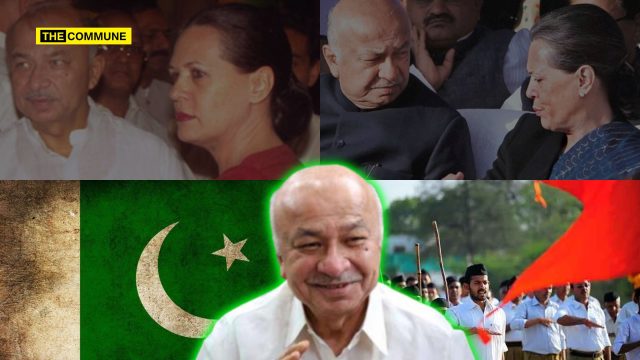
While 26/11’s mastermind walked free and Indian civilians died in bomb blasts, India’s Home Minister was busy accusing the Hindus, BJP and RSS of terrorism, gifting Hafiz Saeed a global propaganda weapon, and privately trembling at the thought of visiting the state he was constitutionally sworn to protect.
Sushil Kumar Shinde was Home Minister of India from 2012 to 2014. In that time, he did not bring Hafiz Saeed to justice. He did not prevent the Hyderabad blasts. He did not secure Kashmir. What he did do: consistently, publicly, and without remorse was use India’s most sensitive security crises to attack Hindus, exonerate Pakistan’s terror infrastructure, and manufacture a courage he did not possess.
This is not a matter of political interpretation. It is a matter of record. His own words, on the record, across multiple occasions, form a case so complete that no editorial framing is required. The statements speak. The consequences followed. And not once did accountability arrive.
What follows is that record – in full.
In January 2013, at the Congress party’s Chintan Shivir conclave in Jaipur, Home Minister Sushilkumar Shinde stood before the nation and delivered what remains one of the most damaging statements ever made by a sitting security chief of any democracy.
He announced: “Reports have come during investigation that BJP and RSS conduct terror training camps to spread terrorism… Bombs were planted in Samjhauta Express, Mecca Masjid and also a blast was carried out in Malegaon.”
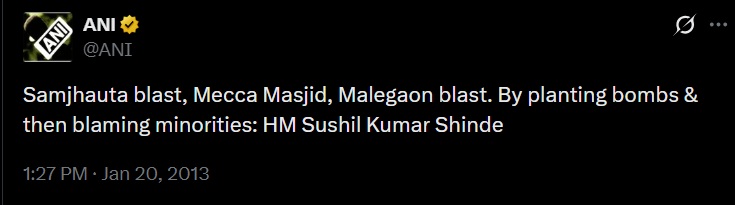
He also said, “After investigations we have seen that be it BJP or RSS, their training camps are promoting Hindu terrorism,” he declared — and then went further, naming three of India’s most devastating terror attacks: “Samjhauta Express blast, Mecca Masjid blast, Malegaon blast – by planting bombs and then blaming minorities.”
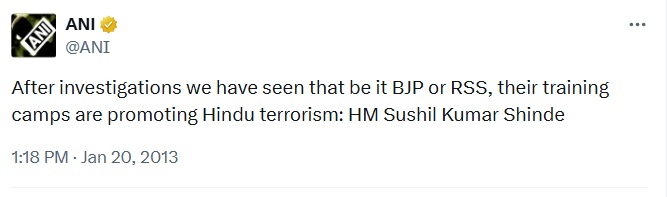
No court had delivered such a verdict. No investigation was concluded. But India’s own Home Minister had just publicly branded the country’s largest opposition party as a terrorist organisation, without a conviction, without evidence placed on record, and without consequence.
The blowback was not limited to domestic politics.
When confronted by media and BJP, Shinde did not retreat. He doubled down: “This has come so many times in the papers. It is not a new thing that I have said. This is saffron terrorism that I have talked about. It is the same thing and nothing new. It has come in the media several times.”
When specifically asked: “Is it Hindu terrorism or saffron terrorism?” Shinde replied: “This is saffron terrorism that I have stated.”
He treated the entire controversy as a semantic quibble – insisting the substance of the accusation (that RSS/BJP ran terror camps and bombed Indians) was established fact reported in newspapers. He was not apologising. He was saying: everyone already knows this.
Within 24 hours, Lashkar-e-Taiba chief Hafiz Saeed, the architect of the 26/11 Mumbai attacks that killed 166 people, went public with a statement that made full use of Shinde’s gift. Saeed declared that Shinde’s remarks proved LeT was innocent and demanded that the international community formally declare India a “terror state.”
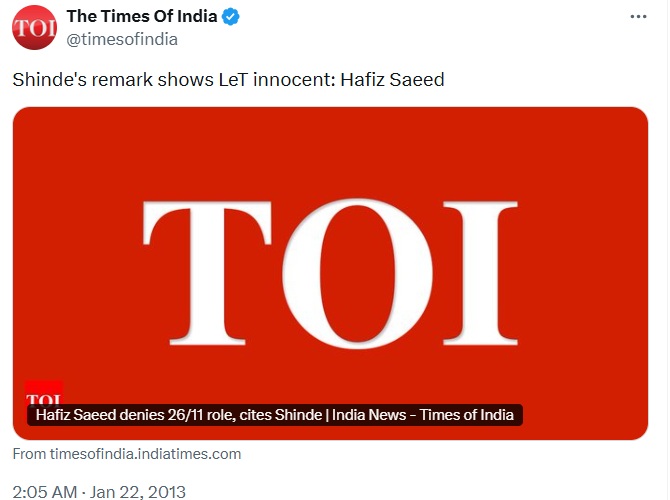
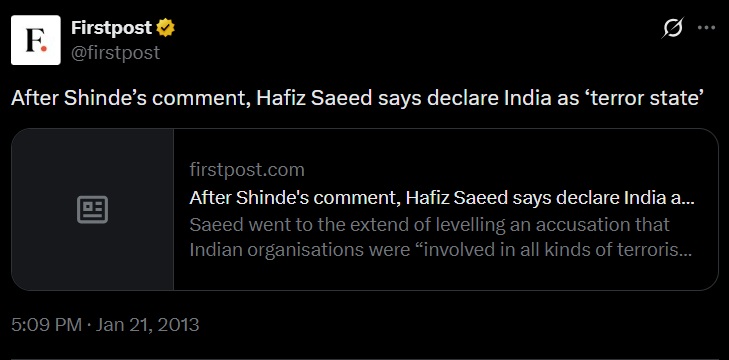
A man India had spent years trying to have prosecuted had just been handed a ready-made defence authored by India’s own Home Minister. Shinde had not been coerced, not been misquoted, and not been taken out of context. He had simply spoken.
The pattern did not stop there.
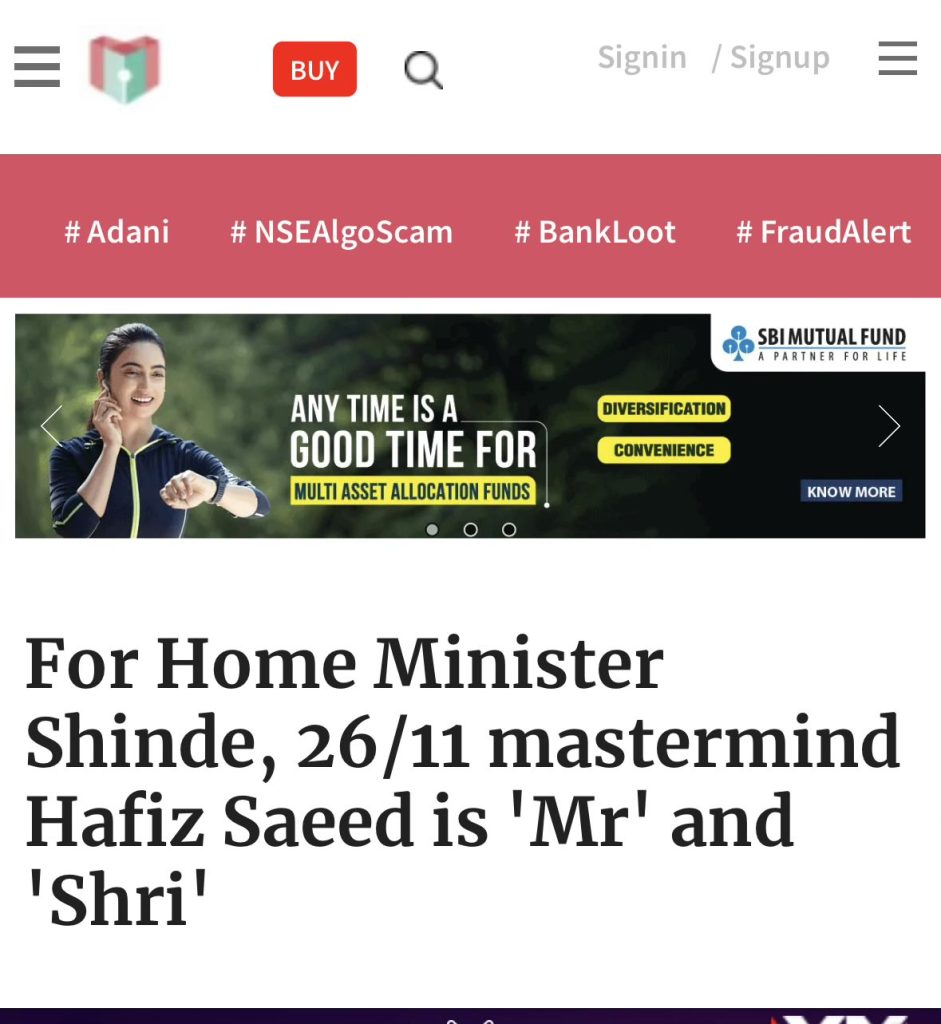
He even went on to address a terrorist such as Hafiz Saeed as “Mr/Shri”.
On 21 February 2013, twin bomb blasts tore through Dilsukhnagar in Hyderabad, killing 16 civilians and wounding over 100. The nation waited for its Home Minister to respond with resolve. Instead, Shinde went before the press and said: “The Hyderabad blasts are a reaction to the executions of Ajmal Kasab and Afzal Guru.”
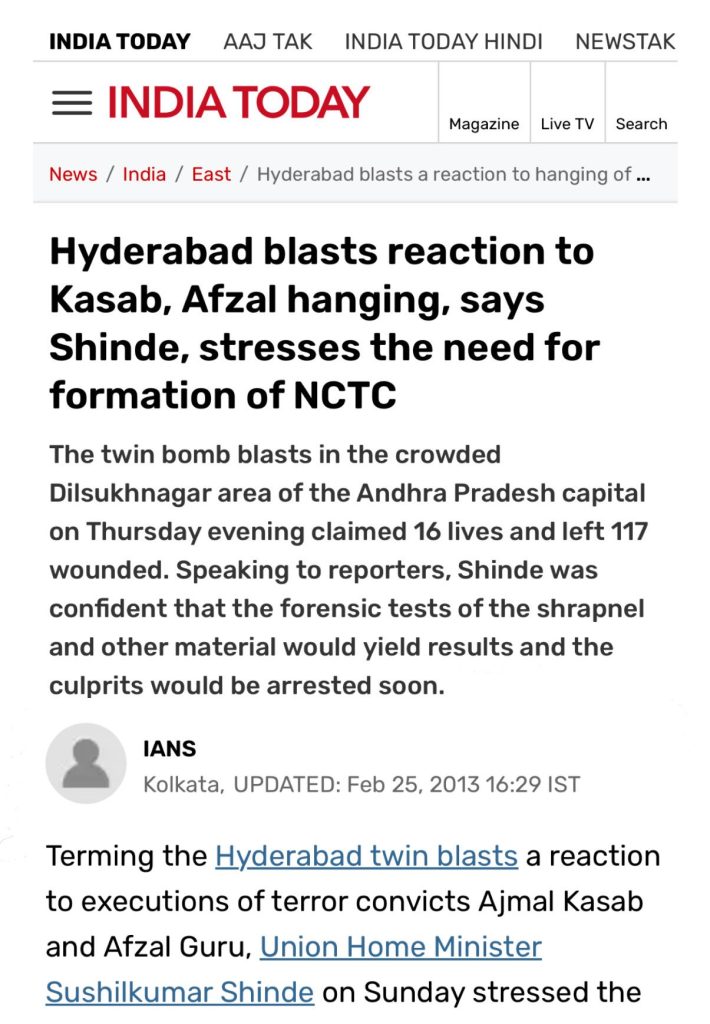
He had already telegraphed this logic. After the executions of Kasab and Afzal Guru, Shinde had publicly stated: “After the execution of Ajmal Kasab and Afzal Guru, we knew there will be such attempts.”
Read together, these two statements form a single, devastating admission: the UPA government had advance knowledge that retaliatory strikes were coming and when those strikes came and civilians died, its Home Minister’s instinct was not to condemn the bombers but to contextualize the bombing as an understandable response to India hanging its own convicted terrorists.
The full picture of Shinde’s tenure only became complete in September 2024, at the launch of his memoir ‘Five Decades in Politics’ in Mumbai. In it, Shinde attempted to rehabilitate himself: “I had come across the term ‘saffron terror’ in one of the confidential papers prepared by the Union Home Ministry. I was careful to first check the veracity of the allegation before going public with it.”
In another event when asked about his visits to Kashmir as Home Minister, visits that were widely covered in the press as demonstrations of UPA’s security confidence, Shinde dropped all pretence.
“They told me to go to Kashmir and do a photo-op at Dal Lake for mine and UPA’s public image as Home Minister of India. But to whom could I tell that ‘meri fat gayi thi – I was terrified!”
He elaborated: “People thought there was a Home Minister who visited without any fear – but in reality, I used to get scared.”
“They told me to go Kashmir & do Photo-op at Dal lake for mine & UPA’s Public image as HM of India. But to whom could I tell that मेरी फट गई थी!”- Sushil Kumar Shinde who was HOME MINISTER in UPA.
Today Rahul Ghandy can freely go to Kashmir & eat ice-cream.
This’s #Modi Power💪 pic.twitter.com/TUjR271rW6
— BhikuMhatre (@MumbaichaDon) September 10, 2024
The man who spent years assuring Indians that Kashmir was safe, who accused the BJP of manufacturing fear, who smeared national institutions with terrorism charges was privately petrified to set foot in the Valley he was constitutionally responsible for securing.
In October 2024, in an interview with journalist Shubhankar Mishra, Shinde finally, eleven years later, conceded the obvious:
When asked: “Now that you have retired, do you think the term ‘saffron terrorism’ was correct?”
Shinde replied: “Whatever came in the record, we had told that at that time… I used the word saffron with terrorism. If you ask correctly – why did I use the word terrorism with saffron? We do not know. The word terrorism should not have been used with saffron.”
He continued: “There should not have been the term saffron terrorism. There is no terrorism in saffron, red, or white.”
Veteran Congress leader Sushil Kumar Shinde exposed the Anti Hindu agenda of Congress.
Congress had carefully crafted the narrative of saffron terrorism.
Congress has always had a single agenda: defame Hindus and be the slave of a particular religion, so that it can keep… pic.twitter.com/vnwf3xGo9F
— Sunanda Roy 👑 (@SaffronSunanda) October 20, 2024
This is a full admission, eleven years after the fact, that the term was wrong. Not that his facts were wrong. Not that innocent Hindus were jailed on false charges. Not that Hafiz Saeed celebrated his words. Just: the terminology was unfortunate.
Crucially, in the same interview, when asked whether Afzal Guru, the 2001 Parliament attack convict who was hanged in 2013 was a terrorist, Shinde refused to call him one. The man who readily called BJP and RSS “terror camps” could not bring himself to call the Parliament attack convict a terrorist.
The legacy carries on. His daughter Praniti Shinde, an MP from the Congress party even recently called Operation Sindoor, a ‘tamasha’. The apple surely did not fall too far from the tree.
Meet Praniti Shinde (MP CONg) -daughter of Sushil Kumar Shinde (Former HM CONg)
Praniti called Operation Sindoor ‘A Tamasha’
Her father had addressed terrorist Hafiz Saeed as ‘Shri Hafiz Saeed’
The rotten apple didn’t fall to far from the worm infested tree pic.twitter.com/QICJQf1Nhb
— Sameer (@BesuraTaansane) July 28, 2025
Sushilkumar Shinde spent eleven years as the man who gave “saffron terror” its most powerful official boost, as a sitting Home Minister, in front of the entire Congress leadership, in a speech that Hafiz Saeed celebrated within 24 hours. Innocent Hindus including a serving Army officer were jailed. The July 2025 Malegaon acquittal demolished the entire edifice. In 2024, Shinde admitted the terminology was wrong while simultaneously refusing to call the Parliament attack convict a terrorist, and while releasing a memoir with Sonia Gandhi’s foreword defending his record.
Subscribe to our channels on WhatsApp, Telegram, Instagram and YouTube to get the best stories of the day delivered to you personally.