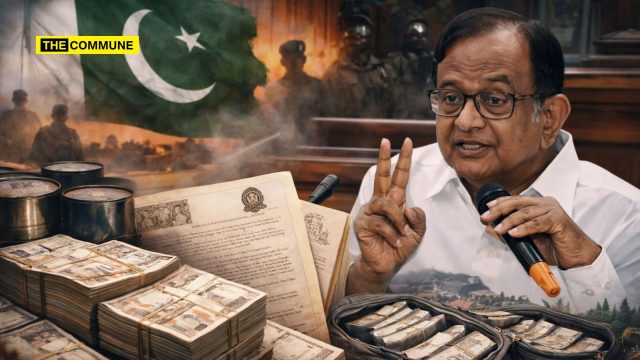
As the debate over Dhurandhar’s portrayal of Pakistan’s fake currency network rages on social media, a Parliament record from December 2012 settles the argument decisively. The Congress government itself, through Finance Minister P. Chidambaram, stood on the floor of the upper house and acknowledged in plain terms what the film dramatises on screen: Pakistan was printing near-perfect fake Indian currency notes using the same ink, paper, and intaglio printing technology as the Indian government and smuggling them through Nepal. The government admitted it could not stop it at the source.
The Parliament Exchange
On 13 December 2012, an RJD Member of Parliament raised a pointed question in the Rajya Sabha: how is Pakistan able to print fake Indian currency notes using the same ink, paper, and intaglio technology as genuine Indian notes, and smuggle them into India via Nepal? He said, “…with international agencies, with the cooperation of international agencies, check at the source point — because Pakistan is procuring the same paper, same ink, same band from the same source. So why not we have a check at that point itself, so that these currency notes are not printed by them and, you know, dumped into our country to destabilize our economy.”
Chidambaram’s response, now on official parliamentary record, was unambiguous: “Sir, as I said, guardedly – these fake Indian currency notes are smuggled into India from across the border. And I think that statement tells you more than what I should be saying publicly. Now, this is, in my view and in my assessment, an organised activity with some kind of state support. Now, therefore, all that we can do is to stop the entry of currency notes into India and to stop the circulation of currency notes. Now, how do I go to the source of this currency note when it is manufactured across the border with state support? So I think there are serious issues there, in answering the question of the honourable member. I am aware of it. The government is aware of it.”
🚨 EXCLUSIVE! Remember Khanani from Dhurandhar smuggling fake currency through Nepal?
– It was TRUE. Cong Govt ACCEPTED it in the Parliament in 2012🤯RJD MP questions how Pakistan prints fake Indian currency with the same INK, PAPER & INTAGLIO tech, smuggling via Nepal.… pic.twitter.com/ulki6eIlzV
— The Analyzer (News Updates🗞️) (@Indian_Analyzer) March 27, 2026
This was India’s Finance Minister, the country’s top economic officer publicly conceding inside Parliament that a foreign state was waging economic warfare on India, and that his government had no answer to it.
The Technology Breach: De La Rue
The RJD MP’s reference to “same ink, paper, and intaglio technology” was not a hypothetical. It pointed to a real and documented vulnerability. In 2004, under Chidambaram’s tenure as Finance Minister in the first UPA government, his ministry authorised the Reserve Bank of India to enter into exclusivity agreements with De La Rue – a British security printing firm that supplied banknote production technology to both India and Pakistan. CBI documents and parliamentary committee findings confirm that this shared technological framework gave Pakistan-based counterfeiters access to near-identical specifications for Indian currency security features making their FICN (Fake Indian Currency Notes) virtually indistinguishable from genuine notes in circulation.
The Nepal Route: Confirmed Before Parliament
Pakistan’s use of Nepal as the primary smuggling corridor is not a film invention either. An even earlier Parliament record from a Lok Sabha answer in 2000, confirmed that a UDC employee of the Pakistan Embassy in Kathmandu was caught red-handed by Nepali Police while attempting to exchange fake Indian currency notes. By 2012, intelligence reports had established that the Birganj border point in Nepal’s Terai region had become the principal transit hub for FICN, with ISI operatives stationed in the Pakistan Embassy in Kathmandu directly supervising the operations.
The Khanani Network: Real, Not Reel
The character of Khanani in Dhurandhar is based on the real-world Khanani & Kalia International (KKI) criminal syndicate, which NIA and intelligence agencies have documented as a key node in the ISI-backed FICN pipeline into India. The network used Nepal, Bangladesh, and Gulf routes to flood Indian markets with high-quality counterfeits -precisely as depicted in the film. Former J&K DGP S.P. Vaid publicly stated that Dhurandhar is “rooted in hard truths rather than propaganda.”
View this post on Instagram
Demonetisation in This Context
This documented FICN threat is also the essential context for understanding the November 2016 demonetisation. A detailed analysis of the FICN pipeline estimated that a staggering ₹71,000 crore worth of fake notes were staged for injection into India’s economy around that period. By overnight withdrawal of ₹500 and ₹1,000 notes, the government rendered the entire stockpile worthless – a pre-emptive strike that could not be measured by seizures alone, but by what it destroyed in Pakistani storage vaults.
The next time someone calls Dhurandhar “propaganda,” the answer is a 13-year-old parliamentary transcript. In December 2012, the Congress government did not deny the fake currency threat – it admitted it, confirmed state sponsorship by Pakistan, acknowledged the Nepal route, and told Parliament it had no means to stop it at the source. The film did not invent this crisis. It simply showed what the government of the day was too helpless or too indifferent to fix.
Subscribe to our channels on WhatsApp, Telegram, Instagram and YouTube to get the best stories of the day delivered to you personally.